

freshwater aquatic eco-toxicity (FEP), marine aquatic eco-toxicity (MEP) and terrestrial eco-toxicity (TEP). SimaPro 8.0.2 was used for the implementation [18].
2.2 Social Assessment
The social dimension is frequently considered as the weakest pillar of sustainable
development, as reflected by the limited analytical and theoretical tools for its
evaluation [19]. In order to develop a standardized methodology, UNEP-SETAC
published the Guidelines for Social Life Cycle Assessment of Products, together
with the methodological sheets for subcategories in Social Life Cycle Assessment
(SLCA) [8, 20]. The methodological sheets contain all the necessary information to
collect data for 31 defined impact sub-categories, which correspond to relevant
characterised social issues. The sub-categories representing social impacts are
classified into five stakeholder categories: workers, consumers, local community,
society and value chain actors. The given information includes a definition of each
sub-category and an explanation of issues associated with it, as well as examples of
inventory indicators, units of measurement and data sources [20].
ASTAXANTHIN IN
OLEORESIN (10%)
AIR, SOIL & WATER
EMISSIONS
FOREGROUND SYSTEM
BACKGROUND
SYSTEM
RAW MATERIALS, WATER & FOSSIL FUELS
CHEMICALS
(Nutrients &
Solvents)
MACHINERY
ELECTRICITY
AIR SUPPLY
WASTES TO
TREATMENT
BYPRODUCT
(FERTILIZER)
WATER SUPPLY
SUBSYSTEM 1: CLEAN.
AND STERILIZ.
SUBSYSTEM 2: PREPARATION
OF CULTURE MEDIUM
SUBSYSTEM 3:
CULTIVATION
SUBSYSTEM 4:
HARVESTING
SUBSYSTEM 5: EXTRACTION
REACTOR
STERILIZATION
GROWTH IN PBR
CENTRIFUGATION
SPRAY DRYING/
FREEZE-DRYING
ADDITION OF
NUTRIENTS
TO WATER
AUTOCLAVING
INOCULUM
ADDITION
(CO-)SOLVENT ADDITION
VORTEX MIXING
CENTRIFUGATION
T
T Transport
T
INCUBATION
REVERSE OSMOSIS FILTER
UV FILTER
SETTLING
STRESS STAGE
SETTLING
SUPERCRITICAL CO 2
EXTRACTION
Lab-scale
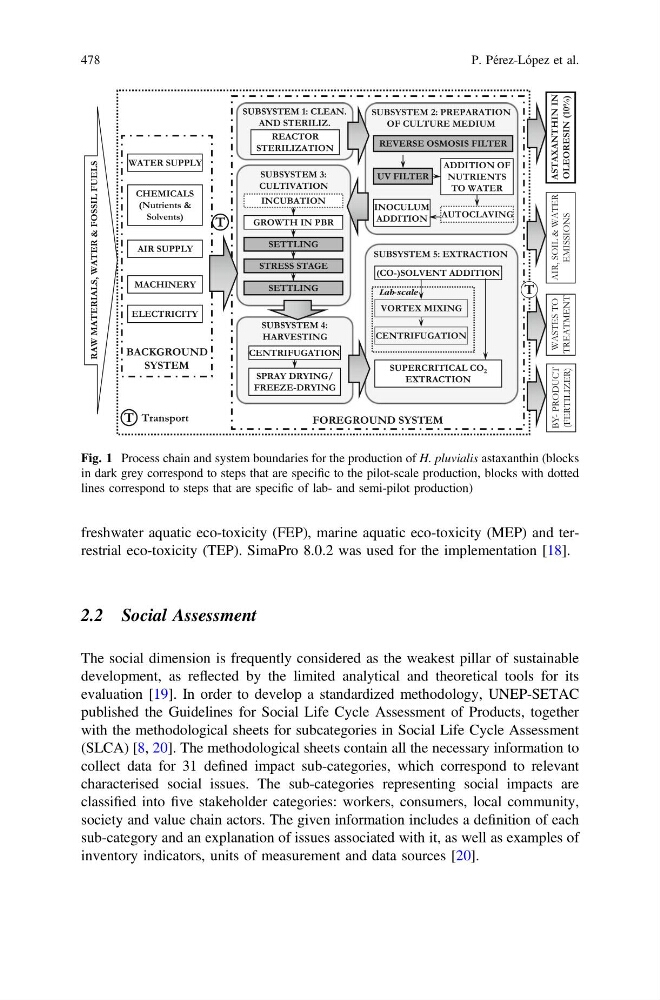
Fig. 1 Process chain and system boundaries for the production of H. pluvialis astaxanthin (blocks
in dark grey correspond to steps that are specific to the pilot-scale production, blocks with dotted
lines correspond to steps that are specific of lab- and semi-pilot production)
478
P. Pérez-López et al.
2.2 Social Assessment
The social dimension is frequently considered as the weakest pillar of sustainable
development, as reflected by the limited analytical and theoretical tools for its
evaluation [19]. In order to develop a standardized methodology, UNEP-SETAC
published the Guidelines for Social Life Cycle Assessment of Products, together
with the methodological sheets for subcategories in Social Life Cycle Assessment
(SLCA) [8, 20]. The methodological sheets contain all the necessary information to
collect data for 31 defined impact sub-categories, which correspond to relevant
characterised social issues. The sub-categories representing social impacts are
classified into five stakeholder categories: workers, consumers, local community,
society and value chain actors. The given information includes a definition of each
sub-category and an explanation of issues associated with it, as well as examples of
inventory indicators, units of measurement and data sources [20].
ASTAXANTHIN IN
OLEORESIN (10%)
AIR, SOIL & WATER
EMISSIONS
FOREGROUND SYSTEM
BACKGROUND
SYSTEM
RAW MATERIALS, WATER & FOSSIL FUELS
CHEMICALS
(Nutrients &
Solvents)
MACHINERY
ELECTRICITY
AIR SUPPLY
WASTES TO
TREATMENT
BYPRODUCT
(FERTILIZER)
WATER SUPPLY
SUBSYSTEM 1: CLEAN.
AND STERILIZ.
SUBSYSTEM 2: PREPARATION
OF CULTURE MEDIUM
SUBSYSTEM 3:
CULTIVATION
SUBSYSTEM 4:
HARVESTING
SUBSYSTEM 5: EXTRACTION
REACTOR
STERILIZATION
GROWTH IN PBR
CENTRIFUGATION
SPRAY DRYING/
FREEZE-DRYING
ADDITION OF
NUTRIENTS
TO WATER
AUTOCLAVING
INOCULUM
ADDITION
(CO-)SOLVENT ADDITION
VORTEX MIXING
CENTRIFUGATION
T
T Transport
T
INCUBATION
REVERSE OSMOSIS FILTER
UV FILTER
SETTLING
STRESS STAGE
SETTLING
SUPERCRITICAL CO 2
EXTRACTION
Lab-scale
Fig. 1 Process chain and system boundaries for the production of H. pluvialis astaxanthin (blocks
in dark grey correspond to steps that are specific to the pilot-scale production, blocks with dotted
lines correspond to steps that are specific of lab- and semi-pilot production)
478
P. Pérez-López et al.