

2 Approaches for Circular Economy Assessment
2.1 A Short Review on Circular Economy Assessment
Elia et al. provide a critical review of environmental assessment tools and CE index
methods [8]. They evaluate the level of alignment of the identified tools regarding
five CE requirements inspired by the European Environmental Agency [9]—the
report provides an outlook on resource-efficient, low-carbon economic and social
development goals to achieve in 2050:
• Reducing inputs and use of natural resources;
• Reducing emission levels;
• Reducing valuable materials losses;
• Increasing the share of renewable and recyclable resources;
• Increasing the value durability of products.
Amongst the 14 environmental assessment methodologies analysed, the Life
Cycle Assessment (LCA) turns out to have the best level of alignment with the 5 CE
requirements aforementioned. This is the same level of alignment as the Substance
Flow Analysis (SFA), and better than the Material Flow Analysis (MFA) that does not
complete requirement 3 and the Water Footprint (WF) deprived of the second
requirement.
Only three out of the sixteen CE index methods published in the scientific literature
in the last ten years, suits for micro-scale material circularity assessment, i.e. product
or company level. Amongst the Reuse Potential Indicator (RPI) developed by Park
and Chertow [10], the Circular Economy Index (CEI) by Di Maio and Rem [11] and
the Material Circularity Indicator (MCI) by Ellen Mc Arthur Foundation and Granta
Design [12], only the latter one accounts for the loss of material as well as product
durability [8]. Even if it does not account for emission reduction (requirement 2)—but
none of the micro scale CE indexes does—it appears to be the best attempt to comply
with the mentioned CE requirements (Table 1).
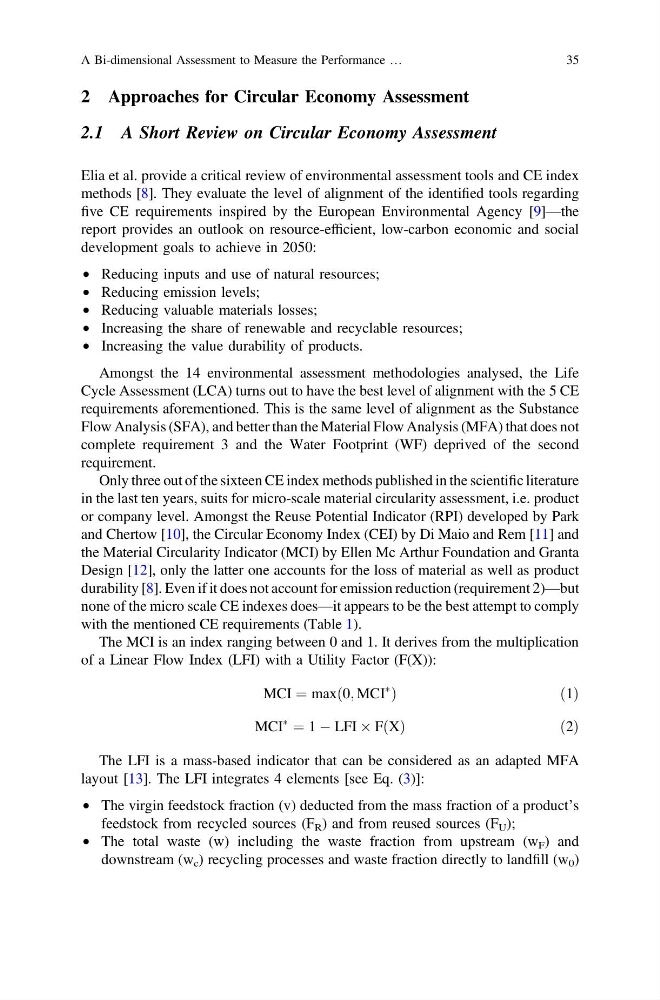
The MCI is an index ranging between 0 and 1. It derives from the multiplication
of a Linear Flow Index (LFI) with a Utility Factor (F(X)):
MCI ¼ max 0; MCI
Ã
ð
Þ
ð 1Þ
MCI
Ã
¼ 1 À LFI Â F X
ð Þ
ð2Þ
The LFI is a mass-based indicator that can be considered as an adapted MFA
layout [13]. The LFI integrates 4 elements [see Eq. (3)]:
• The virgin feedstock fraction (v) deducted from the mass fraction of a product’s
feedstock from recycled sources (F R ) and from reused sources (F U );
• The total waste (w) including the waste fraction from upstream (w F ) and
downstream (w c ) recycling processes and waste fraction directly to landfill (w 0 )
A Bi-dimensional Assessment to Measure the Performance …
35
2.1 A Short Review on Circular Economy Assessment
Elia et al. provide a critical review of environmental assessment tools and CE index
methods [8]. They evaluate the level of alignment of the identified tools regarding
five CE requirements inspired by the European Environmental Agency [9]—the
report provides an outlook on resource-efficient, low-carbon economic and social
development goals to achieve in 2050:
• Reducing inputs and use of natural resources;
• Reducing emission levels;
• Reducing valuable materials losses;
• Increasing the share of renewable and recyclable resources;
• Increasing the value durability of products.
Amongst the 14 environmental assessment methodologies analysed, the Life
Cycle Assessment (LCA) turns out to have the best level of alignment with the 5 CE
requirements aforementioned. This is the same level of alignment as the Substance
Flow Analysis (SFA), and better than the Material Flow Analysis (MFA) that does not
complete requirement 3 and the Water Footprint (WF) deprived of the second
requirement.
Only three out of the sixteen CE index methods published in the scientific literature
in the last ten years, suits for micro-scale material circularity assessment, i.e. product
or company level. Amongst the Reuse Potential Indicator (RPI) developed by Park
and Chertow [10], the Circular Economy Index (CEI) by Di Maio and Rem [11] and
the Material Circularity Indicator (MCI) by Ellen Mc Arthur Foundation and Granta
Design [12], only the latter one accounts for the loss of material as well as product
durability [8]. Even if it does not account for emission reduction (requirement 2)—but
none of the micro scale CE indexes does—it appears to be the best attempt to comply
with the mentioned CE requirements (Table 1).
The MCI is an index ranging between 0 and 1. It derives from the multiplication
of a Linear Flow Index (LFI) with a Utility Factor (F(X)):
MCI ¼ max 0; MCI
Ã
ð
Þ
ð 1Þ
MCI
Ã
¼ 1 À LFI Â F X
ð Þ
ð2Þ
The LFI is a mass-based indicator that can be considered as an adapted MFA
layout [13]. The LFI integrates 4 elements [see Eq. (3)]:
• The virgin feedstock fraction (v) deducted from the mass fraction of a product’s
feedstock from recycled sources (F R ) and from reused sources (F U );
• The total waste (w) including the waste fraction from upstream (w F ) and
downstream (w c ) recycling processes and waste fraction directly to landfill (w 0 )
A Bi-dimensional Assessment to Measure the Performance …
35