

5 Conclusions and Outlook
This paper has synthesized the main findings of our experiments with four classes
of optimization approaches for the MOO of the DWPP in the frame of the project
OASIS. The main conclusions drawn can be summarized as follows.
(1) Hybrid algorithms, and particularly the integrated hybrid algorithm AMOEAMAP, and MILP-based surrogate model have shown the best performances,
compared to other competing alternatives.
(2) The off-the-shelf generic global search metaheuristic algorithms are substantially less efficient than the best classes of algorithms. However, given especially their application straightforwardness, these alternatives cannot be
discarded. Among the tested algorithms, NSGA-II has shown the best performances overall, being closely followed by SPEA2. The experiments with four
other popular metaheuristic algorithms have indicated that, in the myriad of
existing meta-heuristic algorithms with various pros and cons, the best algorithm for a given problem should be chosen carefully.
(3) Constraint (integer) programming is less suitable than MILP classical algorithms in our context of loosely constrained small size surrogate optimization
problem, where feasibility is not a major concern.
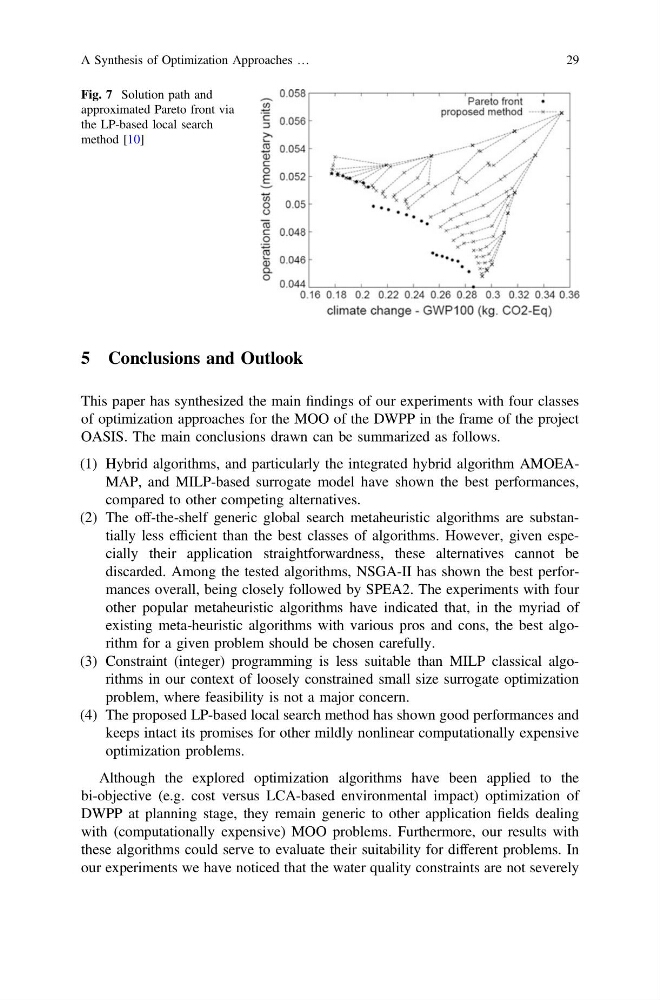
(4) The proposed LP-based local search method has shown good performances and
keeps intact its promises for other mildly nonlinear computationally expensive
optimization problems.
Although the explored optimization algorithms have been applied to the
bi-objective (e.g. cost versus LCA-based environmental impact) optimization of
DWPP at planning stage, they remain generic to other application fields dealing
with (computationally expensive) MOO problems. Furthermore, our results with
these algorithms could serve to evaluate their suitability for different problems. In
our experiments we have noticed that the water quality constraints are not severely
Fig. 7 Solution path and
approximated Pareto front via
the LP-based local search
method [10]
A Synthesis of Optimization Approaches …
29
This paper has synthesized the main findings of our experiments with four classes
of optimization approaches for the MOO of the DWPP in the frame of the project
OASIS. The main conclusions drawn can be summarized as follows.
(1) Hybrid algorithms, and particularly the integrated hybrid algorithm AMOEAMAP, and MILP-based surrogate model have shown the best performances,
compared to other competing alternatives.
(2) The off-the-shelf generic global search metaheuristic algorithms are substantially less efficient than the best classes of algorithms. However, given especially their application straightforwardness, these alternatives cannot be
discarded. Among the tested algorithms, NSGA-II has shown the best performances overall, being closely followed by SPEA2. The experiments with four
other popular metaheuristic algorithms have indicated that, in the myriad of
existing meta-heuristic algorithms with various pros and cons, the best algorithm for a given problem should be chosen carefully.
(3) Constraint (integer) programming is less suitable than MILP classical algorithms in our context of loosely constrained small size surrogate optimization
problem, where feasibility is not a major concern.
(4) The proposed LP-based local search method has shown good performances and
keeps intact its promises for other mildly nonlinear computationally expensive
optimization problems.
Although the explored optimization algorithms have been applied to the
bi-objective (e.g. cost versus LCA-based environmental impact) optimization of
DWPP at planning stage, they remain generic to other application fields dealing
with (computationally expensive) MOO problems. Furthermore, our results with
these algorithms could serve to evaluate their suitability for different problems. In
our experiments we have noticed that the water quality constraints are not severely
Fig. 7 Solution path and
approximated Pareto front via
the LP-based local search
method [10]
A Synthesis of Optimization Approaches …
29