

4.4 Results Using Surrogate Model-Based Optimizers
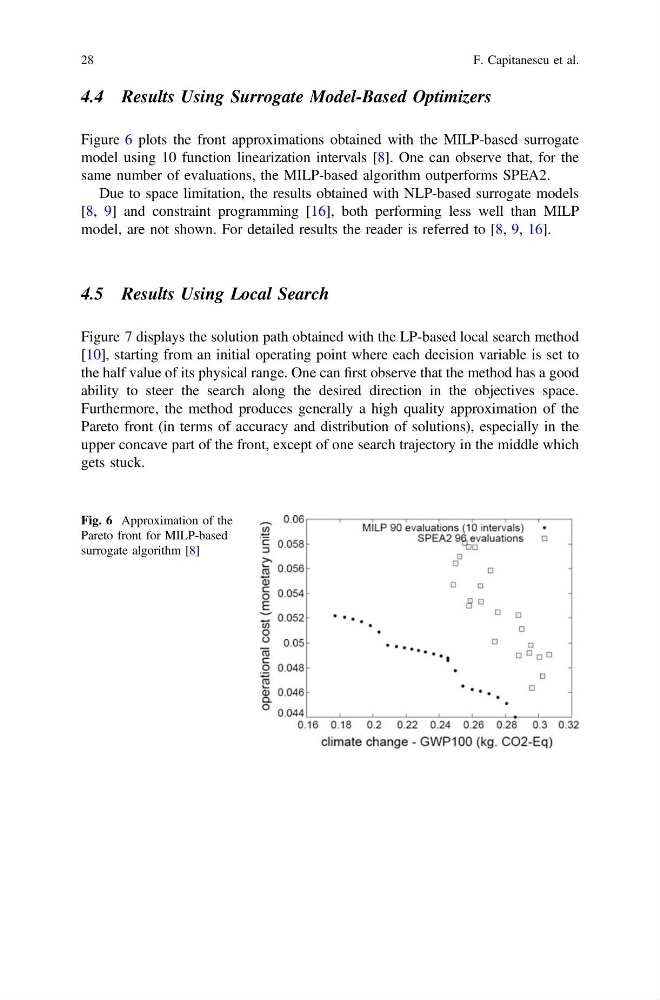
Figure 6 plots the front approximations obtained with the MILP-based surrogate
model using 10 function linearization intervals [8]. One can observe that, for the
same number of evaluations, the MILP-based algorithm outperforms SPEA2.
Due to space limitation, the results obtained with NLP-based surrogate models
[8, 9] and constraint programming [16], both performing less well than MILP
model, are not shown. For detailed results the reader is referred to [8, 9, 16].
4.5 Results Using Local Search
Figure 7 displays the solution path obtained with the LP-based local search method
[10], starting from an initial operating point where each decision variable is set to
the half value of its physical range. One can first observe that the method has a good
ability to steer the search along the desired direction in the objectives space.
Furthermore, the method produces generally a high quality approximation of the
Pareto front (in terms of accuracy and distribution of solutions), especially in the
upper concave part of the front, except of one search trajectory in the middle which
gets stuck.
Fig. 6 Approximation of the
Pareto front for MILP-based
surrogate algorithm [8]
28
F. Capitanescu et al.
Figure 6 plots the front approximations obtained with the MILP-based surrogate
model using 10 function linearization intervals [8]. One can observe that, for the
same number of evaluations, the MILP-based algorithm outperforms SPEA2.
Due to space limitation, the results obtained with NLP-based surrogate models
[8, 9] and constraint programming [16], both performing less well than MILP
model, are not shown. For detailed results the reader is referred to [8, 9, 16].
4.5 Results Using Local Search
Figure 7 displays the solution path obtained with the LP-based local search method
[10], starting from an initial operating point where each decision variable is set to
the half value of its physical range. One can first observe that the method has a good
ability to steer the search along the desired direction in the objectives space.
Furthermore, the method produces generally a high quality approximation of the
Pareto front (in terms of accuracy and distribution of solutions), especially in the
upper concave part of the front, except of one search trajectory in the middle which
gets stuck.
Fig. 6 Approximation of the
Pareto front for MILP-based
surrogate algorithm [8]
28
F. Capitanescu et al.