

this bottom-up simulation model [6] we are able to assess the influence of material,
technology and design choices on both construction and operating energy
requirements and finally extrapolate results to the national level. For some of the
sectors, e.g. water supply and sanitation, where building a comprehensive LCA
model would be out of the scope of this study, we rely instead on a set of international studies to assess the range of construction and operational energy intensities corresponding to different technologies and contextual conditions. Illustrative
results of the energy requirements in different sectors for India and Brazil are shown
in Sect. 4.
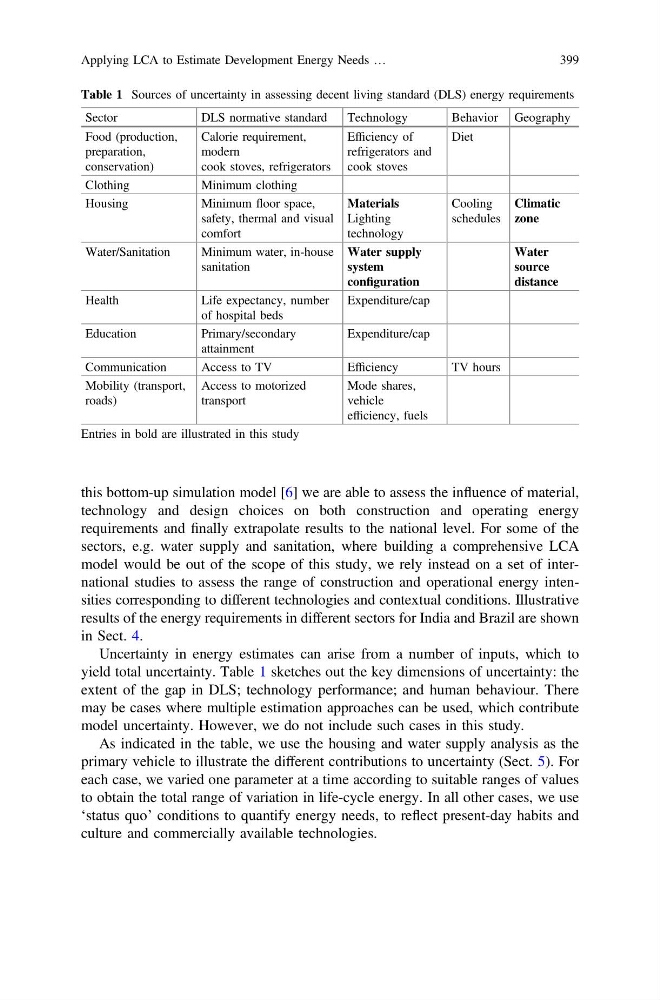
Uncertainty in energy estimates can arise from a number of inputs, which to
yield total uncertainty. Table 1 sketches out the key dimensions of uncertainty: the
extent of the gap in DLS; technology performance; and human behaviour. There
may be cases where multiple estimation approaches can be used, which contribute
model uncertainty. However, we do not include such cases in this study.
As indicated in the table, we use the housing and water supply analysis as the
primary vehicle to illustrate the different contributions to uncertainty (Sect. 5). For
each case, we varied one parameter at a time according to suitable ranges of values
to obtain the total range of variation in life-cycle energy. In all other cases, we use
‘status quo’ conditions to quantify energy needs, to reflect present-day habits and
culture and commercially available technologies.
Table 1 Sources of uncertainty in assessing decent living standard (DLS) energy requirements
Sector
DLS normative standard
Technology
Behavior Geography
Food (production,
preparation,
conservation)
Calorie requirement,
modern
cook stoves, refrigerators
Efficiency of
refrigerators and
cook stoves
Diet
Clothing
Minimum clothing
Housing
Minimum floor space,
safety, thermal and visual
comfort
Materials
Lighting
technology
Cooling
schedules
Climatic
zone
Water/Sanitation
Minimum water, in-house
sanitation
Water supply
system
configuration
Water
source
distance
Health
Life expectancy, number
of hospital beds
Expenditure/cap
Education
Primary/secondary
attainment
Expenditure/cap
Communication
Access to TV
Efficiency
TV hours
Mobility (transport,
roads)
Access to motorized
transport
Mode shares,
vehicle
efficiency, fuels
Entries in bold are illustrated in this study
Applying LCA to Estimate Development Energy Needs …
399
technology and design choices on both construction and operating energy
requirements and finally extrapolate results to the national level. For some of the
sectors, e.g. water supply and sanitation, where building a comprehensive LCA
model would be out of the scope of this study, we rely instead on a set of international studies to assess the range of construction and operational energy intensities corresponding to different technologies and contextual conditions. Illustrative
results of the energy requirements in different sectors for India and Brazil are shown
in Sect. 4.
Uncertainty in energy estimates can arise from a number of inputs, which to
yield total uncertainty. Table 1 sketches out the key dimensions of uncertainty: the
extent of the gap in DLS; technology performance; and human behaviour. There
may be cases where multiple estimation approaches can be used, which contribute
model uncertainty. However, we do not include such cases in this study.
As indicated in the table, we use the housing and water supply analysis as the
primary vehicle to illustrate the different contributions to uncertainty (Sect. 5). For
each case, we varied one parameter at a time according to suitable ranges of values
to obtain the total range of variation in life-cycle energy. In all other cases, we use
‘status quo’ conditions to quantify energy needs, to reflect present-day habits and
culture and commercially available technologies.
Table 1 Sources of uncertainty in assessing decent living standard (DLS) energy requirements
Sector
DLS normative standard
Technology
Behavior Geography
Food (production,
preparation,
conservation)
Calorie requirement,
modern
cook stoves, refrigerators
Efficiency of
refrigerators and
cook stoves
Diet
Clothing
Minimum clothing
Housing
Minimum floor space,
safety, thermal and visual
comfort
Materials
Lighting
technology
Cooling
schedules
Climatic
zone
Water/Sanitation
Minimum water, in-house
sanitation
Water supply
system
configuration
Water
source
distance
Health
Life expectancy, number
of hospital beds
Expenditure/cap
Education
Primary/secondary
attainment
Expenditure/cap
Communication
Access to TV
Efficiency
TV hours
Mobility (transport,
roads)
Access to motorized
transport
Mode shares,
vehicle
efficiency, fuels
Entries in bold are illustrated in this study
Applying LCA to Estimate Development Energy Needs …
399