

service. This eco-design framework of reference corresponds to writing the environmental requirements into the product specifications, one of the essential criteria
for integrating environment in the design process [14].
E3PICS methodology is shaped by technical and organizational constraints
consisting of four steps. The first one concerns the iterative design of the evolving
eco-design framework of reference with the “Eco-design” team and with innovation
leaders thus generating crossed learning. The second step consists in the
“Eco-design” team’s support for all innovation leaders so that they systematically
use the eco-design framework of reference. The third step is the development of an
analytical tool to assess the impact of innovations on vehicles’ end-of-life recyclability rate (OSIRIS) [15]; models of vehicles must be created to solve the
problem of insufficient data on the complete system during the design phase and to
anticipate impacts on the future vehicle. Finally, the fourth step deals with developing a second analytical tool to evaluate the impact of innovations on vehicles’
environmental life cycle performance (TEEPI). This tool also requires a method for
developing environmental models of vehicles [16].
4 The Eco-design Framework of Reference
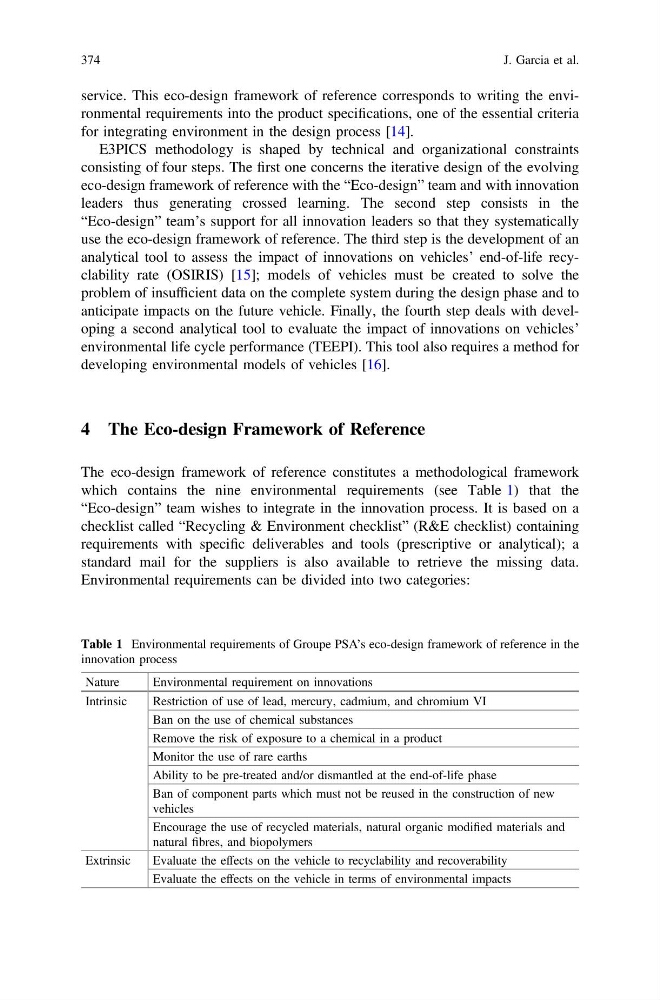
The eco-design framework of reference constitutes a methodological framework
which contains the nine environmental requirements (see Table 1) that the
“Eco-design” team wishes to integrate in the innovation process. It is based on a
checklist called “Recycling & Environment checklist” (R&E checklist) containing
requirements with specific deliverables and tools (prescriptive or analytical); a
standard mail for the suppliers is also available to retrieve the missing data.
Environmental requirements can be divided into two categories:
Table 1 Environmental requirements of Groupe PSA’s eco-design framework of reference in the
innovation process
Nature
Environmental requirement on innovations
Intrinsic
Restriction of use of lead, mercury, cadmium, and chromium VI
Ban on the use of chemical substances
Remove the risk of exposure to a chemical in a product
Monitor the use of rare earths
Ability to be pre-treated and/or dismantled at the end-of-life phase
Ban of component parts which must not be reused in the construction of new
vehicles
Encourage the use of recycled materials, natural organic modified materials and
natural fibres, and biopolymers
Extrinsic
Evaluate the effects on the vehicle to recyclability and recoverability
Evaluate the effects on the vehicle in terms of environmental impacts
374
J. Garcia et al.
for integrating environment in the design process [14].
E3PICS methodology is shaped by technical and organizational constraints
consisting of four steps. The first one concerns the iterative design of the evolving
eco-design framework of reference with the “Eco-design” team and with innovation
leaders thus generating crossed learning. The second step consists in the
“Eco-design” team’s support for all innovation leaders so that they systematically
use the eco-design framework of reference. The third step is the development of an
analytical tool to assess the impact of innovations on vehicles’ end-of-life recyclability rate (OSIRIS) [15]; models of vehicles must be created to solve the
problem of insufficient data on the complete system during the design phase and to
anticipate impacts on the future vehicle. Finally, the fourth step deals with developing a second analytical tool to evaluate the impact of innovations on vehicles’
environmental life cycle performance (TEEPI). This tool also requires a method for
developing environmental models of vehicles [16].
4 The Eco-design Framework of Reference
The eco-design framework of reference constitutes a methodological framework
which contains the nine environmental requirements (see Table 1) that the
“Eco-design” team wishes to integrate in the innovation process. It is based on a
checklist called “Recycling & Environment checklist” (R&E checklist) containing
requirements with specific deliverables and tools (prescriptive or analytical); a
standard mail for the suppliers is also available to retrieve the missing data.
Environmental requirements can be divided into two categories:
Table 1 Environmental requirements of Groupe PSA’s eco-design framework of reference in the
innovation process
Nature
Environmental requirement on innovations
Intrinsic
Restriction of use of lead, mercury, cadmium, and chromium VI
Ban on the use of chemical substances
Remove the risk of exposure to a chemical in a product
Monitor the use of rare earths
Ability to be pre-treated and/or dismantled at the end-of-life phase
Ban of component parts which must not be reused in the construction of new
vehicles
Encourage the use of recycled materials, natural organic modified materials and
natural fibres, and biopolymers
Extrinsic
Evaluate the effects on the vehicle to recyclability and recoverability
Evaluate the effects on the vehicle in terms of environmental impacts
374
J. Garcia et al.