

The automotive industry has developed several eco-design methods, e.g. Ford’s
Product Sustainability Index [6], Volvo’s Environmental Priority Strategies [7] and
Environmental Effect Analysis [8] methods, or Toyota’s Eco-Vehicle Assessment
System [9]. With the study on the life cycle design of an air intake collector,
Keoleian and Kar [10] conclude that evaluating the results of integrating the
innovative sub system should be carried out at the future complex system level. But
in order to do this, environmental profiles of that complex system are needed. As
there is very few data available during the innovation phase, complex systems must
be represented by models. Neither the majority of tools developed by car manufacturers, nor the majority of tools available for eco-designing subsystems in the
innovation phase [11–13] make it possible to use models to simplify the evaluation
of innovative subsystems.
3 Groupe PSA’s Method for Integrating
the Environmental Dimension into the Innovation Phase
The role of Groupe PSA’s “Environment” service within the “Materials” department is related to the material composition of the vehicles, and is to control a set of
environmental requirements, mostly from regulations. The “Environment” service
does not deal with reducing CO 2 and pollutants emissions in use. It also hosts an
“Eco-design” team dedicated to eco-design process and Life Cycle Assessment
(LCA). The requirements driven by this service are already well integrated in
the vehicle development programs, but not formalized in the innovation phase. The
objective of the “Environment” service is to integrate these requirements during the
innovation phase.
E3PICS methodology is based on the definition of an evolving eco-design
framework of reference and its use during the innovation phase. It contains all the
environmental requirements driven by the car manufacturer’s “Environment”
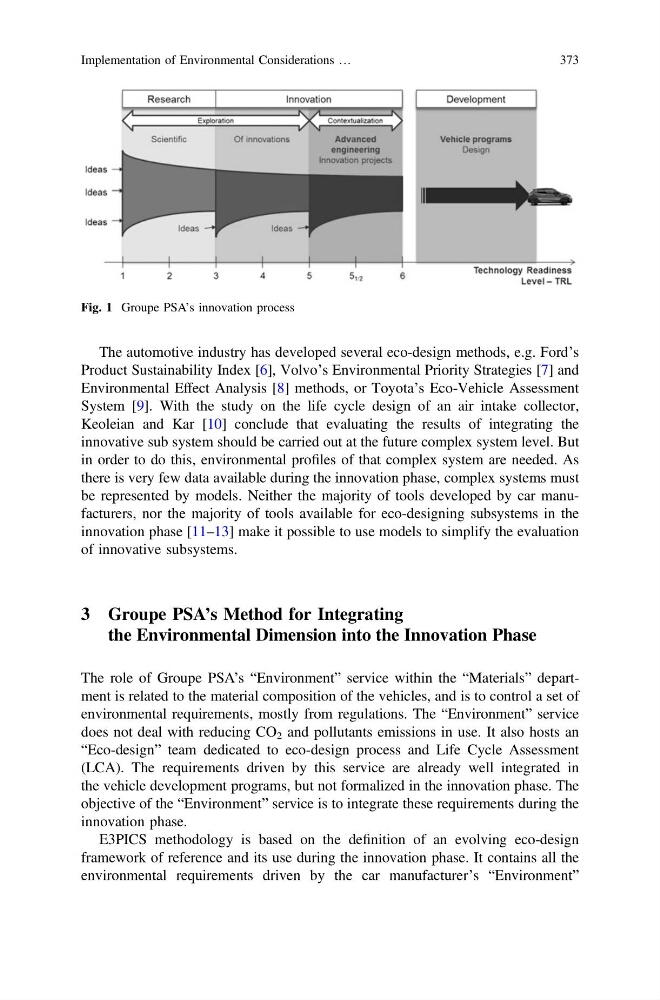
Fig. 1 Groupe PSA’s innovation process
Implementation of Environmental Considerations …
373
Product Sustainability Index [6], Volvo’s Environmental Priority Strategies [7] and
Environmental Effect Analysis [8] methods, or Toyota’s Eco-Vehicle Assessment
System [9]. With the study on the life cycle design of an air intake collector,
Keoleian and Kar [10] conclude that evaluating the results of integrating the
innovative sub system should be carried out at the future complex system level. But
in order to do this, environmental profiles of that complex system are needed. As
there is very few data available during the innovation phase, complex systems must
be represented by models. Neither the majority of tools developed by car manufacturers, nor the majority of tools available for eco-designing subsystems in the
innovation phase [11–13] make it possible to use models to simplify the evaluation
of innovative subsystems.
3 Groupe PSA’s Method for Integrating
the Environmental Dimension into the Innovation Phase
The role of Groupe PSA’s “Environment” service within the “Materials” department is related to the material composition of the vehicles, and is to control a set of
environmental requirements, mostly from regulations. The “Environment” service
does not deal with reducing CO 2 and pollutants emissions in use. It also hosts an
“Eco-design” team dedicated to eco-design process and Life Cycle Assessment
(LCA). The requirements driven by this service are already well integrated in
the vehicle development programs, but not formalized in the innovation phase. The
objective of the “Environment” service is to integrate these requirements during the
innovation phase.
E3PICS methodology is based on the definition of an evolving eco-design
framework of reference and its use during the innovation phase. It contains all the
environmental requirements driven by the car manufacturer’s “Environment”
Fig. 1 Groupe PSA’s innovation process
Implementation of Environmental Considerations …
373