

or system. On the other hand, different methodological choices between actors (or
stakeholders) in a supply chain or product system make it difficult to find consensus
and agree on common metrics, which decreases the confidence level of the end user
and decision maker in LCA as a tool.
Many review studies have compiled the most important methodological issues that
remain open in LCA today. That was done e.g. in the program Sustainable Process
Industry through Resource and Energy Efficiency “SPIRE” with the specific projects
Sustainability assessment methods and tools project “SAMT” and Metrics for
Sustainability Assessment in European Process Industries “MEASURE” in 2016,
with ISPN members contribution [5]. For every industry sector, the key methodological issues are different: for example, while allocation between co-products is a
key issue in the food industry and the waste sector, methods to assess (eco-) toxicity
are of paramount importance for the chemicals or pharmaceuticals sector. The
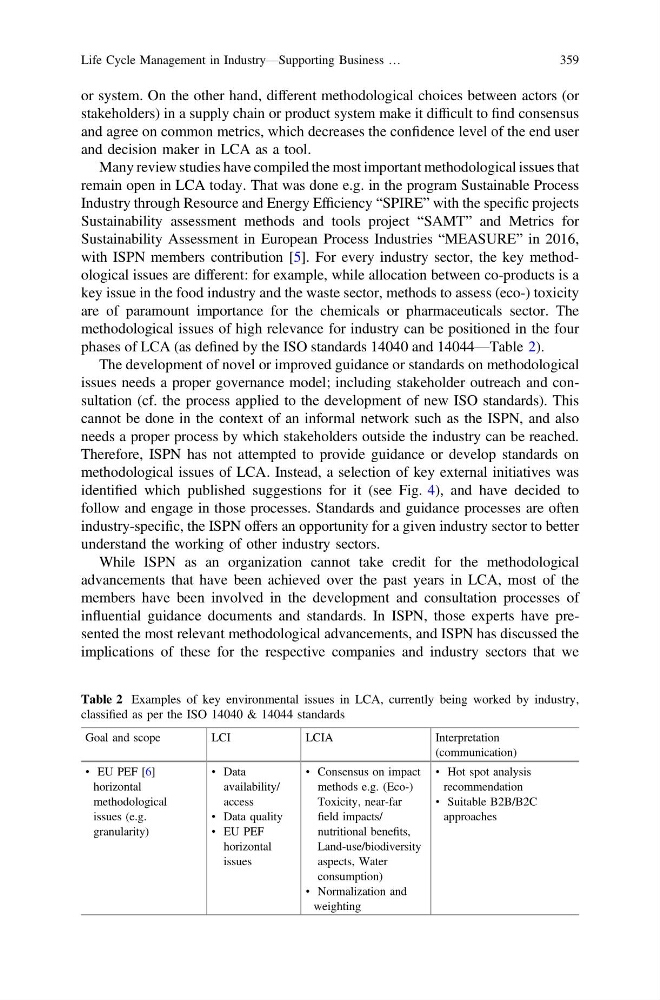
methodological issues of high relevance for industry can be positioned in the four
phases of LCA (as defined by the ISO standards 14040 and 14044—Table 2).
The development of novel or improved guidance or standards on methodological
issues needs a proper governance model; including stakeholder outreach and consultation (cf. the process applied to the development of new ISO standards). This
cannot be done in the context of an informal network such as the ISPN, and also
needs a proper process by which stakeholders outside the industry can be reached.
Therefore, ISPN has not attempted to provide guidance or develop standards on
methodological issues of LCA. Instead, a selection of key external initiatives was
identified which published suggestions for it (see Fig. 4), and have decided to
follow and engage in those processes. Standards and guidance processes are often
industry-specific, the ISPN offers an opportunity for a given industry sector to better
understand the working of other industry sectors.
While ISPN as an organization cannot take credit for the methodological
advancements that have been achieved over the past years in LCA, most of the
members have been involved in the development and consultation processes of
influential guidance documents and standards. In ISPN, those experts have presented the most relevant methodological advancements, and ISPN has discussed the
implications of these for the respective companies and industry sectors that we
Table 2 Examples of key environmental issues in LCA, currently being worked by industry,
classified as per the ISO 14040 & 14044 standards
Goal and scope
LCI
LCIA
Interpretation
(communication)
• EU PEF [6]
horizontal
methodological
issues (e.g.
granularity)
• Data
availability/
access
• Data quality
• EU PEF
horizontal
issues
• Consensus on impact
methods e.g. (Eco-)
Toxicity, near-far
field impacts/
nutritional benefits,
Land-use/biodiversity
aspects, Water
consumption)
• Normalization and
weighting
• Hot spot analysis
recommendation
• Suitable B2B/B2C
approaches
Life Cycle Management in Industry—Supporting Business …
359
stakeholders) in a supply chain or product system make it difficult to find consensus
and agree on common metrics, which decreases the confidence level of the end user
and decision maker in LCA as a tool.
Many review studies have compiled the most important methodological issues that
remain open in LCA today. That was done e.g. in the program Sustainable Process
Industry through Resource and Energy Efficiency “SPIRE” with the specific projects
Sustainability assessment methods and tools project “SAMT” and Metrics for
Sustainability Assessment in European Process Industries “MEASURE” in 2016,
with ISPN members contribution [5]. For every industry sector, the key methodological issues are different: for example, while allocation between co-products is a
key issue in the food industry and the waste sector, methods to assess (eco-) toxicity
are of paramount importance for the chemicals or pharmaceuticals sector. The
methodological issues of high relevance for industry can be positioned in the four
phases of LCA (as defined by the ISO standards 14040 and 14044—Table 2).
The development of novel or improved guidance or standards on methodological
issues needs a proper governance model; including stakeholder outreach and consultation (cf. the process applied to the development of new ISO standards). This
cannot be done in the context of an informal network such as the ISPN, and also
needs a proper process by which stakeholders outside the industry can be reached.
Therefore, ISPN has not attempted to provide guidance or develop standards on
methodological issues of LCA. Instead, a selection of key external initiatives was
identified which published suggestions for it (see Fig. 4), and have decided to
follow and engage in those processes. Standards and guidance processes are often
industry-specific, the ISPN offers an opportunity for a given industry sector to better
understand the working of other industry sectors.
While ISPN as an organization cannot take credit for the methodological
advancements that have been achieved over the past years in LCA, most of the
members have been involved in the development and consultation processes of
influential guidance documents and standards. In ISPN, those experts have presented the most relevant methodological advancements, and ISPN has discussed the
implications of these for the respective companies and industry sectors that we
Table 2 Examples of key environmental issues in LCA, currently being worked by industry,
classified as per the ISO 14040 & 14044 standards
Goal and scope
LCI
LCIA
Interpretation
(communication)
• EU PEF [6]
horizontal
methodological
issues (e.g.
granularity)
• Data
availability/
access
• Data quality
• EU PEF
horizontal
issues
• Consensus on impact
methods e.g. (Eco-)
Toxicity, near-far
field impacts/
nutritional benefits,
Land-use/biodiversity
aspects, Water
consumption)
• Normalization and
weighting
• Hot spot analysis
recommendation
• Suitable B2B/B2C
approaches
Life Cycle Management in Industry—Supporting Business …
359