

Examples of issues that lead to such problems:
• Naming of environmental flows in different datasets varies
• Amount and naming of compartments for flows differ between databases/
software systems
• Application of substance specific characterization factors in different software is
not the same
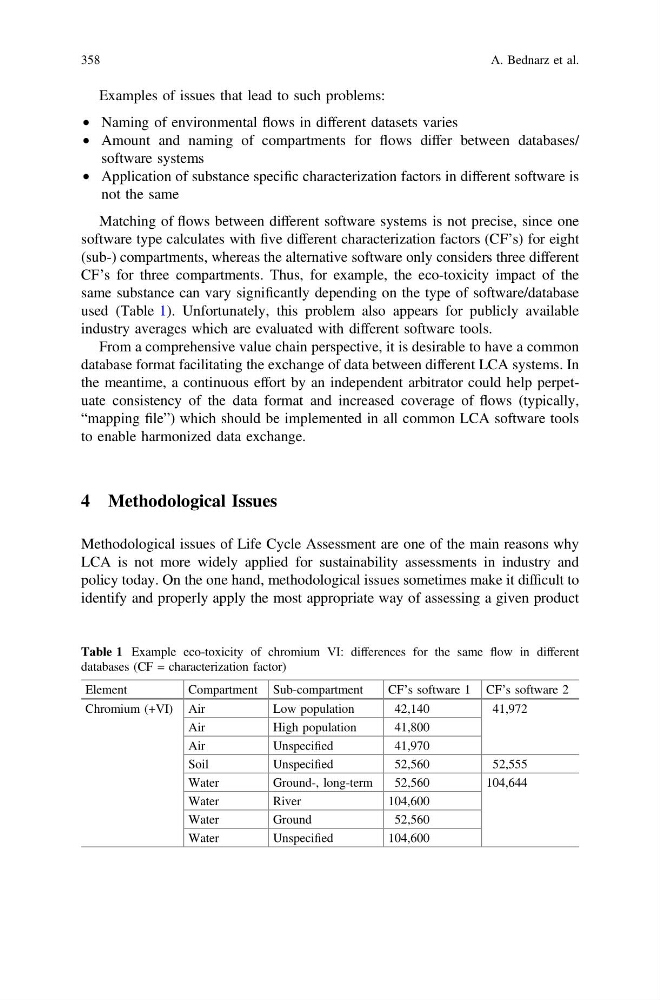
Matching of flows between different software systems is not precise, since one
software type calculates with five different characterization factors (CF’s) for eight
(sub-) compartments, whereas the alternative software only considers three different
CF’s for three compartments. Thus, for example, the eco-toxicity impact of the
same substance can vary significantly depending on the type of software/database
used (Table 1). Unfortunately, this problem also appears for publicly available
industry averages which are evaluated with different software tools.
From a comprehensive value chain perspective, it is desirable to have a common
database format facilitating the exchange of data between different LCA systems. In
the meantime, a continuous effort by an independent arbitrator could help perpetuate consistency of the data format and increased coverage of flows (typically,
“mapping file”) which should be implemented in all common LCA software tools
to enable harmonized data exchange.
4 Methodological Issues
Methodological issues of Life Cycle Assessment are one of the main reasons why
LCA is not more widely applied for sustainability assessments in industry and
policy today. On the one hand, methodological issues sometimes make it difficult to
identify and properly apply the most appropriate way of assessing a given product
Table 1 Example eco-toxicity of chromium VI: differences for the same flow in different
databases (CF = characterization factor)
Element
Compartment Sub-compartment
CF’s software 1 CF’s software 2
Chromium (+VI) Air
Low population
42,140
41,972
Air
High population
41,800
Air
Unspecified
41,970
Soil
Unspecified
52,560
52,555
Water
Ground-, long-term
52,560
104,644
Water
River
104,600
Water
Ground
52,560
Water
Unspecified
104,600
358
A. Bednarz et al.
• Naming of environmental flows in different datasets varies
• Amount and naming of compartments for flows differ between databases/
software systems
• Application of substance specific characterization factors in different software is
not the same
Matching of flows between different software systems is not precise, since one
software type calculates with five different characterization factors (CF’s) for eight
(sub-) compartments, whereas the alternative software only considers three different
CF’s for three compartments. Thus, for example, the eco-toxicity impact of the
same substance can vary significantly depending on the type of software/database
used (Table 1). Unfortunately, this problem also appears for publicly available
industry averages which are evaluated with different software tools.
From a comprehensive value chain perspective, it is desirable to have a common
database format facilitating the exchange of data between different LCA systems. In
the meantime, a continuous effort by an independent arbitrator could help perpetuate consistency of the data format and increased coverage of flows (typically,
“mapping file”) which should be implemented in all common LCA software tools
to enable harmonized data exchange.
4 Methodological Issues
Methodological issues of Life Cycle Assessment are one of the main reasons why
LCA is not more widely applied for sustainability assessments in industry and
policy today. On the one hand, methodological issues sometimes make it difficult to
identify and properly apply the most appropriate way of assessing a given product
Table 1 Example eco-toxicity of chromium VI: differences for the same flow in different
databases (CF = characterization factor)
Element
Compartment Sub-compartment
CF’s software 1 CF’s software 2
Chromium (+VI) Air
Low population
42,140
41,972
Air
High population
41,800
Air
Unspecified
41,970
Soil
Unspecified
52,560
52,555
Water
Ground-, long-term
52,560
104,644
Water
River
104,600
Water
Ground
52,560
Water
Unspecified
104,600
358
A. Bednarz et al.