

– Buildings;
– Energy and water flows related to building consumption, during use;
– Transport infrastructure (roads, cycle tracks, pedestrian paths, parking, rails);
– Network infrastructure (electricity, heat, water, lighting);
– Other (activity resources, green areas).
The scope of the LCA is set to include input and output flows of materials
(including water) and energy related to each life phases of the project (production
and provision of construction materials, construction phase, use phase and end of
life), in accordance with a functional unit and an evaluation period [9].
The environmental impacts are then calculated from these flows, thanks to
environmental databases that can be specific to the construction sector; such as the
German ökobau database [10] or the INIES database (French national reference
database of environmental declarations for products, equipment, and services in the
construction sector) [11].
Depending on the objectives of the LCA and the nature of the urban project (e.g.
renovation operation, new construction), the environmental impacts of each object
are 100% allocated to the project or allocation rules can be identified. The LCA
result is a set of environmental indicators that reflect the environmental burden of
the urban project. These results can be aggregated or presented for each life cycle
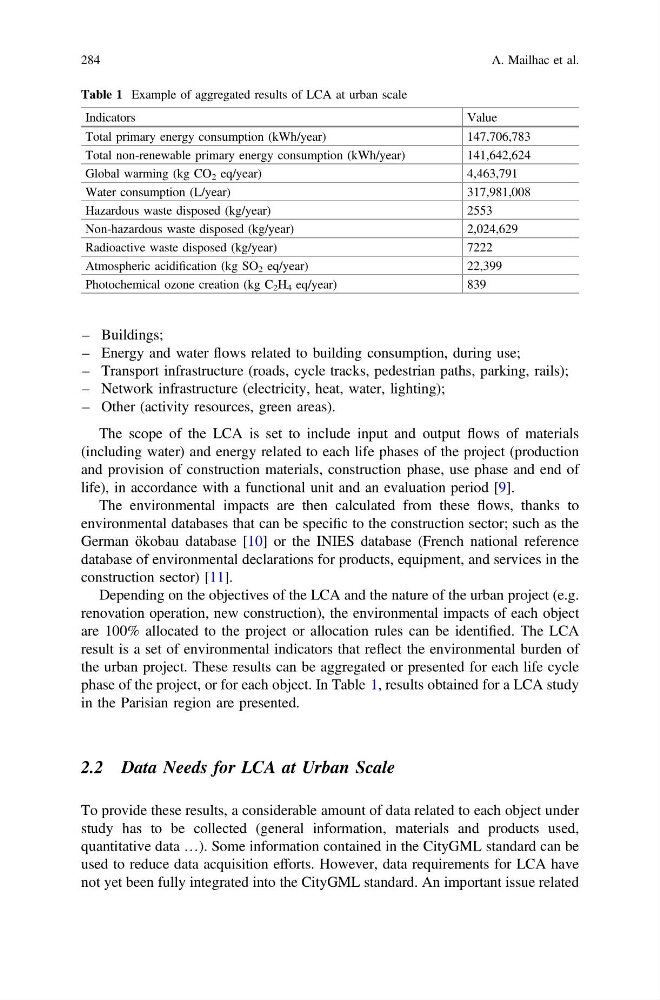
phase of the project, or for each object. In Table 1, results obtained for a LCA study
in the Parisian region are presented.
2.2 Data Needs for LCA at Urban Scale
To provide these results, a considerable amount of data related to each object under
study has to be collected (general information, materials and products used,
quantitative data …). Some information contained in the CityGML standard can be
used to reduce data acquisition efforts. However, data requirements for LCA have
not yet been fully integrated into the CityGML standard. An important issue related
Table 1 Example of aggregated results of LCA at urban scale
Indicators
Value
Total primary energy consumption (kWh/year)
147,706,783
Total non-renewable primary energy consumption (kWh/year)
141,642,624
Global warming (kg CO 2 eq/year)
4,463,791
Water consumption (L/year)
317,981,008
Hazardous waste disposed (kg/year)
2553
Non-hazardous waste disposed (kg/year)
2,024,629
Radioactive waste disposed (kg/year)
7222
Atmospheric acidification (kg SO 2 eq/year)
22,399
Photochemical ozone creation (kg C 2 H 4 eq/year)
839
284
A. Mailhac et al.
– Energy and water flows related to building consumption, during use;
– Transport infrastructure (roads, cycle tracks, pedestrian paths, parking, rails);
– Network infrastructure (electricity, heat, water, lighting);
– Other (activity resources, green areas).
The scope of the LCA is set to include input and output flows of materials
(including water) and energy related to each life phases of the project (production
and provision of construction materials, construction phase, use phase and end of
life), in accordance with a functional unit and an evaluation period [9].
The environmental impacts are then calculated from these flows, thanks to
environmental databases that can be specific to the construction sector; such as the
German ökobau database [10] or the INIES database (French national reference
database of environmental declarations for products, equipment, and services in the
construction sector) [11].
Depending on the objectives of the LCA and the nature of the urban project (e.g.
renovation operation, new construction), the environmental impacts of each object
are 100% allocated to the project or allocation rules can be identified. The LCA
result is a set of environmental indicators that reflect the environmental burden of
the urban project. These results can be aggregated or presented for each life cycle
phase of the project, or for each object. In Table 1, results obtained for a LCA study
in the Parisian region are presented.
2.2 Data Needs for LCA at Urban Scale
To provide these results, a considerable amount of data related to each object under
study has to be collected (general information, materials and products used,
quantitative data …). Some information contained in the CityGML standard can be
used to reduce data acquisition efforts. However, data requirements for LCA have
not yet been fully integrated into the CityGML standard. An important issue related
Table 1 Example of aggregated results of LCA at urban scale
Indicators
Value
Total primary energy consumption (kWh/year)
147,706,783
Total non-renewable primary energy consumption (kWh/year)
141,642,624
Global warming (kg CO 2 eq/year)
4,463,791
Water consumption (L/year)
317,981,008
Hazardous waste disposed (kg/year)
2553
Non-hazardous waste disposed (kg/year)
2,024,629
Radioactive waste disposed (kg/year)
7222
Atmospheric acidification (kg SO 2 eq/year)
22,399
Photochemical ozone creation (kg C 2 H 4 eq/year)
839
284
A. Mailhac et al.