

4 Recovery and Recycling Rate and Destination of Waste
The recovery and recycling rate of CDW is an important piece of data to define the
current state of Member States, with regards to the 70% recovery goal and recycling
rates set by the WFD. Nevertheless, this information is very difficult to find and the
associated data are not reliable yet. The European “Resource Efficient Use of Mixed
Waste” research program [5] tried to fill the gaps and inconsistencies by collecting
data from each Member State, based on statistics provided by national agencies.
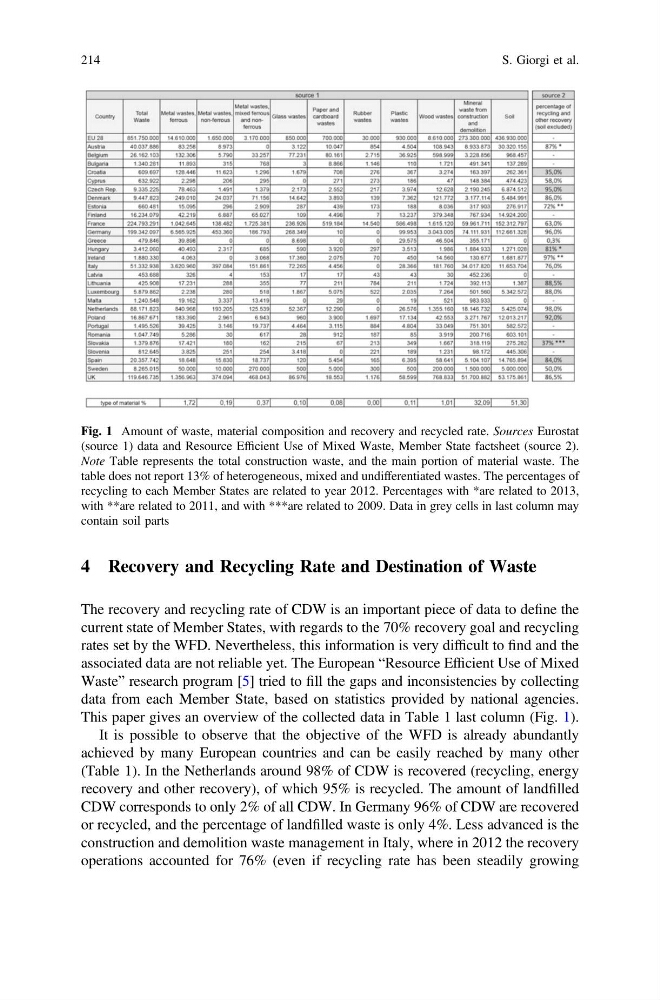
This paper gives an overview of the collected data in Table 1 last column (Fig. 1).
It is possible to observe that the objective of the WFD is already abundantly
achieved by many European countries and can be easily reached by many other
(Table 1). In the Netherlands around 98% of CDW is recovered (recycling, energy
recovery and other recovery), of which 95% is recycled. The amount of landfilled
CDW corresponds to only 2% of all CDW. In Germany 96% of CDW are recovered
or recycled, and the percentage of landfilled waste is only 4%. Less advanced is the
construction and demolition waste management in Italy, where in 2012 the recovery
operations accounted for 76% (even if recycling rate has been steadily growing
Fig. 1 Amount of waste, material composition and recovery and recycled rate. Sources Eurostat
(source 1) data and Resource Efficient Use of Mixed Waste, Member State factsheet (source 2).
Note Table represents the total construction waste, and the main portion of material waste. The
table does not report 13% of heterogeneous, mixed and undifferentiated wastes. The percentages of
recycling to each Member States are related to year 2012. Percentages with *are related to 2013,
with **are related to 2011, and with ***are related to 2009. Data in grey cells in last column may
contain soil parts
214
S. Giorgi et al.
The recovery and recycling rate of CDW is an important piece of data to define the
current state of Member States, with regards to the 70% recovery goal and recycling
rates set by the WFD. Nevertheless, this information is very difficult to find and the
associated data are not reliable yet. The European “Resource Efficient Use of Mixed
Waste” research program [5] tried to fill the gaps and inconsistencies by collecting
data from each Member State, based on statistics provided by national agencies.
This paper gives an overview of the collected data in Table 1 last column (Fig. 1).
It is possible to observe that the objective of the WFD is already abundantly
achieved by many European countries and can be easily reached by many other
(Table 1). In the Netherlands around 98% of CDW is recovered (recycling, energy
recovery and other recovery), of which 95% is recycled. The amount of landfilled
CDW corresponds to only 2% of all CDW. In Germany 96% of CDW are recovered
or recycled, and the percentage of landfilled waste is only 4%. Less advanced is the
construction and demolition waste management in Italy, where in 2012 the recovery
operations accounted for 76% (even if recycling rate has been steadily growing
Fig. 1 Amount of waste, material composition and recovery and recycled rate. Sources Eurostat
(source 1) data and Resource Efficient Use of Mixed Waste, Member State factsheet (source 2).
Note Table represents the total construction waste, and the main portion of material waste. The
table does not report 13% of heterogeneous, mixed and undifferentiated wastes. The percentages of
recycling to each Member States are related to year 2012. Percentages with *are related to 2013,
with **are related to 2011, and with ***are related to 2009. Data in grey cells in last column may
contain soil parts
214
S. Giorgi et al.