

methodology that assists in the prediction of energy and resource flows for innovative composite manufacturing chains [19]. In summary, approaches covering
single aspects within the LCE support of lightweight vehicle structures are present.
However, a comprehensive methodology supporting the design and LCE of lightweight structures is missing for the automotive application. Experiences from
aviation applications could serve as a fruitful input for the automotive case.
However, the benefits of lightweight structures and consequently the environmental
break-even differ due to longer use periods.
3 Key Requirements for Effective LCE
in the Development of Lightweight Concepts
The current research builds on findings from a public-private collaboration comprising expertise from industrial practice and academic research. The joint development is executed in a lab environment that is designated for developing and
providing methods and tools towards developing eco-efficient lightweight concepts
for large-scale vehicle manufacturing. The engineering on a product and technology
level is in the focus of the current research. This follows the bottom up approach of
LCE as described in [1]. The collaboration between experts from design and production engineering as well as life cycle evaluation during the development of
various hybrid vehicle lightweight structures enables the derivation of five key
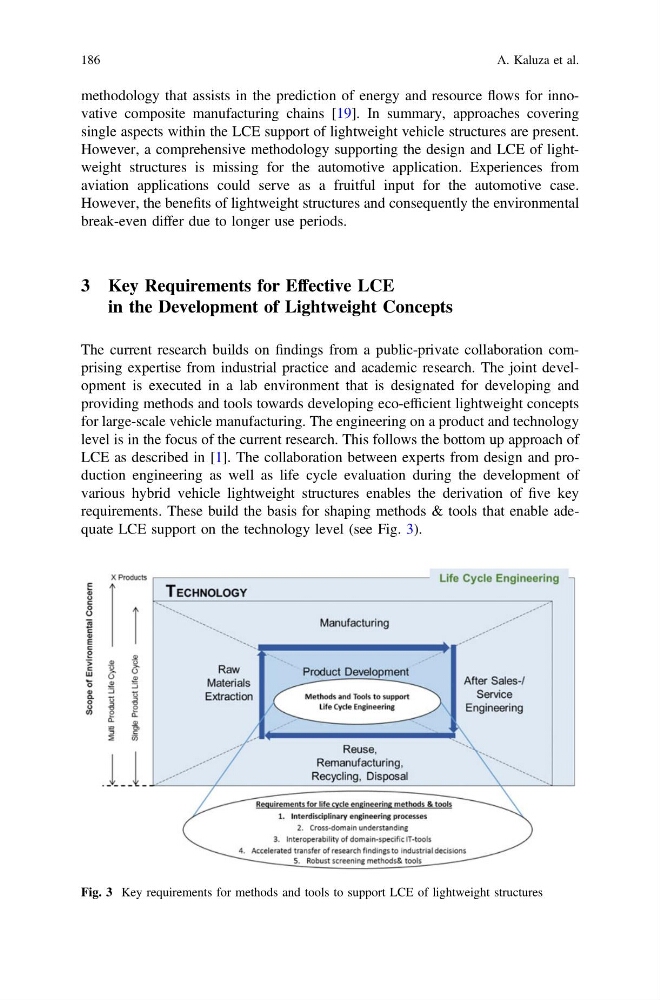
requirements. These build the basis for shaping methods & tools that enable adequate LCE support on the technology level (see Fig. 3).
Fig. 3 Key requirements for methods and tools to support LCE of lightweight structures
186
A. Kaluza et al.
single aspects within the LCE support of lightweight vehicle structures are present.
However, a comprehensive methodology supporting the design and LCE of lightweight structures is missing for the automotive application. Experiences from
aviation applications could serve as a fruitful input for the automotive case.
However, the benefits of lightweight structures and consequently the environmental
break-even differ due to longer use periods.
3 Key Requirements for Effective LCE
in the Development of Lightweight Concepts
The current research builds on findings from a public-private collaboration comprising expertise from industrial practice and academic research. The joint development is executed in a lab environment that is designated for developing and
providing methods and tools towards developing eco-efficient lightweight concepts
for large-scale vehicle manufacturing. The engineering on a product and technology
level is in the focus of the current research. This follows the bottom up approach of
LCE as described in [1]. The collaboration between experts from design and production engineering as well as life cycle evaluation during the development of
various hybrid vehicle lightweight structures enables the derivation of five key
requirements. These build the basis for shaping methods & tools that enable adequate LCE support on the technology level (see Fig. 3).
Fig. 3 Key requirements for methods and tools to support LCE of lightweight structures
186
A. Kaluza et al.