

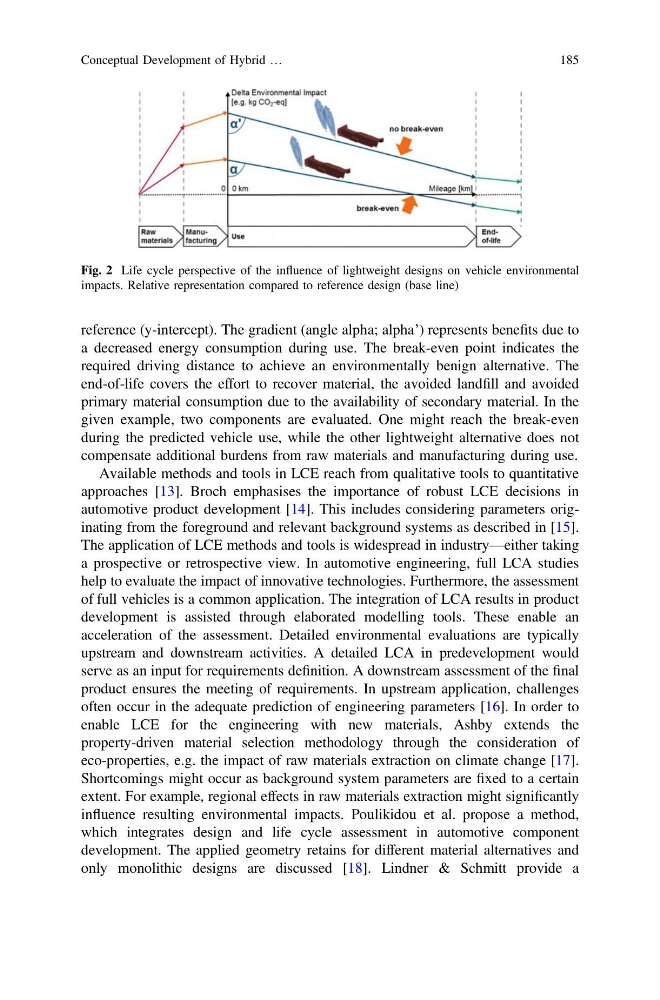
reference (y-intercept). The gradient (angle alpha; alpha’) represents benefits due to
a decreased energy consumption during use. The break-even point indicates the
required driving distance to achieve an environmentally benign alternative. The
end-of-life covers the effort to recover material, the avoided landfill and avoided
primary material consumption due to the availability of secondary material. In the
given example, two components are evaluated. One might reach the break-even
during the predicted vehicle use, while the other lightweight alternative does not
compensate additional burdens from raw materials and manufacturing during use.
Available methods and tools in LCE reach from qualitative tools to quantitative
approaches [13]. Broch emphasises the importance of robust LCE decisions in
automotive product development [14]. This includes considering parameters originating from the foreground and relevant background systems as described in [15].
The application of LCE methods and tools is widespread in industry—either taking
a prospective or retrospective view. In automotive engineering, full LCA studies
help to evaluate the impact of innovative technologies. Furthermore, the assessment
of full vehicles is a common application. The integration of LCA results in product
development is assisted through elaborated modelling tools. These enable an
acceleration of the assessment. Detailed environmental evaluations are typically
upstream and downstream activities. A detailed LCA in predevelopment would
serve as an input for requirements definition. A downstream assessment of the final
product ensures the meeting of requirements. In upstream application, challenges
often occur in the adequate prediction of engineering parameters [16]. In order to
enable LCE for the engineering with new materials, Ashby extends the
property-driven material selection methodology through the consideration of
eco-properties, e.g. the impact of raw materials extraction on climate change [17].
Shortcomings might occur as background system parameters are fixed to a certain
extent. For example, regional effects in raw materials extraction might significantly
influence resulting environmental impacts. Poulikidou et al. propose a method,
which integrates design and life cycle assessment in automotive component
development. The applied geometry retains for different material alternatives and
only monolithic designs are discussed [18]. Lindner & Schmitt provide a
Fig. 2 Life cycle perspective of the influence of lightweight designs on vehicle environmental
impacts. Relative representation compared to reference design (base line)
Conceptual Development of Hybrid …
185
a decreased energy consumption during use. The break-even point indicates the
required driving distance to achieve an environmentally benign alternative. The
end-of-life covers the effort to recover material, the avoided landfill and avoided
primary material consumption due to the availability of secondary material. In the
given example, two components are evaluated. One might reach the break-even
during the predicted vehicle use, while the other lightweight alternative does not
compensate additional burdens from raw materials and manufacturing during use.
Available methods and tools in LCE reach from qualitative tools to quantitative
approaches [13]. Broch emphasises the importance of robust LCE decisions in
automotive product development [14]. This includes considering parameters originating from the foreground and relevant background systems as described in [15].
The application of LCE methods and tools is widespread in industry—either taking
a prospective or retrospective view. In automotive engineering, full LCA studies
help to evaluate the impact of innovative technologies. Furthermore, the assessment
of full vehicles is a common application. The integration of LCA results in product
development is assisted through elaborated modelling tools. These enable an
acceleration of the assessment. Detailed environmental evaluations are typically
upstream and downstream activities. A detailed LCA in predevelopment would
serve as an input for requirements definition. A downstream assessment of the final
product ensures the meeting of requirements. In upstream application, challenges
often occur in the adequate prediction of engineering parameters [16]. In order to
enable LCE for the engineering with new materials, Ashby extends the
property-driven material selection methodology through the consideration of
eco-properties, e.g. the impact of raw materials extraction on climate change [17].
Shortcomings might occur as background system parameters are fixed to a certain
extent. For example, regional effects in raw materials extraction might significantly
influence resulting environmental impacts. Poulikidou et al. propose a method,
which integrates design and life cycle assessment in automotive component
development. The applied geometry retains for different material alternatives and
only monolithic designs are discussed [18]. Lindner & Schmitt provide a
Fig. 2 Life cycle perspective of the influence of lightweight designs on vehicle environmental
impacts. Relative representation compared to reference design (base line)
Conceptual Development of Hybrid …
185