

The later in the supply chain food is wasted the more environmental impacts are
associated with this food waste. Food waste reduction by prevention would
therefore avoid those impacts.
Concluding the presentation, she emphasised that taking measures to reduce
food waste at the consumer level is key, also for industry. Governments have an
important role to play in providing transparency on legal options for food redistribution. By preventing food waste at the consumer level, around 26 Mio tonnes of
food can be saved from being wasted (assuming that 57% of food waste is
avoidable). This would result in a reduction potential of 69 Mio tonnes CO 2 eq.
(corresponding to the level of Finland’s total greenhouse gas emissions).
3 Business Opportunity Through Co-digestion of Dairy
Manure in the US
Methane emissions from food waste landfill and dairy manure anaerobic lagoons
are causing significant greenhouse gas emissions (GHG). This case study, presented
by Ying Wang, shows how the introduction of a sustainable dairy anaerobic
digester system can have co-benefits across the supply chain by turning waste into
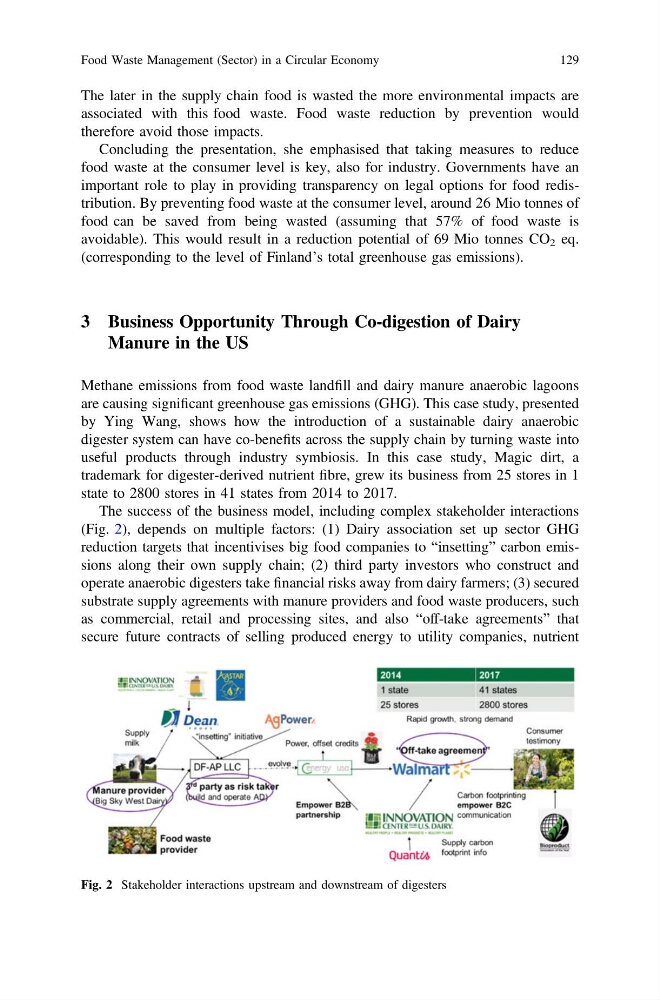
useful products through industry symbiosis. In this case study, Magic dirt, a
trademark for digester-derived nutrient fibre, grew its business from 25 stores in 1
state to 2800 stores in 41 states from 2014 to 2017.
The success of the business model, including complex stakeholder interactions
(Fig. 2), depends on multiple factors: (1) Dairy association set up sector GHG
reduction targets that incentivises big food companies to “insetting” carbon emissions along their own supply chain; (2) third party investors who construct and
operate anaerobic digesters take financial risks away from dairy farmers; (3) secured
substrate supply agreements with manure providers and food waste producers, such
as commercial, retail and processing sites, and also “off-take agreements” that
secure future contracts of selling produced energy to utility companies, nutrient
Fig. 2 Stakeholder interactions upstream and downstream of digesters
Food Waste Management (Sector) in a Circular Economy
129
associated with this food waste. Food waste reduction by prevention would
therefore avoid those impacts.
Concluding the presentation, she emphasised that taking measures to reduce
food waste at the consumer level is key, also for industry. Governments have an
important role to play in providing transparency on legal options for food redistribution. By preventing food waste at the consumer level, around 26 Mio tonnes of
food can be saved from being wasted (assuming that 57% of food waste is
avoidable). This would result in a reduction potential of 69 Mio tonnes CO 2 eq.
(corresponding to the level of Finland’s total greenhouse gas emissions).
3 Business Opportunity Through Co-digestion of Dairy
Manure in the US
Methane emissions from food waste landfill and dairy manure anaerobic lagoons
are causing significant greenhouse gas emissions (GHG). This case study, presented
by Ying Wang, shows how the introduction of a sustainable dairy anaerobic
digester system can have co-benefits across the supply chain by turning waste into
useful products through industry symbiosis. In this case study, Magic dirt, a
trademark for digester-derived nutrient fibre, grew its business from 25 stores in 1
state to 2800 stores in 41 states from 2014 to 2017.
The success of the business model, including complex stakeholder interactions
(Fig. 2), depends on multiple factors: (1) Dairy association set up sector GHG
reduction targets that incentivises big food companies to “insetting” carbon emissions along their own supply chain; (2) third party investors who construct and
operate anaerobic digesters take financial risks away from dairy farmers; (3) secured
substrate supply agreements with manure providers and food waste producers, such
as commercial, retail and processing sites, and also “off-take agreements” that
secure future contracts of selling produced energy to utility companies, nutrient
Fig. 2 Stakeholder interactions upstream and downstream of digesters
Food Waste Management (Sector) in a Circular Economy
129