

EU focuses on boosting the market for secondary raw materials, which currently
only account for a small proportion of materials used in the EU. With these ambitious targets, the need for science based guidance is eminent. Any approach tackling
food waste needs to align to sustainable development, making environmental, social
and economic sense. The aim of this session is to explore the role of waste management (sector) as industry and society move towards a circular economy model.
Four oral presentations by speakers from four countries addressed the session
topic from different angles. Two presentations, by Sergiy Smetana and Francesco
Razza have full papers accompanying them that are also part of this book.
2 Food Waste Generation in Europe
The management of food waste starts with understanding how much food waste is
currently produced and what share of it can be prevented. Silvia Scherhaufer presented in this context outcomes of the EU FP7 funded project FUSIONS (http://
www.eu-fusions.org/) where this was evaluated on a European level.
Food waste and other side flows from the food supply chain include food and
other, non-edible parts occur at every step of the supply chain. In total 88 Mio
tonnes of food waste is generated in Europe per year, the majority (about 53%)
occurring during food preparation and consumption at home. Based on these figures, 31 Mio tonnes of food wastes would need to be reduced each year in order to
meet the United Nations’ Sustainable Development goal by 2030.
Silvia Scherhaufer then further expanded the procedure developed to estimate
the impacts of the food supply chain and impacts which can be related to food waste
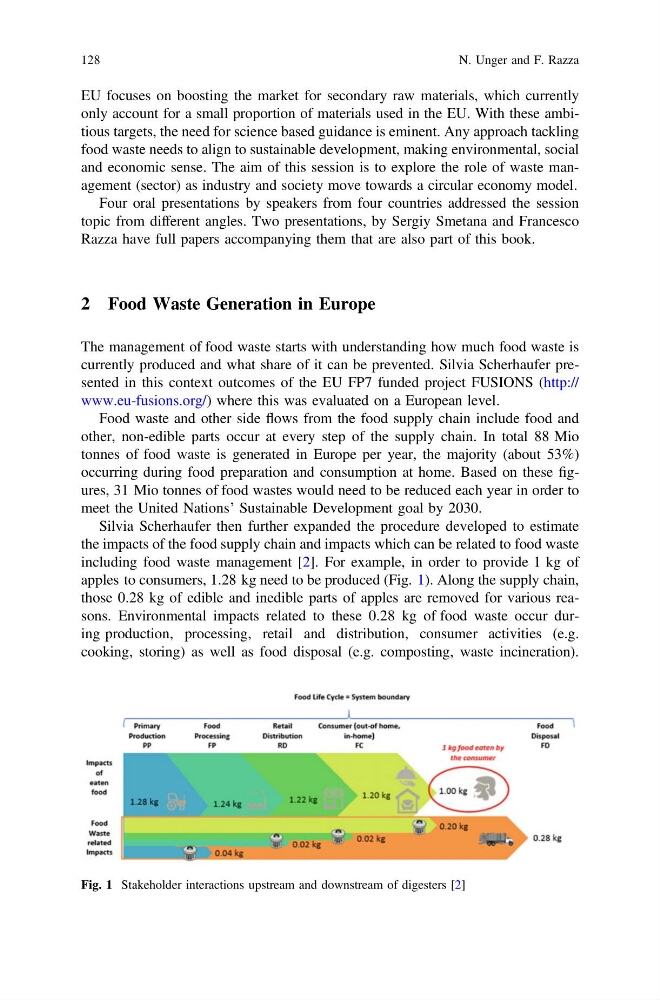
including food waste management [2]. For example, in order to provide 1 kg of
apples to consumers, 1.28 kg need to be produced (Fig. 1). Along the supply chain,
those 0.28 kg of edible and inedible parts of apples are removed for various reasons. Environmental impacts related to these 0.28 kg of food waste occur during production, processing, retail and distribution, consumer activities (e.g.
cooking, storing) as well as food disposal (e.g. composting, waste incineration).
Fig. 1 Stakeholder interactions upstream and downstream of digesters [2]
128
N. Unger and F. Razza
only account for a small proportion of materials used in the EU. With these ambitious targets, the need for science based guidance is eminent. Any approach tackling
food waste needs to align to sustainable development, making environmental, social
and economic sense. The aim of this session is to explore the role of waste management (sector) as industry and society move towards a circular economy model.
Four oral presentations by speakers from four countries addressed the session
topic from different angles. Two presentations, by Sergiy Smetana and Francesco
Razza have full papers accompanying them that are also part of this book.
2 Food Waste Generation in Europe
The management of food waste starts with understanding how much food waste is
currently produced and what share of it can be prevented. Silvia Scherhaufer presented in this context outcomes of the EU FP7 funded project FUSIONS (http://
www.eu-fusions.org/) where this was evaluated on a European level.
Food waste and other side flows from the food supply chain include food and
other, non-edible parts occur at every step of the supply chain. In total 88 Mio
tonnes of food waste is generated in Europe per year, the majority (about 53%)
occurring during food preparation and consumption at home. Based on these figures, 31 Mio tonnes of food wastes would need to be reduced each year in order to
meet the United Nations’ Sustainable Development goal by 2030.
Silvia Scherhaufer then further expanded the procedure developed to estimate
the impacts of the food supply chain and impacts which can be related to food waste
including food waste management [2]. For example, in order to provide 1 kg of
apples to consumers, 1.28 kg need to be produced (Fig. 1). Along the supply chain,
those 0.28 kg of edible and inedible parts of apples are removed for various reasons. Environmental impacts related to these 0.28 kg of food waste occur during production, processing, retail and distribution, consumer activities (e.g.
cooking, storing) as well as food disposal (e.g. composting, waste incineration).
Fig. 1 Stakeholder interactions upstream and downstream of digesters [2]
128
N. Unger and F. Razza