

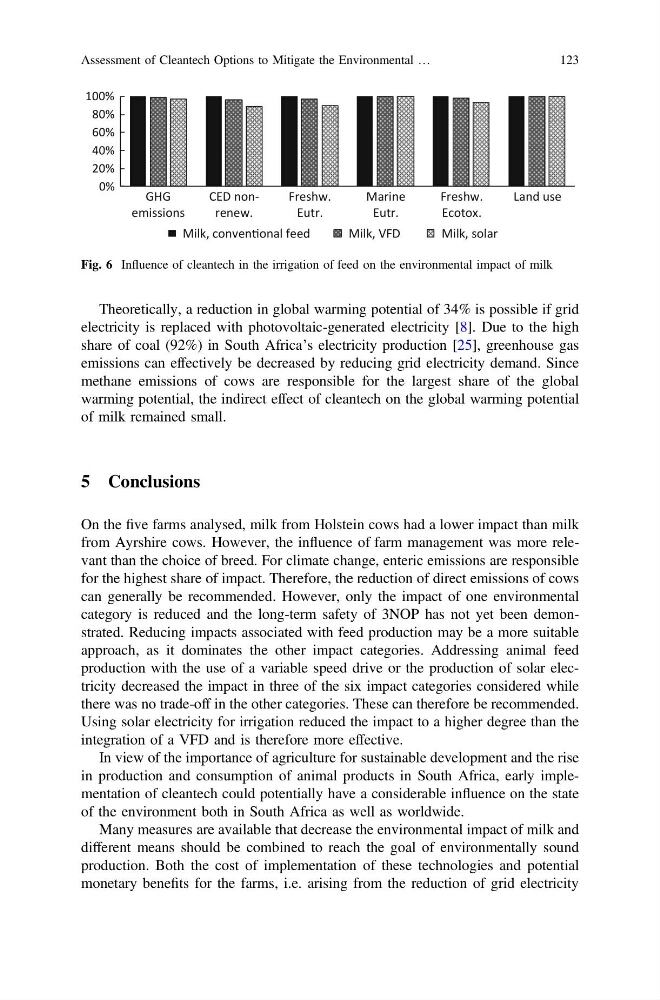
Theoretically, a reduction in global warming potential of 34% is possible if grid
electricity is replaced with photovoltaic-generated electricity [8]. Due to the high
share of coal (92%) in South Africa’s electricity production [25], greenhouse gas
emissions can effectively be decreased by reducing grid electricity demand. Since
methane emissions of cows are responsible for the largest share of the global
warming potential, the indirect effect of cleantech on the global warming potential
of milk remained small.
5 Conclusions
On the five farms analysed, milk from Holstein cows had a lower impact than milk
from Ayrshire cows. However, the influence of farm management was more relevant than the choice of breed. For climate change, enteric emissions are responsible
for the highest share of impact. Therefore, the reduction of direct emissions of cows
can generally be recommended. However, only the impact of one environmental
category is reduced and the long-term safety of 3NOP has not yet been demonstrated. Reducing impacts associated with feed production may be a more suitable
approach, as it dominates the other impact categories. Addressing animal feed
production with the use of a variable speed drive or the production of solar electricity decreased the impact in three of the six impact categories considered while
there was no trade-off in the other categories. These can therefore be recommended.
Using solar electricity for irrigation reduced the impact to a higher degree than the
integration of a VFD and is therefore more effective.
In view of the importance of agriculture for sustainable development and the rise
in production and consumption of animal products in South Africa, early implementation of cleantech could potentially have a considerable influence on the state
of the environment both in South Africa as well as worldwide.
Many measures are available that decrease the environmental impact of milk and
different means should be combined to reach the goal of environmentally sound
production. Both the cost of implementation of these technologies and potential
monetary benefits for the farms, i.e. arising from the reduction of grid electricity
0%
20%
40%
60%
80%
100%
GHG
emissions
CED nonrenew.
Freshw.
Eutr.
Marine
Eutr.
Freshw.
Ecotox.
Land use
Milk, convenƟonal feed
Milk, VFD
Milk, solar
Fig. 6 Influence of cleantech in the irrigation of feed on the environmental impact of milk
Assessment of Cleantech Options to Mitigate the Environmental …
123
electricity is replaced with photovoltaic-generated electricity [8]. Due to the high
share of coal (92%) in South Africa’s electricity production [25], greenhouse gas
emissions can effectively be decreased by reducing grid electricity demand. Since
methane emissions of cows are responsible for the largest share of the global
warming potential, the indirect effect of cleantech on the global warming potential
of milk remained small.
5 Conclusions
On the five farms analysed, milk from Holstein cows had a lower impact than milk
from Ayrshire cows. However, the influence of farm management was more relevant than the choice of breed. For climate change, enteric emissions are responsible
for the highest share of impact. Therefore, the reduction of direct emissions of cows
can generally be recommended. However, only the impact of one environmental
category is reduced and the long-term safety of 3NOP has not yet been demonstrated. Reducing impacts associated with feed production may be a more suitable
approach, as it dominates the other impact categories. Addressing animal feed
production with the use of a variable speed drive or the production of solar electricity decreased the impact in three of the six impact categories considered while
there was no trade-off in the other categories. These can therefore be recommended.
Using solar electricity for irrigation reduced the impact to a higher degree than the
integration of a VFD and is therefore more effective.
In view of the importance of agriculture for sustainable development and the rise
in production and consumption of animal products in South Africa, early implementation of cleantech could potentially have a considerable influence on the state
of the environment both in South Africa as well as worldwide.
Many measures are available that decrease the environmental impact of milk and
different means should be combined to reach the goal of environmentally sound
production. Both the cost of implementation of these technologies and potential
monetary benefits for the farms, i.e. arising from the reduction of grid electricity
0%
20%
40%
60%
80%
100%
GHG
emissions
CED nonrenew.
Freshw.
Eutr.
Marine
Eutr.
Freshw.
Ecotox.
Land use
Milk, convenƟonal feed
Milk, VFD
Milk, solar
Fig. 6 Influence of cleantech in the irrigation of feed on the environmental impact of milk
Assessment of Cleantech Options to Mitigate the Environmental …
123