

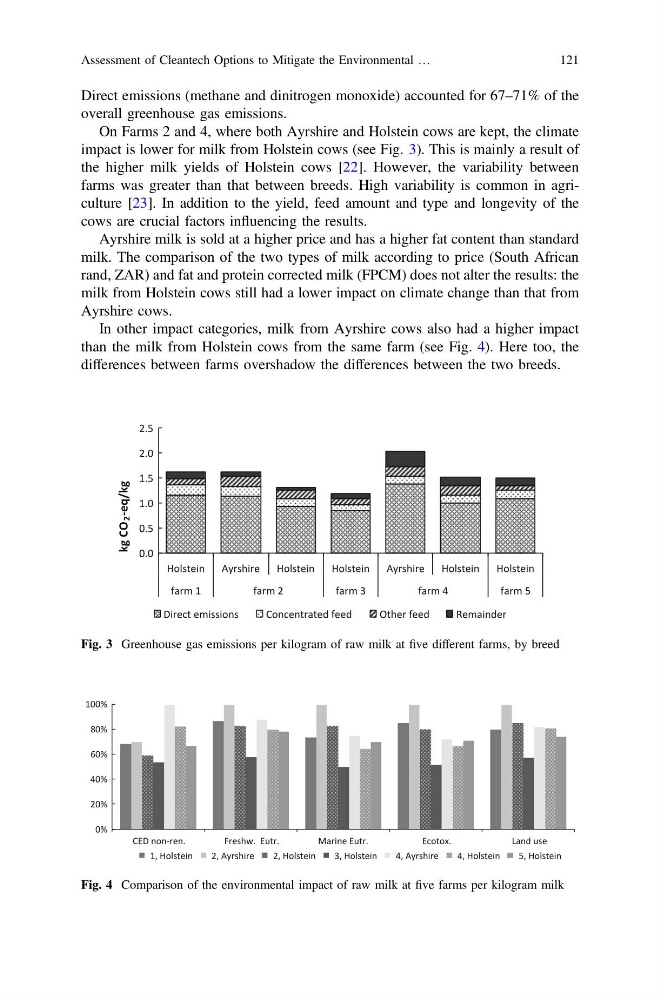
Direct emissions (methane and dinitrogen monoxide) accounted for 67–71% of the
overall greenhouse gas emissions.
On Farms 2 and 4, where both Ayrshire and Holstein cows are kept, the climate
impact is lower for milk from Holstein cows (see Fig. 3). This is mainly a result of
the higher milk yields of Holstein cows [22]. However, the variability between
farms was greater than that between breeds. High variability is common in agriculture [23]. In addition to the yield, feed amount and type and longevity of the
cows are crucial factors influencing the results.
Ayrshire milk is sold at a higher price and has a higher fat content than standard
milk. The comparison of the two types of milk according to price (South African
rand, ZAR) and fat and protein corrected milk (FPCM) does not alter the results: the
milk from Holstein cows still had a lower impact on climate change than that from
Ayrshire cows.
In other impact categories, milk from Ayrshire cows also had a higher impact
than the milk from Holstein cows from the same farm (see Fig. 4). Here too, the
differences between farms overshadow the differences between the two breeds.
0.0
0.5
1.0
1.5
2.0
2.5
Holstein Ayrshire Holstein
Holstein Ayrshire Holstein
Holstein
farm 1
farm 2
farm 3
farm 4
farm 5
kg CO
2 -eq/kg
Direct emissions
Concentrated feed
Other feed
Remainder
Fig. 3 Greenhouse gas emissions per kilogram of raw milk at five different farms, by breed
0%
20%
40%
60%
80%
100%
CED non-ren.
Freshw. Eutr.
Marine Eutr.
Ecotox.
Land use
1, Holstein
2, Ayrshire
2, Holstein
3, Holstein
4, Ayrshire
4, Holstein
5, Holstein
Fig. 4 Comparison of the environmental impact of raw milk at five farms per kilogram milk
Assessment of Cleantech Options to Mitigate the Environmental …
121
overall greenhouse gas emissions.
On Farms 2 and 4, where both Ayrshire and Holstein cows are kept, the climate
impact is lower for milk from Holstein cows (see Fig. 3). This is mainly a result of
the higher milk yields of Holstein cows [22]. However, the variability between
farms was greater than that between breeds. High variability is common in agriculture [23]. In addition to the yield, feed amount and type and longevity of the
cows are crucial factors influencing the results.
Ayrshire milk is sold at a higher price and has a higher fat content than standard
milk. The comparison of the two types of milk according to price (South African
rand, ZAR) and fat and protein corrected milk (FPCM) does not alter the results: the
milk from Holstein cows still had a lower impact on climate change than that from
Ayrshire cows.
In other impact categories, milk from Ayrshire cows also had a higher impact
than the milk from Holstein cows from the same farm (see Fig. 4). Here too, the
differences between farms overshadow the differences between the two breeds.
0.0
0.5
1.0
1.5
2.0
2.5
Holstein Ayrshire Holstein
Holstein Ayrshire Holstein
Holstein
farm 1
farm 2
farm 3
farm 4
farm 5
kg CO
2 -eq/kg
Direct emissions
Concentrated feed
Other feed
Remainder
Fig. 3 Greenhouse gas emissions per kilogram of raw milk at five different farms, by breed
0%
20%
40%
60%
80%
100%
CED non-ren.
Freshw. Eutr.
Marine Eutr.
Ecotox.
Land use
1, Holstein
2, Ayrshire
2, Holstein
3, Holstein
4, Ayrshire
4, Holstein
5, Holstein
Fig. 4 Comparison of the environmental impact of raw milk at five farms per kilogram milk
Assessment of Cleantech Options to Mitigate the Environmental …
121