

287
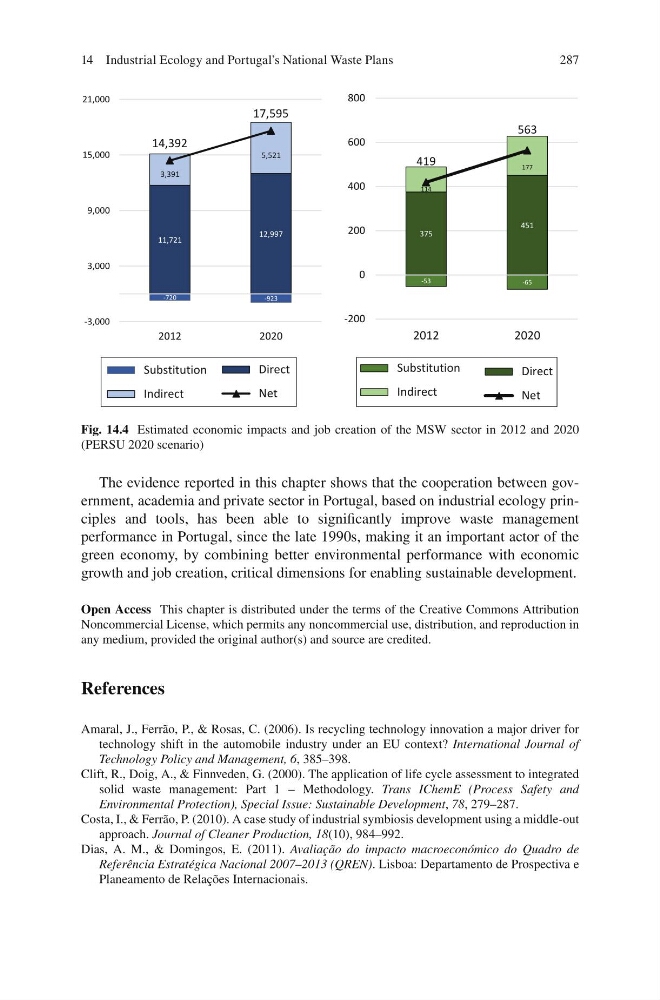
The evidence reported in this chapter shows that the cooperation between government, academia and private sector in Portugal, based on industrial ecology principles and tools, has been able to signifi cantly improve waste management
performance in Portugal, since the late 1990s, making it an important actor of the
green economy, by combining better environmental performance with economic
growth and job creation, critical dimensions for enabling sustainable development.
11,721
12,997
3,391
5,521
-720
-923
14,392
17,595
-3,000
3,000
9,000
15,000
21,000
2012
2020
Substitution
Indirect
Direct
Net
375
451
114
177
-53
-65
419
563
-200
0
200
400
600
800
2012
2020
Substitution
Indirect
Direct
Net
Fig. 14.4 Estimated economic impacts and job creation of the MSW sector in 2012 and 2020
(PERSU 2020 scenario)
Open Access This chapter is distributed under the terms of the Creative Commons Attribution
Noncommercial License, which permits any noncommercial use, distribution, and reproduction in
any medium, provided the original author(s) and source are credited.
References
Amaral, J., Ferrão, P., & Rosas, C. (2006). Is recycling technology innovation a major driver for
technology shift in the automobile industry under an EU context? International Journal of
Technology Policy and Management, 6 , 385–398.
Clift, R., Doig, A., & Finnveden, G. (2000). The application of life cycle assessment to integrated
solid waste management: Part 1 – Methodology. Trans IChemE (Process Safety and
Environmental Protection), Special Issue: Sustainable Development , 78 , 279–287.
Costa, I., & Ferrão, P. (2010). A case study of industrial symbiosis development using a middle-out
approach. Journal of Cleaner Production, 18 (10), 984–992.
Dias, A. M., & Domingos, E. (2011). Avaliação do impacto macroeconómico do Quadro de
Referência Estratégica Nacional 2007–2013 (QREN) . Lisboa: Departamento de Prospectiva e
Planeamento de Relações Internacionais.
14 Industrial Ecology and Portugal’s National Waste Plans
The evidence reported in this chapter shows that the cooperation between government, academia and private sector in Portugal, based on industrial ecology principles and tools, has been able to signifi cantly improve waste management
performance in Portugal, since the late 1990s, making it an important actor of the
green economy, by combining better environmental performance with economic
growth and job creation, critical dimensions for enabling sustainable development.
11,721
12,997
3,391
5,521
-720
-923
14,392
17,595
-3,000
3,000
9,000
15,000
21,000
2012
2020
Substitution
Indirect
Direct
Net
375
451
114
177
-53
-65
419
563
-200
0
200
400
600
800
2012
2020
Substitution
Indirect
Direct
Net
Fig. 14.4 Estimated economic impacts and job creation of the MSW sector in 2012 and 2020
(PERSU 2020 scenario)
Open Access This chapter is distributed under the terms of the Creative Commons Attribution
Noncommercial License, which permits any noncommercial use, distribution, and reproduction in
any medium, provided the original author(s) and source are credited.
References
Amaral, J., Ferrão, P., & Rosas, C. (2006). Is recycling technology innovation a major driver for
technology shift in the automobile industry under an EU context? International Journal of
Technology Policy and Management, 6 , 385–398.
Clift, R., Doig, A., & Finnveden, G. (2000). The application of life cycle assessment to integrated
solid waste management: Part 1 – Methodology. Trans IChemE (Process Safety and
Environmental Protection), Special Issue: Sustainable Development , 78 , 279–287.
Costa, I., & Ferrão, P. (2010). A case study of industrial symbiosis development using a middle-out
approach. Journal of Cleaner Production, 18 (10), 984–992.
Dias, A. M., & Domingos, E. (2011). Avaliação do impacto macroeconómico do Quadro de
Referência Estratégica Nacional 2007–2013 (QREN) . Lisboa: Departamento de Prospectiva e
Planeamento de Relações Internacionais.
14 Industrial Ecology and Portugal’s National Waste Plans