

285
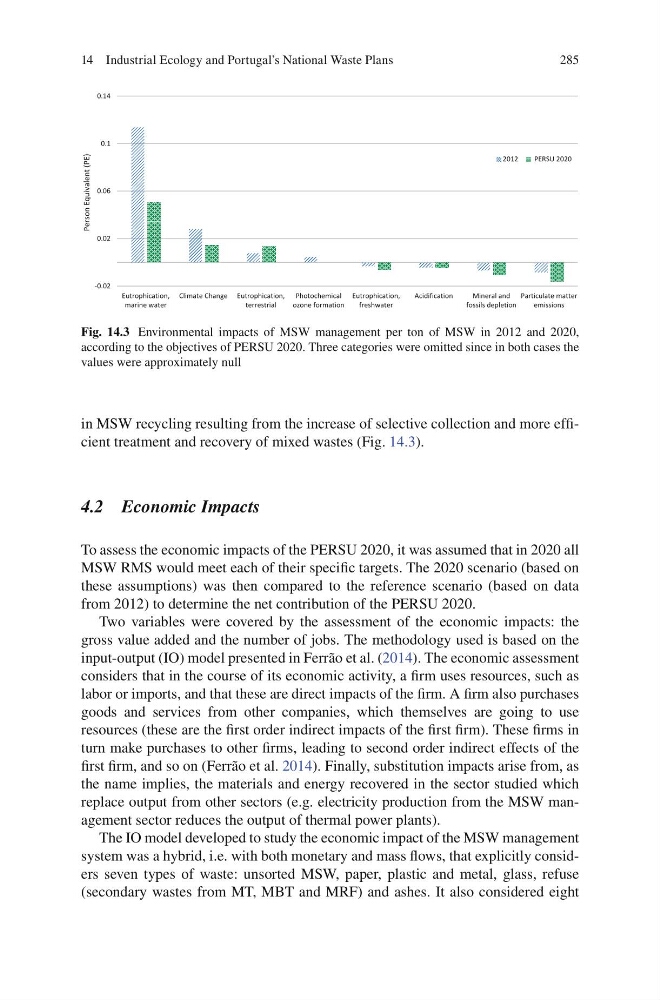
in MSW recycling resulting from the increase of selective collection and more effi -
cient treatment and recovery of mixed wastes (Fig. 14.3 ).
4.2 Economic Impacts
To assess the economic impacts of the PERSU 2020, it was assumed that in 2020 all
MSW RMS would meet each of their specifi c targets. The 2020 scenario (based on
these assumptions) was then compared to the reference scenario (based on data
from 2012) to determine the net contribution of the PERSU 2020.
Two variables were covered by the assessment of the economic impacts: the
gross value added and the number of jobs. The methodology used is based on the
input-output (IO) model presented in Ferrão et al. ( 2014 ). The economic assessment
considers that in the course of its economic activity, a fi rm uses resources, such as
labor or imports, and that these are direct impacts of the fi rm. A fi rm also purchases
goods and services from other companies, which themselves are going to use
resources (these are the fi rst order indirect impacts of the fi rst fi rm). These fi rms in
turn make purchases to other fi rms, leading to second order indirect effects of the
fi rst fi rm, and so on (Ferrão et al. 2014 ). Finally, substitution impacts arise from, as
the name implies, the materials and energy recovered in the sector studied which
replace output from other sectors (e.g. electricity production from the MSW management sector reduces the output of thermal power plants).
The IO model developed to study the economic impact of the MSW management
system was a hybrid, i.e. with both monetary and mass fl ows, that explicitly considers seven types of waste: unsorted MSW, paper, plastic and metal, glass, refuse
(secondary wastes from MT, MBT and MRF) and ashes. It also considered eight
-0.02
0.02
0.06
0.1
0.14
Eutrophication,
marine water
Climate Change Eutrophication,
terrestrial
Photochemical
ozone formation
Eutrophication,
freshwater
Acidification
Mineral and
fossils depletion
Particulate matter
emissions
Person Equivalent (PE)
2012
PERSU 2020
Fig. 14.3 Environmental impacts of MSW management per ton of MSW in 2012 and 2020,
according to the objectives of PERSU 2020. Three categories were omitted since in both cases the
values were approximately null
14 Industrial Ecology and Portugal’s National Waste Plans
in MSW recycling resulting from the increase of selective collection and more effi -
cient treatment and recovery of mixed wastes (Fig. 14.3 ).
4.2 Economic Impacts
To assess the economic impacts of the PERSU 2020, it was assumed that in 2020 all
MSW RMS would meet each of their specifi c targets. The 2020 scenario (based on
these assumptions) was then compared to the reference scenario (based on data
from 2012) to determine the net contribution of the PERSU 2020.
Two variables were covered by the assessment of the economic impacts: the
gross value added and the number of jobs. The methodology used is based on the
input-output (IO) model presented in Ferrão et al. ( 2014 ). The economic assessment
considers that in the course of its economic activity, a fi rm uses resources, such as
labor or imports, and that these are direct impacts of the fi rm. A fi rm also purchases
goods and services from other companies, which themselves are going to use
resources (these are the fi rst order indirect impacts of the fi rst fi rm). These fi rms in
turn make purchases to other fi rms, leading to second order indirect effects of the
fi rst fi rm, and so on (Ferrão et al. 2014 ). Finally, substitution impacts arise from, as
the name implies, the materials and energy recovered in the sector studied which
replace output from other sectors (e.g. electricity production from the MSW management sector reduces the output of thermal power plants).
The IO model developed to study the economic impact of the MSW management
system was a hybrid, i.e. with both monetary and mass fl ows, that explicitly considers seven types of waste: unsorted MSW, paper, plastic and metal, glass, refuse
(secondary wastes from MT, MBT and MRF) and ashes. It also considered eight
-0.02
0.02
0.06
0.1
0.14
Eutrophication,
marine water
Climate Change Eutrophication,
terrestrial
Photochemical
ozone formation
Eutrophication,
freshwater
Acidification
Mineral and
fossils depletion
Particulate matter
emissions
Person Equivalent (PE)
2012
PERSU 2020
Fig. 14.3 Environmental impacts of MSW management per ton of MSW in 2012 and 2020,
according to the objectives of PERSU 2020. Three categories were omitted since in both cases the
values were approximately null
14 Industrial Ecology and Portugal’s National Waste Plans