

241
4.1 Challenges, Metrics and Models
This motivation to improve human development standards comes with signifi cant
challenges specifi c to developing countries, due to limited data availability. The IE
community can provide signifi cant assistance to developing countries by simplifying and downsizing data requirements to a point which yields suffi ciently accurate
results to inform policy. It would indeed be counterproductive if developing countries were to wait for economic growth to fuel complex data gathering operations
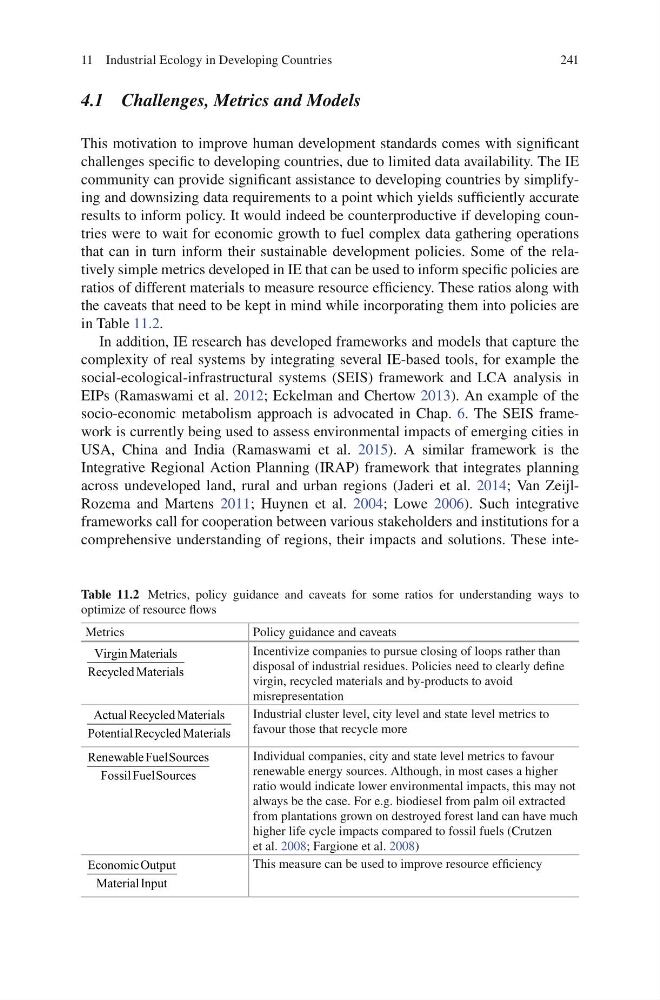
that can in turn inform their sustainable development policies. Some of the relatively simple metrics developed in IE that can be used to inform specifi c policies are
ratios of different materials to measure resource effi ciency . These ratios along with
the caveats that need to be kept in mind while incorporating them into policies are
in Table 11.2 .
In addition, IE research has developed frameworks and models that capture the
complexity of real systems by integrating several IE-based tools, for example the
social-ecological-infrastructural systems (SEIS) framework and LCA analysis in
EIPs (Ramaswami et al. 2012 ; Eckelman and Chertow 2013 ). An example of the
socio-economic metabolism approach is advocated in Chap. 6 . The SEIS framework is currently being used to assess environmental impacts of emerging cities in
USA, China and India (Ramaswami et al. 2015 ). A similar framework is the
Integrative Regional Action Planning (IRAP) framework that integrates planning
across undeveloped land, rural and urban regions (Jaderi et al. 2014 ; Van ZeijlRozema and Martens 2011 ; Huynen et al. 2004 ; Lowe 2006 ). Such integrative
frameworks call for cooperation between various stakeholders and institutions for a
comprehensive understanding of regions, their impacts and solutions. These inteTable 11.2 Metrics, policy guidance and caveats for some ratios for understanding ways to
optimize of resource fl ows
Metrics
Policy guidance and caveats
Virgin Materials
Recycled Materials
Incentivize companies to pursue closing of loops rather than
disposal of industrial residues. Policies need to clearly defi ne
virgin, recycled materials and by-products to avoid
misrepresentation
Actual Recycled Materials
Potential Recycled Materials
Industrial cluster level, city level and state level metrics to
favour those that recycle more
Renewable FuelSources
Fossil FuelSources
Individual companies, city and state level metrics to favour
renewable energy sources. Although, in most cases a higher
ratio would indicate lower environmental impacts, this may not
always be the case. For e.g. biodiesel from palm oil extracted
from plantations grown on destroyed forest land can have much
higher life cycle impacts compared to fossil fuels (Crutzen
et al. 2008 ; Fargione et al. 2008 )
Economic Output
Material Input
This measure can be used to improve resource effi ciency
11 Industrial Ecology in Developing Countries
4.1 Challenges, Metrics and Models
This motivation to improve human development standards comes with signifi cant
challenges specifi c to developing countries, due to limited data availability. The IE
community can provide signifi cant assistance to developing countries by simplifying and downsizing data requirements to a point which yields suffi ciently accurate
results to inform policy. It would indeed be counterproductive if developing countries were to wait for economic growth to fuel complex data gathering operations
that can in turn inform their sustainable development policies. Some of the relatively simple metrics developed in IE that can be used to inform specifi c policies are
ratios of different materials to measure resource effi ciency . These ratios along with
the caveats that need to be kept in mind while incorporating them into policies are
in Table 11.2 .
In addition, IE research has developed frameworks and models that capture the
complexity of real systems by integrating several IE-based tools, for example the
social-ecological-infrastructural systems (SEIS) framework and LCA analysis in
EIPs (Ramaswami et al. 2012 ; Eckelman and Chertow 2013 ). An example of the
socio-economic metabolism approach is advocated in Chap. 6 . The SEIS framework is currently being used to assess environmental impacts of emerging cities in
USA, China and India (Ramaswami et al. 2015 ). A similar framework is the
Integrative Regional Action Planning (IRAP) framework that integrates planning
across undeveloped land, rural and urban regions (Jaderi et al. 2014 ; Van ZeijlRozema and Martens 2011 ; Huynen et al. 2004 ; Lowe 2006 ). Such integrative
frameworks call for cooperation between various stakeholders and institutions for a
comprehensive understanding of regions, their impacts and solutions. These inteTable 11.2 Metrics, policy guidance and caveats for some ratios for understanding ways to
optimize of resource fl ows
Metrics
Policy guidance and caveats
Virgin Materials
Recycled Materials
Incentivize companies to pursue closing of loops rather than
disposal of industrial residues. Policies need to clearly defi ne
virgin, recycled materials and by-products to avoid
misrepresentation
Actual Recycled Materials
Potential Recycled Materials
Industrial cluster level, city level and state level metrics to
favour those that recycle more
Renewable FuelSources
Fossil FuelSources
Individual companies, city and state level metrics to favour
renewable energy sources. Although, in most cases a higher
ratio would indicate lower environmental impacts, this may not
always be the case. For e.g. biodiesel from palm oil extracted
from plantations grown on destroyed forest land can have much
higher life cycle impacts compared to fossil fuels (Crutzen
et al. 2008 ; Fargione et al. 2008 )
Economic Output
Material Input
This measure can be used to improve resource effi ciency
11 Industrial Ecology in Developing Countries