

240
IE concepts and tools but new ways of framing their problems and hence fi nding
solutions (Erkman and Ramaswamy 2000 ).
If resources are cycled effi ciently, as advocated by the IE paradigm, then we can
expect to devote progressively less fi nancial resources into future remediation. This
argument provides a strong case for the fi nancial value of IE, supporting the allocation
of public funding for (1) industrial ecology research and education; (2) providing fi nancial assistance to micro-, small-scale and cottage-scale industries to invest in effi cient,
clean technologies (Erkman and Ramaswamy 2000 ) and (3) monitoring environmental
parameters and measures of human development, a task which is made more complex
by the signifi cance of the unorganized sector (Erkman and Ramaswamy 2003 ).
4 What Can IE Give to the Global South?
Although there is some fi nancial impetus for developing countries to adopt IE, this
need not be the only motivation for adopting IE. Recent research has found that high
levels of human development can be achieved at moderate energy consumption levels
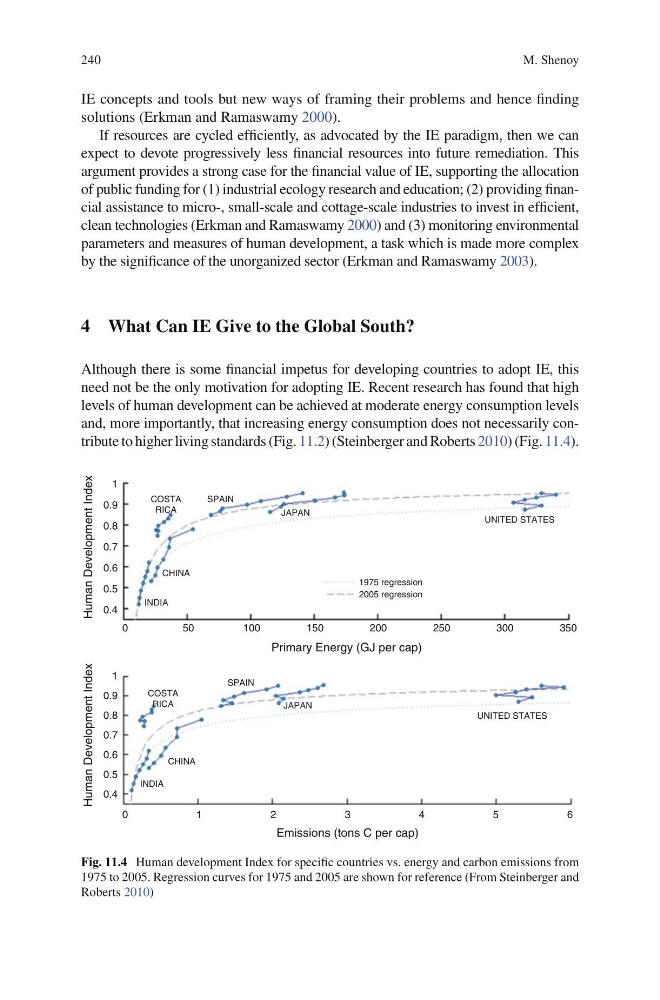
and, more importantly, that increasing energy consumption does not necessarily contribute to higher living standards (Fig. 11.2 ) (Steinberger and Roberts 2010 ) (Fig. 11.4 ).
1
0.9
0.8
0.7
0.6
0.5
0.4
0
50
100
150
Primary Energy (GJ per cap)
200
250
300
350
1
0.9
0.8
0.7
0.6
0.5
0.4
Human Development Index
Human Development Index
0
1
2
3
Emissions (tons C per cap)
4
5
6
COSTA
RICA
COSTA
RICA
SPAIN
SPAIN
CHINA
CHINA
INDIA
INDIA
JAPAN
JAPAN
UNITED STATES
UNITED STATES
1975 regression
2005 regression
Fig. 11.4 Human development Index for specifi c countries vs. energy and carbon emissions from
1975 to 2005. Regression curves for 1975 and 2005 are shown for reference (From Steinberger and
Roberts 2010 )
M. Shenoy
IE concepts and tools but new ways of framing their problems and hence fi nding
solutions (Erkman and Ramaswamy 2000 ).
If resources are cycled effi ciently, as advocated by the IE paradigm, then we can
expect to devote progressively less fi nancial resources into future remediation. This
argument provides a strong case for the fi nancial value of IE, supporting the allocation
of public funding for (1) industrial ecology research and education; (2) providing fi nancial assistance to micro-, small-scale and cottage-scale industries to invest in effi cient,
clean technologies (Erkman and Ramaswamy 2000 ) and (3) monitoring environmental
parameters and measures of human development, a task which is made more complex
by the signifi cance of the unorganized sector (Erkman and Ramaswamy 2003 ).
4 What Can IE Give to the Global South?
Although there is some fi nancial impetus for developing countries to adopt IE, this
need not be the only motivation for adopting IE. Recent research has found that high
levels of human development can be achieved at moderate energy consumption levels
and, more importantly, that increasing energy consumption does not necessarily contribute to higher living standards (Fig. 11.2 ) (Steinberger and Roberts 2010 ) (Fig. 11.4 ).
1
0.9
0.8
0.7
0.6
0.5
0.4
0
50
100
150
Primary Energy (GJ per cap)
200
250
300
350
1
0.9
0.8
0.7
0.6
0.5
0.4
Human Development Index
Human Development Index
0
1
2
3
Emissions (tons C per cap)
4
5
6
COSTA
RICA
COSTA
RICA
SPAIN
SPAIN
CHINA
CHINA
INDIA
INDIA
JAPAN
JAPAN
UNITED STATES
UNITED STATES
1975 regression
2005 regression
Fig. 11.4 Human development Index for specifi c countries vs. energy and carbon emissions from
1975 to 2005. Regression curves for 1975 and 2005 are shown for reference (From Steinberger and
Roberts 2010 )
M. Shenoy