

238
and social impacts of EIPs for their long term sustainability (Eckelman and Chertow
2013 ; Ashton and Shenoy 2015 ).
Other than CP and EIPs, case studies that examine resource fl ows in systems in
India have highlighted that in the developing world context it is important to (1)
focus on scarce resources, such as water, including mapping its distribution over
many sources and users, a majority of which are unorganized or informal; (2)
redefi ne the pollution problems to highlight scarcity and imbalanced use of these
resources; (3) examine the possibilities of using well tested, off-the-shelf technologies that are used for other purposes before exploring new technologies and (4)
evaluate possibilities and solutions for the long-term maintenance of new technologies and practices before recommending their implementation (Erkman and
Ramaswamy 2000 , 2003 ; ROI 2005 ; Shenoy et al. 2010 ).
3 Current Issues
Continuing with the approach of ‘the glass is half full’ and asking ‘with what?’, we
now examine the current situation: how and with what to fi ll the rest of the glass. For
IE to yield truly sustainable initiatives in the developing world, we need to view the
current environmental crises as symptoms of a particular development paradigm
(Prins et al. 2010 ), founded on profl igate use of fossil fuels and consumerist attitudes with exorbitant embedded energy and resource demands. Developing countries need to realize the value of this perspective and not follow the same development
pathway (Shenoy 2010 ). A new development paradigm which places sustainability
above economic growth has been pioneered by Bhutan in its concept of Gross
National Happiness (GNH) (Ura et al. 2012 ). In 2011, the UN adopted the Gross
National Happiness (GNH) and is now examining ways to measure this index in
countries around the world (Kelly 2012 ). However, most developing countries place
economic gains above sustainability in their development, owing to which they have
undergone tremendous environmental damage in the recent past (GFW 2012 ).
3.1 Impact of Technology
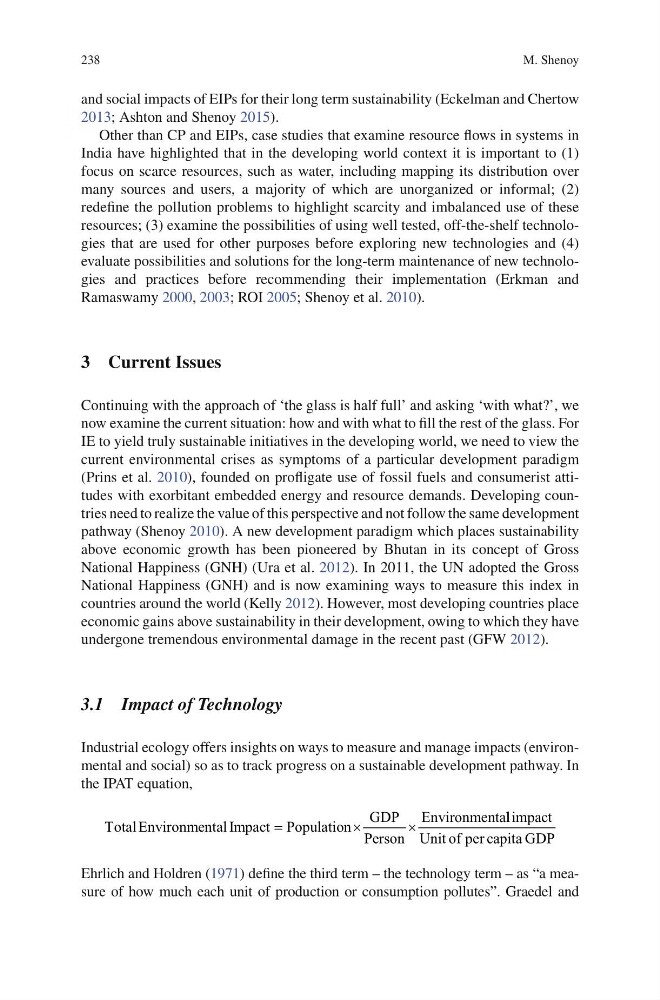
Industrial ecology offers insights on ways to measure and manage impacts (environmental and social) so as to track progress on a sustainable development pathway. In
the IPAT equation,
Total Environmental Impact Population
GDP
Person
Environmenta
l limpact
Unit of per capita GDP
Ehrlich and Holdren ( 1971 ) defi ne the third term – the technology term – as “a measure of how much each unit of production or consumption pollutes”. Graedel and
M. Shenoy
and social impacts of EIPs for their long term sustainability (Eckelman and Chertow
2013 ; Ashton and Shenoy 2015 ).
Other than CP and EIPs, case studies that examine resource fl ows in systems in
India have highlighted that in the developing world context it is important to (1)
focus on scarce resources, such as water, including mapping its distribution over
many sources and users, a majority of which are unorganized or informal; (2)
redefi ne the pollution problems to highlight scarcity and imbalanced use of these
resources; (3) examine the possibilities of using well tested, off-the-shelf technologies that are used for other purposes before exploring new technologies and (4)
evaluate possibilities and solutions for the long-term maintenance of new technologies and practices before recommending their implementation (Erkman and
Ramaswamy 2000 , 2003 ; ROI 2005 ; Shenoy et al. 2010 ).
3 Current Issues
Continuing with the approach of ‘the glass is half full’ and asking ‘with what?’, we
now examine the current situation: how and with what to fi ll the rest of the glass. For
IE to yield truly sustainable initiatives in the developing world, we need to view the
current environmental crises as symptoms of a particular development paradigm
(Prins et al. 2010 ), founded on profl igate use of fossil fuels and consumerist attitudes with exorbitant embedded energy and resource demands. Developing countries need to realize the value of this perspective and not follow the same development
pathway (Shenoy 2010 ). A new development paradigm which places sustainability
above economic growth has been pioneered by Bhutan in its concept of Gross
National Happiness (GNH) (Ura et al. 2012 ). In 2011, the UN adopted the Gross
National Happiness (GNH) and is now examining ways to measure this index in
countries around the world (Kelly 2012 ). However, most developing countries place
economic gains above sustainability in their development, owing to which they have
undergone tremendous environmental damage in the recent past (GFW 2012 ).
3.1 Impact of Technology
Industrial ecology offers insights on ways to measure and manage impacts (environmental and social) so as to track progress on a sustainable development pathway. In
the IPAT equation,
Total Environmental Impact Population
GDP
Person
Environmenta
l limpact
Unit of per capita GDP
Ehrlich and Holdren ( 1971 ) defi ne the third term – the technology term – as “a measure of how much each unit of production or consumption pollutes”. Graedel and
M. Shenoy