

129
cate the magnitude of the problem at the largest scale and underline the importance
of coupling mitigation strategies with material effi ciency strategies. The following
sections expand on a selection of strategies, again relating to aluminium stocks and
their use in society.
4.1 Reducing Resource Use in the Product
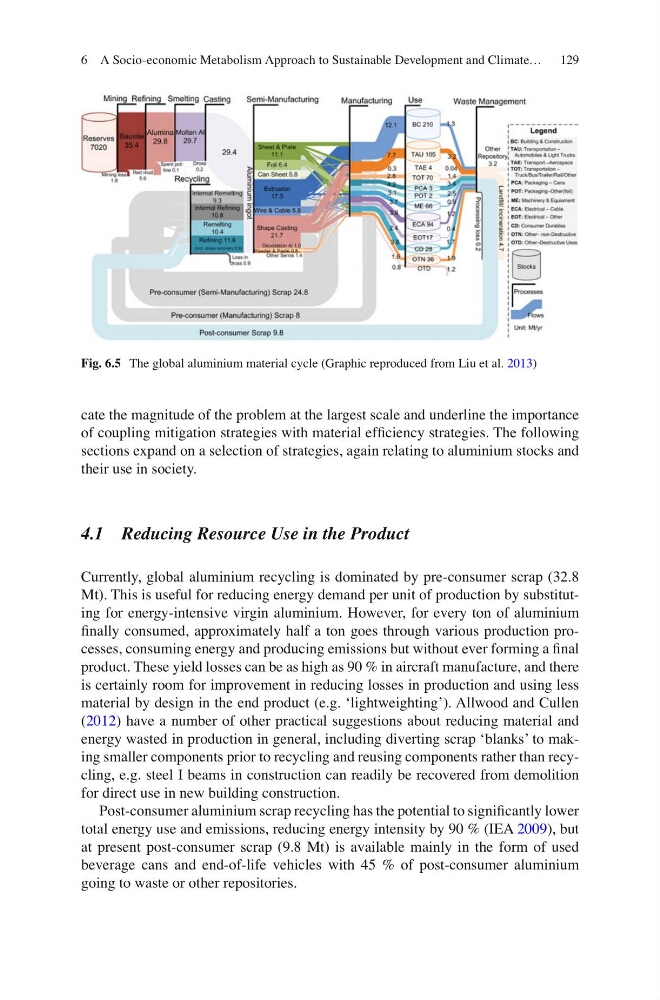
Currently, global aluminium recycling is dominated by pre-consumer scrap (32.8
Mt). This is useful for reducing energy demand per unit of production by substituting for energy-intensive virgin aluminium. However, for every ton of aluminium
fi nally consumed, approximately half a ton goes through various production processes, consuming energy and producing emissions but without ever forming a fi nal
product. These yield losses can be as high as 90 % in aircraft manufacture, and there
is certainly room for improvement in reducing losses in production and using less
material by design in the end product (e.g. ‘lightweighting’). Allwood and Cullen
( 2012 ) have a number of other practical suggestions about reducing material and
energy wasted in production in general, including diverting scrap ‘blanks’ to making smaller components prior to recycling and reusing components rather than recycling, e.g. steel I beams in construction can readily be recovered from demolition
for direct use in new building construction.
Post-consumer aluminium scrap recycling has the potential to signifi cantly lower
total energy use and emissions, reducing energy intensity by 90 % (IEA 2009 ), but
at present post-consumer scrap (9.8 Mt) is available mainly in the form of used
beverage cans and end-of-life vehicles with 45 % of post-consumer aluminium
going to waste or other repositories.
Fig. 6.5 The global aluminium material cycle (Graphic reproduced from Liu et al. 2013 )
6 A Socio-economic Metabolism Approach to Sustainable Development and Climate…
cate the magnitude of the problem at the largest scale and underline the importance
of coupling mitigation strategies with material effi ciency strategies. The following
sections expand on a selection of strategies, again relating to aluminium stocks and
their use in society.
4.1 Reducing Resource Use in the Product
Currently, global aluminium recycling is dominated by pre-consumer scrap (32.8
Mt). This is useful for reducing energy demand per unit of production by substituting for energy-intensive virgin aluminium. However, for every ton of aluminium
fi nally consumed, approximately half a ton goes through various production processes, consuming energy and producing emissions but without ever forming a fi nal
product. These yield losses can be as high as 90 % in aircraft manufacture, and there
is certainly room for improvement in reducing losses in production and using less
material by design in the end product (e.g. ‘lightweighting’). Allwood and Cullen
( 2012 ) have a number of other practical suggestions about reducing material and
energy wasted in production in general, including diverting scrap ‘blanks’ to making smaller components prior to recycling and reusing components rather than recycling, e.g. steel I beams in construction can readily be recovered from demolition
for direct use in new building construction.
Post-consumer aluminium scrap recycling has the potential to signifi cantly lower
total energy use and emissions, reducing energy intensity by 90 % (IEA 2009 ), but
at present post-consumer scrap (9.8 Mt) is available mainly in the form of used
beverage cans and end-of-life vehicles with 45 % of post-consumer aluminium
going to waste or other repositories.
Fig. 6.5 The global aluminium material cycle (Graphic reproduced from Liu et al. 2013 )
6 A Socio-economic Metabolism Approach to Sustainable Development and Climate…