

100
According to Table 5.3 , publications of industrial symbiosis papers are concentrated in a few journals, most of which also publish industrial ecology articles. Out
of a total of 124 journals publishing industrial symbiosis articles, the top six journals published fi fty percent of all the papers captured in the analysis. Figure 5.5
represents the number of industrial symbiosis papers published over time and differentiates whether these articles appeared in the top six journals or the others.
Figure 5.5 indicates, in general, that the number of industrial symbiosis papers published in journals other than the top six has increased over time: from one paper in
1996 to 36 papers in 2014. This fi nding reveals that more industrial symbiosisrelated research has emerged in a wider range of journals outside of the core, indicating that industrial symbiosis research is reaching a broader readership.
4.3 Discussion of Industrial Symbiosis Research
The evolution of industrial symbiosis research can be examined qualitatively by
looking at common themes and questions addressed in the literature. One key question relates to the scale of industrial symbiosis given that geographic proximity is a
well-recognized element that facilitates industrial symbiosis. Sterr and Ott ( 2004 ),
for example, argued that the regional scale is favorable for industrial symbiosis
because it is a scale that is broad enough to offer opportunities for economically
viable material reuse among actors and, at the same time, small enough to allow
communication and collaboration. Responding to these conceptual discussions
0
10
20
30
40
50
60
70
80
Foundations
Performance
Mechanism
Modeling
Structure
Case Study
Proposal
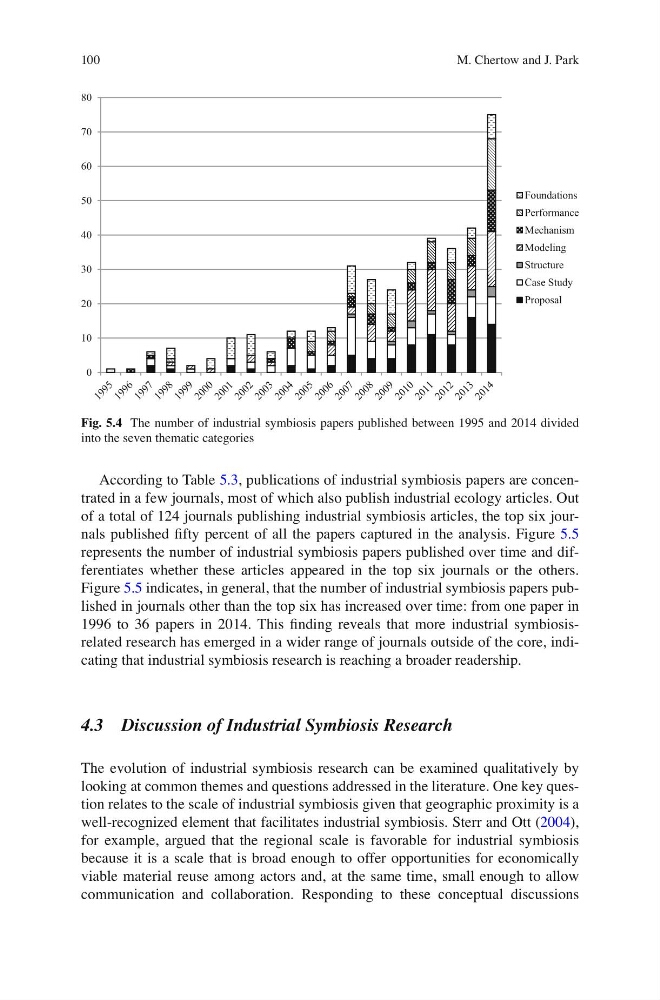
Fig. 5.4 The number of industrial symbiosis papers published between 1995 and 2014 divided
into the seven thematic categories
M. Chertow and J. Park
According to Table 5.3 , publications of industrial symbiosis papers are concentrated in a few journals, most of which also publish industrial ecology articles. Out
of a total of 124 journals publishing industrial symbiosis articles, the top six journals published fi fty percent of all the papers captured in the analysis. Figure 5.5
represents the number of industrial symbiosis papers published over time and differentiates whether these articles appeared in the top six journals or the others.
Figure 5.5 indicates, in general, that the number of industrial symbiosis papers published in journals other than the top six has increased over time: from one paper in
1996 to 36 papers in 2014. This fi nding reveals that more industrial symbiosisrelated research has emerged in a wider range of journals outside of the core, indicating that industrial symbiosis research is reaching a broader readership.
4.3 Discussion of Industrial Symbiosis Research
The evolution of industrial symbiosis research can be examined qualitatively by
looking at common themes and questions addressed in the literature. One key question relates to the scale of industrial symbiosis given that geographic proximity is a
well-recognized element that facilitates industrial symbiosis. Sterr and Ott ( 2004 ),
for example, argued that the regional scale is favorable for industrial symbiosis
because it is a scale that is broad enough to offer opportunities for economically
viable material reuse among actors and, at the same time, small enough to allow
communication and collaboration. Responding to these conceptual discussions
0
10
20
30
40
50
60
70
80
Foundations
Performance
Mechanism
Modeling
Structure
Case Study
Proposal
Fig. 5.4 The number of industrial symbiosis papers published between 1995 and 2014 divided
into the seven thematic categories
M. Chertow and J. Park