

98
articles increased sixfold over 10 years and doubled since 2010. Some of the fi ndings of the bibliometric analysis are captured here. At another level, however, it is
through practice that we see actual projects and can assess the extent of the contribution of industrial symbiosis to on-the-ground industrial ecosystems, global
resource management, and collaborative business behavior. Broadly, practitioners
include government actors, private sector actors, and NGO representatives. Of
course, there is a great deal of crossover, and ideally, scholarship can eventually be
tested in practice, and on-the-ground performance can be measured through academic analysis. Many academics serve as idea brokers and also as evaluators and
have been linked to specifi c projects such as Baas and Boons in Rotterdam, the
Netherlands; Park in Ulsan, Korea; Ashton in Puerto Rico; and Salmi on the Kola
Peninsula in Russia. Academics also bring projects to light as we have seen in
Styria, Austria, TEDA in China , and Östergötland in Sweden. Process engineers,
too, have been important bridges between theory and practice.
4.1 Section A: Industrial Symbiosis in Scholarship
Two questions drove the bibliometric analysis of articles from 1995 to 2014:
• What is the intellectual structure of this fi eld based on a review of the academic
literature?
• How have frameworks, concepts, and theories advanced in the last 20 years?
This analysis relied on Scopus and ISI Web of Knowledge searches for bibliographic acquisition. Both of these services lean to the “scientifi c” aspects of a topic
under study, in contrast to, for example, Google Scholar, which goes beyond strictly
scientifi c academic journals to include other informative publications. Thus, the
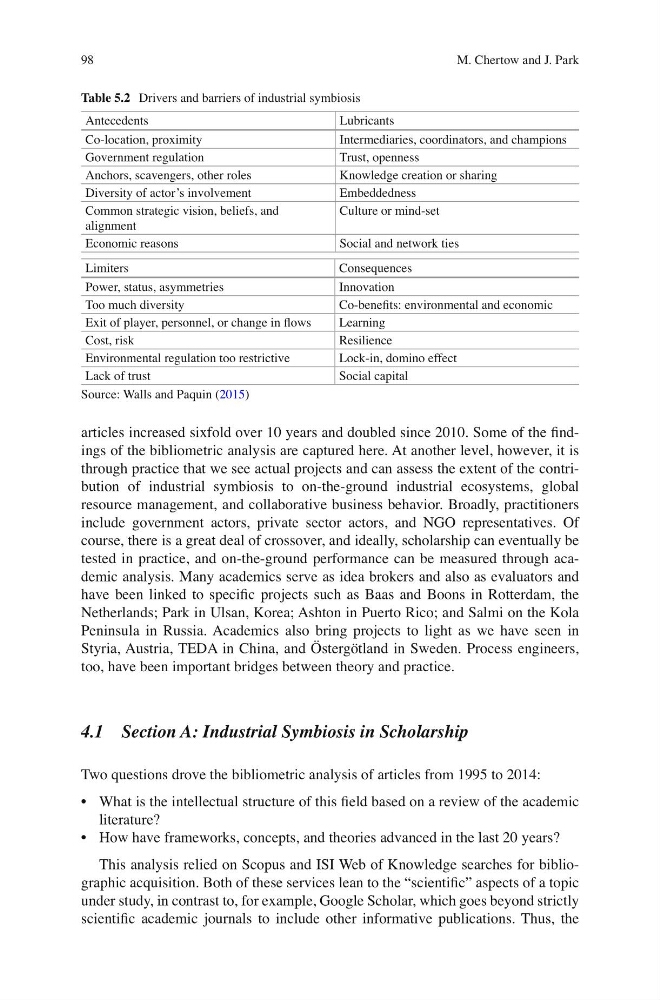
Table 5.2 Drivers and barriers of industrial symbiosis
Antecedents
Lubricants
Co-location, proximity
Intermediaries, coordinators, and champions
Government regulation
Trust, openness
Anchors, scavengers, other roles
Knowledge creation or sharing
Diversity of actor’s involvement
Embeddedness
Common strategic vision, beliefs, and
alignment
Culture or mind-set
Economic reasons
Social and network ties
Limiters
Consequences
Power, status, asymmetries
Innovation
Too much diversity
Co-benefi ts: environmental and economic
Exit of player, personnel, or change in fl ows
Learning
Cost, risk
Resilience
Environmental regulation too restrictive
Lock-in, domino effect
Lack of trust
Social capital
Source: Walls and Paquin ( 2015 )
M. Chertow and J. Park
articles increased sixfold over 10 years and doubled since 2010. Some of the fi ndings of the bibliometric analysis are captured here. At another level, however, it is
through practice that we see actual projects and can assess the extent of the contribution of industrial symbiosis to on-the-ground industrial ecosystems, global
resource management, and collaborative business behavior. Broadly, practitioners
include government actors, private sector actors, and NGO representatives. Of
course, there is a great deal of crossover, and ideally, scholarship can eventually be
tested in practice, and on-the-ground performance can be measured through academic analysis. Many academics serve as idea brokers and also as evaluators and
have been linked to specifi c projects such as Baas and Boons in Rotterdam, the
Netherlands; Park in Ulsan, Korea; Ashton in Puerto Rico; and Salmi on the Kola
Peninsula in Russia. Academics also bring projects to light as we have seen in
Styria, Austria, TEDA in China , and Östergötland in Sweden. Process engineers,
too, have been important bridges between theory and practice.
4.1 Section A: Industrial Symbiosis in Scholarship
Two questions drove the bibliometric analysis of articles from 1995 to 2014:
• What is the intellectual structure of this fi eld based on a review of the academic
literature?
• How have frameworks, concepts, and theories advanced in the last 20 years?
This analysis relied on Scopus and ISI Web of Knowledge searches for bibliographic acquisition. Both of these services lean to the “scientifi c” aspects of a topic
under study, in contrast to, for example, Google Scholar, which goes beyond strictly
scientifi c academic journals to include other informative publications. Thus, the
Table 5.2 Drivers and barriers of industrial symbiosis
Antecedents
Lubricants
Co-location, proximity
Intermediaries, coordinators, and champions
Government regulation
Trust, openness
Anchors, scavengers, other roles
Knowledge creation or sharing
Diversity of actor’s involvement
Embeddedness
Common strategic vision, beliefs, and
alignment
Culture or mind-set
Economic reasons
Social and network ties
Limiters
Consequences
Power, status, asymmetries
Innovation
Too much diversity
Co-benefi ts: environmental and economic
Exit of player, personnel, or change in fl ows
Learning
Cost, risk
Resilience
Environmental regulation too restrictive
Lock-in, domino effect
Lack of trust
Social capital
Source: Walls and Paquin ( 2015 )
M. Chertow and J. Park