

95
economy policy. The second highest number of articles is about the USA, followed
by Australia, Denmark, the UK, Finland, Japan, and South Korea, many of which
have or had national industrial symbiosis-related programs and initiatives or have
representative industrial clusters such as Kalundborg and Kwinana. The increasing
focus on developing countries can be seen at the bottom of Fig. 5.3 with each having
one peer-reviewed paper, thus entering the broader conversation. Many more papers
and conference proceedings appear in the “gray literature” found in search engines
and the offi ces of professors, consultants, and project offi cials, but this was not fully
surveyed here.
3.5 Understanding Industrial Symbiosis in a Chinese Context
Given the prominence of industrial symbiosis in China (Fig. 5.3 ), it is important to
describe its development in more depth. Professor Shi Lei of Tsinghua University
put together some background information, noting that the emergence of industrial
symbiosis and eco-industrial parks in China stems from earlier types of industrial
development following the passage of the 1978 policy on Reform and Opening Up.
In 1984, the fi rst Economic-Technological Development Areas (ETDAs) began
which, according to Pi and Wang ( 2004 ), were “designed to break the ice of the
planned economy” and subsequently began to focus on attracting foreign direct
investment. These were followed by the development of Hi-Tech Parks (HTP) in the
early 1990s. By the turn of the new century, China had shaped a large industrial
system based on more than 6,000 parks located across China. With the high concentration of industrial activities, resource and environmental problems became
increasingly serious, which ignited the rise of EIPs (Shi 2015, January 18, Personal
communication).
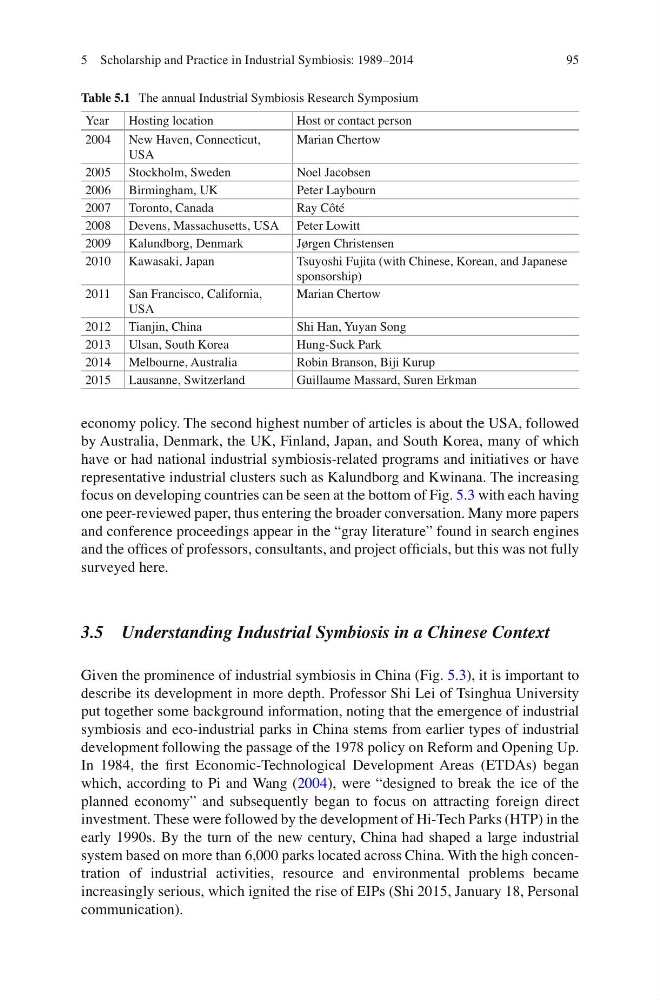
Table 5.1 The annual Industrial Symbiosis Research Symposium
Year
Hosting location
Host or contact person
2004 New Haven, Connecticut,
USA
Marian Chertow
2005 Stockholm, Sweden
Noel Jacobsen
2006 Birmingham, UK
Peter Laybourn
2007 Toronto, Canada
Ray Côté
2008 Devens, Massachusetts, USA Peter Lowitt
2009 Kalundborg, Denmark
Jørgen Christensen
2010 Kawasaki, Japan
Tsuyoshi Fujita (with Chinese, Korean, and Japanese
sponsorship)
2011 San Francisco, California,
USA
Marian Chertow
2012 Tianjin, China
Shi Han, Yuyan Song
2013 Ulsan, South Korea
Hung-Suck Park
2014 Melbourne, Australia
Robin Branson, Biji Kurup
2015 Lausanne, Switzerland
Guillaume Massard, Suren Erkman
5 Scholarship and Practice in Industrial Symbiosis: 1989–2014
economy policy. The second highest number of articles is about the USA, followed
by Australia, Denmark, the UK, Finland, Japan, and South Korea, many of which
have or had national industrial symbiosis-related programs and initiatives or have
representative industrial clusters such as Kalundborg and Kwinana. The increasing
focus on developing countries can be seen at the bottom of Fig. 5.3 with each having
one peer-reviewed paper, thus entering the broader conversation. Many more papers
and conference proceedings appear in the “gray literature” found in search engines
and the offi ces of professors, consultants, and project offi cials, but this was not fully
surveyed here.
3.5 Understanding Industrial Symbiosis in a Chinese Context
Given the prominence of industrial symbiosis in China (Fig. 5.3 ), it is important to
describe its development in more depth. Professor Shi Lei of Tsinghua University
put together some background information, noting that the emergence of industrial
symbiosis and eco-industrial parks in China stems from earlier types of industrial
development following the passage of the 1978 policy on Reform and Opening Up.
In 1984, the fi rst Economic-Technological Development Areas (ETDAs) began
which, according to Pi and Wang ( 2004 ), were “designed to break the ice of the
planned economy” and subsequently began to focus on attracting foreign direct
investment. These were followed by the development of Hi-Tech Parks (HTP) in the
early 1990s. By the turn of the new century, China had shaped a large industrial
system based on more than 6,000 parks located across China. With the high concentration of industrial activities, resource and environmental problems became
increasingly serious, which ignited the rise of EIPs (Shi 2015, January 18, Personal
communication).
Table 5.1 The annual Industrial Symbiosis Research Symposium
Year
Hosting location
Host or contact person
2004 New Haven, Connecticut,
USA
Marian Chertow
2005 Stockholm, Sweden
Noel Jacobsen
2006 Birmingham, UK
Peter Laybourn
2007 Toronto, Canada
Ray Côté
2008 Devens, Massachusetts, USA Peter Lowitt
2009 Kalundborg, Denmark
Jørgen Christensen
2010 Kawasaki, Japan
Tsuyoshi Fujita (with Chinese, Korean, and Japanese
sponsorship)
2011 San Francisco, California,
USA
Marian Chertow
2012 Tianjin, China
Shi Han, Yuyan Song
2013 Ulsan, South Korea
Hung-Suck Park
2014 Melbourne, Australia
Robin Branson, Biji Kurup
2015 Lausanne, Switzerland
Guillaume Massard, Suren Erkman
5 Scholarship and Practice in Industrial Symbiosis: 1989–2014