

54
6 Correlations in Magnetic Monopole Motion
0
1
2
3
4
5
Temperature (K)
0
0.5
1
1.5
2
2.5
b
experiment
DSIM
NNSI
free plasma
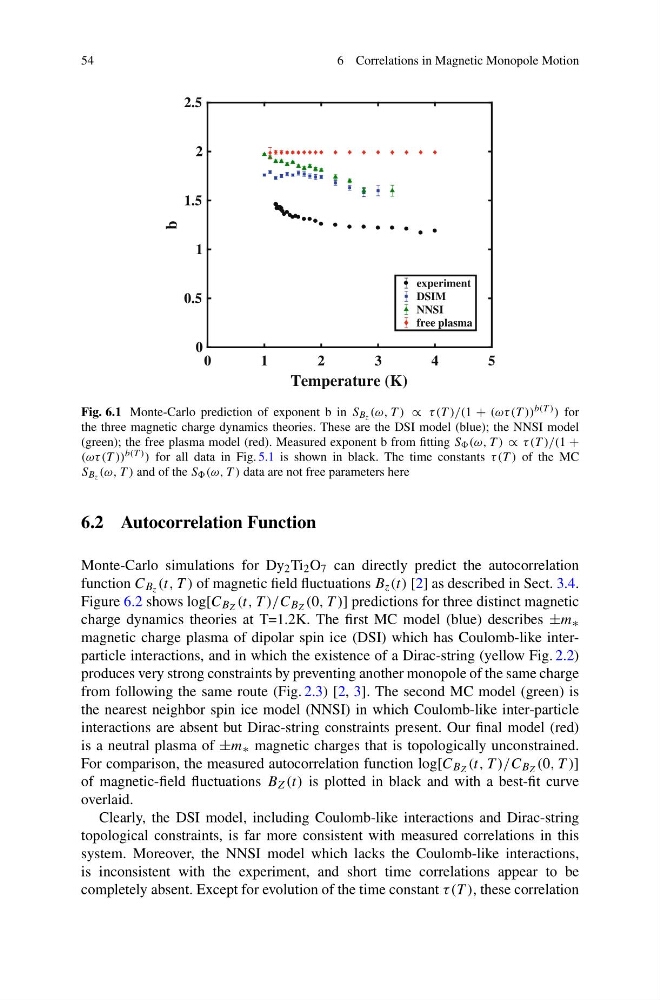
Fig. 6.1 Monte-Carlo prediction of exponent b in S Bz (ω, T ) ∝ τ (T )/(1 + (ωτ (T )) b(T ) ) for
the three magnetic charge dynamics theories. These are the DSI model (blue); the NNSI model
(green); the free plasma model (red). Measured exponent b from fitting S (ω, T ) ∝ τ (T )/(1 +
(ωτ (T )) b(T ) ) for all data in Fig. 5.1 is shown in black. The time constants τ (T ) of the MC
S Bz (ω, T ) and of the S (ω, T ) data are not free parameters here
6.2 Autocorrelation Function
Monte-Carlo simulations for Dy 2 Ti 2 O 7 can directly predict the autocorrelation
function C B z (t, T ) of magnetic field fluctuations B z (t) [2] as described in Sect. 3.4.
Figure 6.2 shows log[C B Z (t, T )/C B Z (0, T )] predictions for three distinct magnetic
charge dynamics theories at T=1.2K. The first MC model (blue) describes ±m ∗
magnetic charge plasma of dipolar spin ice (DSI) which has Coulomb-like interparticle interactions, and in which the existence of a Dirac-string (yellow Fig. 2.2)
produces very strong constraints by preventing another monopole of the same charge
from following the same route (Fig. 2.3) [2, 3]. The second MC model (green) is
the nearest neighbor spin ice model (NNSI) in which Coulomb-like inter-particle
interactions are absent but Dirac-string constraints present. Our final model (red)
is a neutral plasma of ±m ∗ magnetic charges that is topologically unconstrained.
For comparison, the measured autocorrelation function log[C B Z (t, T )/C B Z (0, T )]
of magnetic-field fluctuations B Z (t) is plotted in black and with a best-fit curve
overlaid.
Clearly, the DSI model, including Coulomb-like interactions and Dirac-string
topological constraints, is far more consistent with measured correlations in this
system. Moreover, the NNSI model which lacks the Coulomb-like interactions,
is inconsistent with the experiment, and short time correlations appear to be
completely absent. Except for evolution of the time constant τ (T ), these correlation
6 Correlations in Magnetic Monopole Motion
0
1
2
3
4
5
Temperature (K)
0
0.5
1
1.5
2
2.5
b
experiment
DSIM
NNSI
free plasma
Fig. 6.1 Monte-Carlo prediction of exponent b in S Bz (ω, T ) ∝ τ (T )/(1 + (ωτ (T )) b(T ) ) for
the three magnetic charge dynamics theories. These are the DSI model (blue); the NNSI model
(green); the free plasma model (red). Measured exponent b from fitting S (ω, T ) ∝ τ (T )/(1 +
(ωτ (T )) b(T ) ) for all data in Fig. 5.1 is shown in black. The time constants τ (T ) of the MC
S Bz (ω, T ) and of the S (ω, T ) data are not free parameters here
6.2 Autocorrelation Function
Monte-Carlo simulations for Dy 2 Ti 2 O 7 can directly predict the autocorrelation
function C B z (t, T ) of magnetic field fluctuations B z (t) [2] as described in Sect. 3.4.
Figure 6.2 shows log[C B Z (t, T )/C B Z (0, T )] predictions for three distinct magnetic
charge dynamics theories at T=1.2K. The first MC model (blue) describes ±m ∗
magnetic charge plasma of dipolar spin ice (DSI) which has Coulomb-like interparticle interactions, and in which the existence of a Dirac-string (yellow Fig. 2.2)
produces very strong constraints by preventing another monopole of the same charge
from following the same route (Fig. 2.3) [2, 3]. The second MC model (green) is
the nearest neighbor spin ice model (NNSI) in which Coulomb-like inter-particle
interactions are absent but Dirac-string constraints present. Our final model (red)
is a neutral plasma of ±m ∗ magnetic charges that is topologically unconstrained.
For comparison, the measured autocorrelation function log[C B Z (t, T )/C B Z (0, T )]
of magnetic-field fluctuations B Z (t) is plotted in black and with a best-fit curve
overlaid.
Clearly, the DSI model, including Coulomb-like interactions and Dirac-string
topological constraints, is far more consistent with measured correlations in this
system. Moreover, the NNSI model which lacks the Coulomb-like interactions,
is inconsistent with the experiment, and short time correlations appear to be
completely absent. Except for evolution of the time constant τ (T ), these correlation