

5.3 Linear Relationship Between S(0, T ) and τ (T )
47
5.3 Linear Relationship Between S(0, T ) and τ (T )
One of the most intriguing observations arising from measurements of S (ω, T )
was that that plateau height of the noise increased as T decreased (Fig. 3.10). GR
noise of magnetic monopoles directly predicts the growth of S (ω = 0, T ) with
falling temperature as a natural consequence of S (ω = 0, T ) ∝ τ (T ), and τ (T )
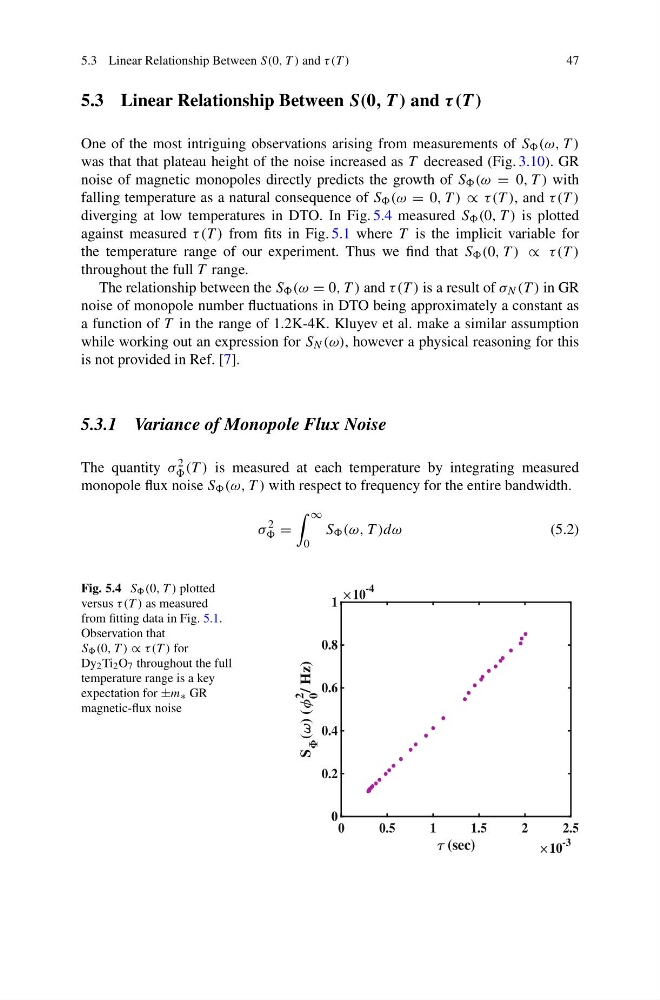
diverging at low temperatures in DTO. In Fig. 5.4 measured S (0, T ) is plotted
against measured τ (T ) from fits in Fig. 5.1 where T is the implicit variable for
the temperature range of our experiment. Thus we find that S (0, T ) ∝ τ (T )
throughout the full T range.
The relationship between the S (ω = 0, T ) and τ (T ) is a result of σ N (T ) in GR
noise of monopole number fluctuations in DTO being approximately a constant as
a function of T in the range of 1.2K-4K. Kluyev et al. make a similar assumption
while working out an expression for S N (ω), however a physical reasoning for this
is not provided in Ref. [7].
5.3.1 Variance of Monopole Flux Noise
The quantity σ 2
(T ) is measured at each temperature by integrating measured
monopole flux noise S (ω, T ) with respect to frequency for the entire bandwidth.
σ
2
=
∞
0
S (ω, T )dω
(5.2)
Fig. 5.4 S (0, T ) plotted
versus τ (T ) as measured
from fitting data in Fig. 5.1.
Observation that
S (0, T ) ∝ τ (T ) for
Dy 2 Ti 2 O 7 throughout the full
temperature range is a key
expectation for ±m ∗ GR
magnetic-flux noise
0
0.5
1
1.5
2
2.5
(sec)
10
-3
0
0.2
0.4
0.6
0.8
1
S ( ) (
0
2
/ Hz)
10
-4
47
5.3 Linear Relationship Between S(0, T ) and τ (T )
One of the most intriguing observations arising from measurements of S (ω, T )
was that that plateau height of the noise increased as T decreased (Fig. 3.10). GR
noise of magnetic monopoles directly predicts the growth of S (ω = 0, T ) with
falling temperature as a natural consequence of S (ω = 0, T ) ∝ τ (T ), and τ (T )
diverging at low temperatures in DTO. In Fig. 5.4 measured S (0, T ) is plotted
against measured τ (T ) from fits in Fig. 5.1 where T is the implicit variable for
the temperature range of our experiment. Thus we find that S (0, T ) ∝ τ (T )
throughout the full T range.
The relationship between the S (ω = 0, T ) and τ (T ) is a result of σ N (T ) in GR
noise of monopole number fluctuations in DTO being approximately a constant as
a function of T in the range of 1.2K-4K. Kluyev et al. make a similar assumption
while working out an expression for S N (ω), however a physical reasoning for this
is not provided in Ref. [7].
5.3.1 Variance of Monopole Flux Noise
The quantity σ 2
(T ) is measured at each temperature by integrating measured
monopole flux noise S (ω, T ) with respect to frequency for the entire bandwidth.
σ
2
=
∞
0
S (ω, T )dω
(5.2)
Fig. 5.4 S (0, T ) plotted
versus τ (T ) as measured
from fitting data in Fig. 5.1.
Observation that
S (0, T ) ∝ τ (T ) for
Dy 2 Ti 2 O 7 throughout the full
temperature range is a key
expectation for ±m ∗ GR
magnetic-flux noise
0
0.5
1
1.5
2
2.5
(sec)
10
-3
0
0.2
0.4
0.6
0.8
1
S ( ) (
0
2
/ Hz)
10
-4