

4.4 Comparison with MC Calculations
41
10
-3
10
-2
10
-1
10
0
(MC steps)
-1
0
0.5
1
1.5
2
2.5
S
B
z
( ) (T
2
/Hz)
10
-19
1
1.1
1.2
1.3
1.4
1.5
1.6
1.7
1.8
1.9
2
2.25
2.5
2.75
3
3.5
4
Temperature (K)
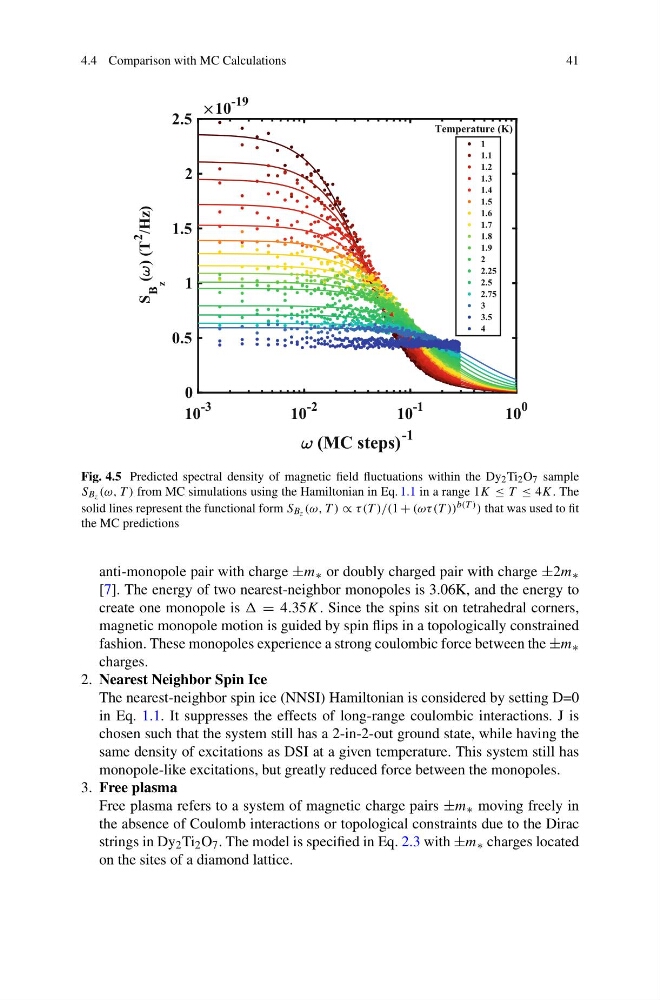
Fig. 4.5 Predicted spectral density of magnetic field fluctuations within the Dy 2 Ti 2 O 7 sample
S Bz (ω, T ) from MC simulations using the Hamiltonian in Eq. 1.1 in a range 1K ≤ T ≤ 4K. The
solid lines represent the functional form S Bz (ω, T ) ∝ τ (T )/(1 + (ωτ (T )) b(T ) ) that was used to fit
the MC predictions
anti-monopole pair with charge ±m ∗ or doubly charged pair with charge ±2m ∗
[7]. The energy of two nearest-neighbor monopoles is 3.06K, and the energy to
create one monopole is = 4.35K. Since the spins sit on tetrahedral corners,
magnetic monopole motion is guided by spin flips in a topologically constrained
fashion. These monopoles experience a strong coulombic force between the ±m ∗
charges.
2. Nearest Neighbor Spin Ice
The nearest-neighbor spin ice (NNSI) Hamiltonian is considered by setting D=0
in Eq. 1.1. It suppresses the effects of long-range coulombic interactions. J is
chosen such that the system still has a 2-in-2-out ground state, while having the
same density of excitations as DSI at a given temperature. This system still has
monopole-like excitations, but greatly reduced force between the monopoles.
3. Free plasma
Free plasma refers to a system of magnetic charge pairs ±m ∗ moving freely in
the absence of Coulomb interactions or topological constraints due to the Dirac
strings in Dy 2 Ti 2 O 7 . The model is specified in Eq. 2.3 with ±m ∗ charges located
on the sites of a diamond lattice.
41
10
-3
10
-2
10
-1
10
0
(MC steps)
-1
0
0.5
1
1.5
2
2.5
S
B
z
( ) (T
2
/Hz)
10
-19
1
1.1
1.2
1.3
1.4
1.5
1.6
1.7
1.8
1.9
2
2.25
2.5
2.75
3
3.5
4
Temperature (K)
Fig. 4.5 Predicted spectral density of magnetic field fluctuations within the Dy 2 Ti 2 O 7 sample
S Bz (ω, T ) from MC simulations using the Hamiltonian in Eq. 1.1 in a range 1K ≤ T ≤ 4K. The
solid lines represent the functional form S Bz (ω, T ) ∝ τ (T )/(1 + (ωτ (T )) b(T ) ) that was used to fit
the MC predictions
anti-monopole pair with charge ±m ∗ or doubly charged pair with charge ±2m ∗
[7]. The energy of two nearest-neighbor monopoles is 3.06K, and the energy to
create one monopole is = 4.35K. Since the spins sit on tetrahedral corners,
magnetic monopole motion is guided by spin flips in a topologically constrained
fashion. These monopoles experience a strong coulombic force between the ±m ∗
charges.
2. Nearest Neighbor Spin Ice
The nearest-neighbor spin ice (NNSI) Hamiltonian is considered by setting D=0
in Eq. 1.1. It suppresses the effects of long-range coulombic interactions. J is
chosen such that the system still has a 2-in-2-out ground state, while having the
same density of excitations as DSI at a given temperature. This system still has
monopole-like excitations, but greatly reduced force between the monopoles.
3. Free plasma
Free plasma refers to a system of magnetic charge pairs ±m ∗ moving freely in
the absence of Coulomb interactions or topological constraints due to the Dirac
strings in Dy 2 Ti 2 O 7 . The model is specified in Eq. 2.3 with ±m ∗ charges located
on the sites of a diamond lattice.