

3.4 Monte Carlo Simulations
27
time (sec)
V
Spectrum Analyzer
Dy 2 Ti 2 O 7
sample
Pickup coil
SQUID
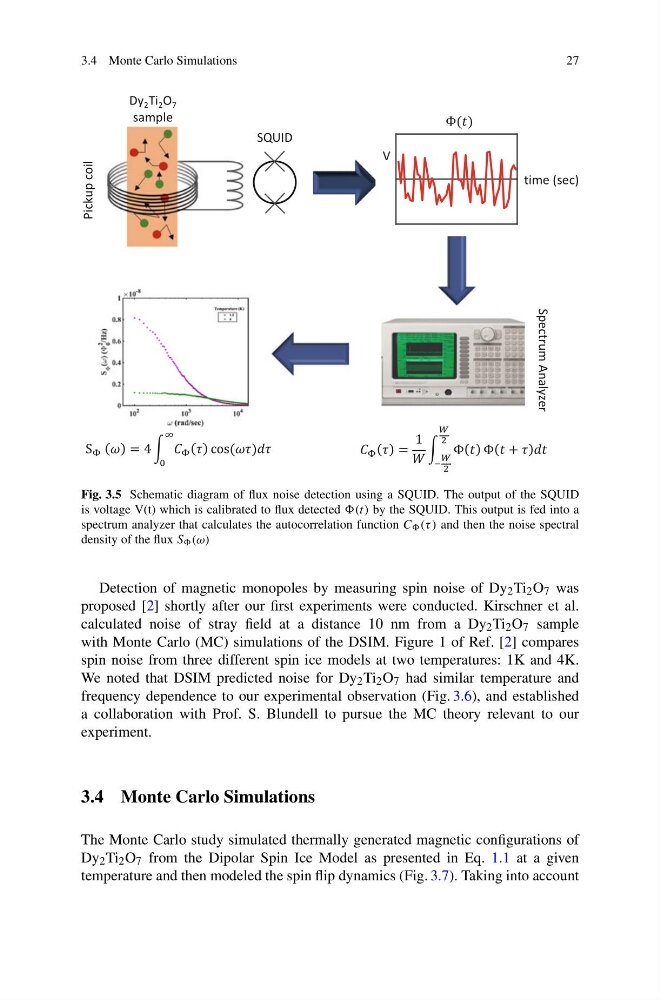
Fig. 3.5 Schematic diagram of flux noise detection using a SQUID. The output of the SQUID
is voltage V(t) which is calibrated to flux detected by the SQUID. This output is fed into a
spectrum analyzer that calculates the autocorrelation function C (τ ) and then the noise spectral
density of the flux S (ω)
Detection of magnetic monopoles by measuring spin noise of Dy 2 Ti 2 O 7 was
proposed [2] shortly after our first experiments were conducted. Kirschner et al.
calculated noise of stray field at a distance 10 nm from a Dy 2 Ti 2 O 7 sample
with Monte Carlo (MC) simulations of the DSIM. Figure 1 of Ref. [2] compares
spin noise from three different spin ice models at two temperatures: 1K and 4K.
We noted that DSIM predicted noise for Dy 2 Ti 2 O 7 had similar temperature and
frequency dependence to our experimental observation (Fig. 3.6), and established
a collaboration with Prof. S. Blundell to pursue the MC theory relevant to our
experiment.
3.4 Monte Carlo Simulations
The Monte Carlo study simulated thermally generated magnetic configurations of
Dy 2 Ti 2 O 7 from the Dipolar Spin Ice Model as presented in Eq. 1.1 at a given
temperature and then modeled the spin flip dynamics (Fig. 3.7). Taking into account
27
time (sec)
V
Spectrum Analyzer
Dy 2 Ti 2 O 7
sample
Pickup coil
SQUID
Fig. 3.5 Schematic diagram of flux noise detection using a SQUID. The output of the SQUID
is voltage V(t) which is calibrated to flux detected by the SQUID. This output is fed into a
spectrum analyzer that calculates the autocorrelation function C (τ ) and then the noise spectral
density of the flux S (ω)
Detection of magnetic monopoles by measuring spin noise of Dy 2 Ti 2 O 7 was
proposed [2] shortly after our first experiments were conducted. Kirschner et al.
calculated noise of stray field at a distance 10 nm from a Dy 2 Ti 2 O 7 sample
with Monte Carlo (MC) simulations of the DSIM. Figure 1 of Ref. [2] compares
spin noise from three different spin ice models at two temperatures: 1K and 4K.
We noted that DSIM predicted noise for Dy 2 Ti 2 O 7 had similar temperature and
frequency dependence to our experimental observation (Fig. 3.6), and established
a collaboration with Prof. S. Blundell to pursue the MC theory relevant to our
experiment.
3.4 Monte Carlo Simulations
The Monte Carlo study simulated thermally generated magnetic configurations of
Dy 2 Ti 2 O 7 from the Dipolar Spin Ice Model as presented in Eq. 1.1 at a given
temperature and then modeled the spin flip dynamics (Fig. 3.7). Taking into account