

4.3 Object Velocity Measurement Methods
75
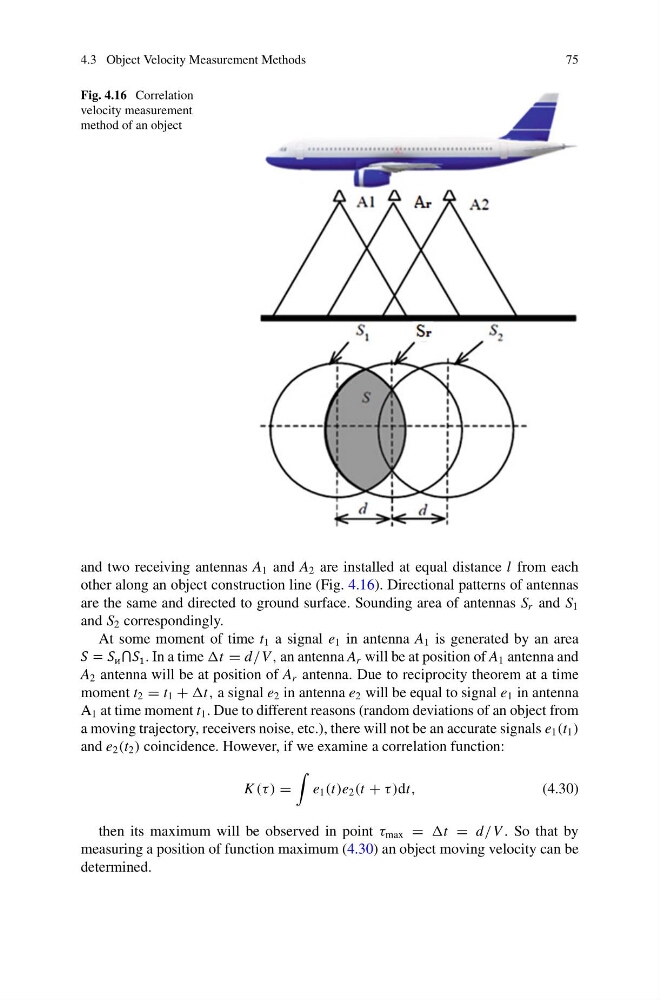
Fig. 4.16 Correlation
velocity measurement
method of an object
and two receiving antennas A 1 and A 2 are installed at equal distance l from each
other along an object construction line (Fig. 4.16). Directional patterns of antennas
are the same and directed to ground surface. Sounding area of antennas S r and S 1
and S 2 correspondingly.
At some moment of time t 1 a signal e 1 in antenna A 1 is generated by an area
. In a time = d/V, an antenna A r will be at position of A 1 antenna and
A 2 antenna will be at position of A r antenna. Due to reciprocity theorem at a time
moment t 2 = t 1 + a signal e 2 in antenna e 2 will be equal to signal e 1 in antenna
A 1 at time moment t 1 . Due to different reasons (random deviations of an object from
a moving trajectory, receivers noise, etc.), there will not be an accurate signals e 1 (t 1 )
and e 2 (t 2 ) coincidence. However, if we examine a correlation function:
K (τ ) =
e 1 (t)e 2 (t + τ )dt,
(4.30)
then its maximum will be observed in point τ max = = d/V . So that by
measuring a position of function maximum (4.30) an object moving velocity can be
determined.
75
Fig. 4.16 Correlation
velocity measurement
method of an object
and two receiving antennas A 1 and A 2 are installed at equal distance l from each
other along an object construction line (Fig. 4.16). Directional patterns of antennas
are the same and directed to ground surface. Sounding area of antennas S r and S 1
and S 2 correspondingly.
At some moment of time t 1 a signal e 1 in antenna A 1 is generated by an area
. In a time = d/V, an antenna A r will be at position of A 1 antenna and
A 2 antenna will be at position of A r antenna. Due to reciprocity theorem at a time
moment t 2 = t 1 + a signal e 2 in antenna e 2 will be equal to signal e 1 in antenna
A 1 at time moment t 1 . Due to different reasons (random deviations of an object from
a moving trajectory, receivers noise, etc.), there will not be an accurate signals e 1 (t 1 )
and e 2 (t 2 ) coincidence. However, if we examine a correlation function:
K (τ ) =
e 1 (t)e 2 (t + τ )dt,
(4.30)
then its maximum will be observed in point τ max = = d/V . So that by
measuring a position of function maximum (4.30) an object moving velocity can be
determined.