

4.2 Angular Coordinates Measurement Methods
65
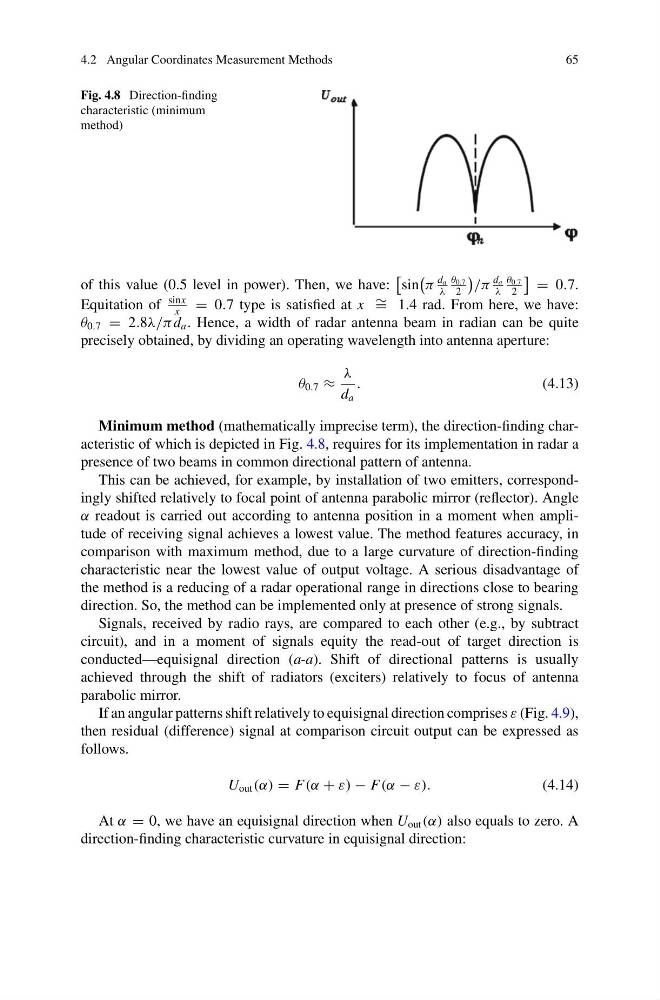
Fig. 4.8 Direction-finding
characteristic (minimum
method)
of this value (0.5 level in power). Then, we have:
sin
π
d a
λ
θ 0.7
2
/π
d a
λ
θ 0.7
2
= 0.7.
Equitation of
sinx
x
= 0.7 type is satisfied at x ∼ = 1.4 rad. From here, we have:
θ 0.7 = 2.8λ/πd a . Hence, a width of radar antenna beam in radian can be quite
precisely obtained, by dividing an operating wavelength into antenna aperture:
θ 0.7 ≈
λ
d a
.
(4.13)
Minimum method (mathematically imprecise term), the direction-finding characteristic of which is depicted in Fig. 4.8, requires for its implementation in radar a
presence of two beams in common directional pattern of antenna.
This can be achieved, for example, by installation of two emitters, correspondingly shifted relatively to focal point of antenna parabolic mirror (reflector). Angle
α readout is carried out according to antenna position in a moment when amplitude of receiving signal achieves a lowest value. The method features accuracy, in
comparison with maximum method, due to a large curvature of direction-finding
characteristic near the lowest value of output voltage. A serious disadvantage of
the method is a reducing of a radar operational range in directions close to bearing
direction. So, the method can be implemented only at presence of strong signals.
Signals, received by radio rays, are compared to each other (e.g., by subtract
circuit), and in a moment of signals equity the read-out of target direction is
conducted—equisignal direction (a-a). Shift of directional patterns is usually
achieved through the shift of radiators (exciters) relatively to focus of antenna
parabolic mirror.
If an angular patterns shift relatively to equisignal direction comprises ε (Fig. 4.9),
then residual (difference) signal at comparison circuit output can be expressed as
follows.
U out (α) = F(α + ε) − F(α − ε).
(4.14)
At α = 0, we have an equisignal direction when U out (α) also equals to zero. A
direction-finding characteristic curvature in equisignal direction:
65
Fig. 4.8 Direction-finding
characteristic (minimum
method)
of this value (0.5 level in power). Then, we have:
sin
π
d a
λ
θ 0.7
2
/π
d a
λ
θ 0.7
2
= 0.7.
Equitation of
sinx
x
= 0.7 type is satisfied at x ∼ = 1.4 rad. From here, we have:
θ 0.7 = 2.8λ/πd a . Hence, a width of radar antenna beam in radian can be quite
precisely obtained, by dividing an operating wavelength into antenna aperture:
θ 0.7 ≈
λ
d a
.
(4.13)
Minimum method (mathematically imprecise term), the direction-finding characteristic of which is depicted in Fig. 4.8, requires for its implementation in radar a
presence of two beams in common directional pattern of antenna.
This can be achieved, for example, by installation of two emitters, correspondingly shifted relatively to focal point of antenna parabolic mirror (reflector). Angle
α readout is carried out according to antenna position in a moment when amplitude of receiving signal achieves a lowest value. The method features accuracy, in
comparison with maximum method, due to a large curvature of direction-finding
characteristic near the lowest value of output voltage. A serious disadvantage of
the method is a reducing of a radar operational range in directions close to bearing
direction. So, the method can be implemented only at presence of strong signals.
Signals, received by radio rays, are compared to each other (e.g., by subtract
circuit), and in a moment of signals equity the read-out of target direction is
conducted—equisignal direction (a-a). Shift of directional patterns is usually
achieved through the shift of radiators (exciters) relatively to focus of antenna
parabolic mirror.
If an angular patterns shift relatively to equisignal direction comprises ε (Fig. 4.9),
then residual (difference) signal at comparison circuit output can be expressed as
follows.
U out (α) = F(α + ε) − F(α − ε).
(4.14)
At α = 0, we have an equisignal direction when U out (α) also equals to zero. A
direction-finding characteristic curvature in equisignal direction: