

3.5 Complex Targets. Calculation Technique of Scattering …
43
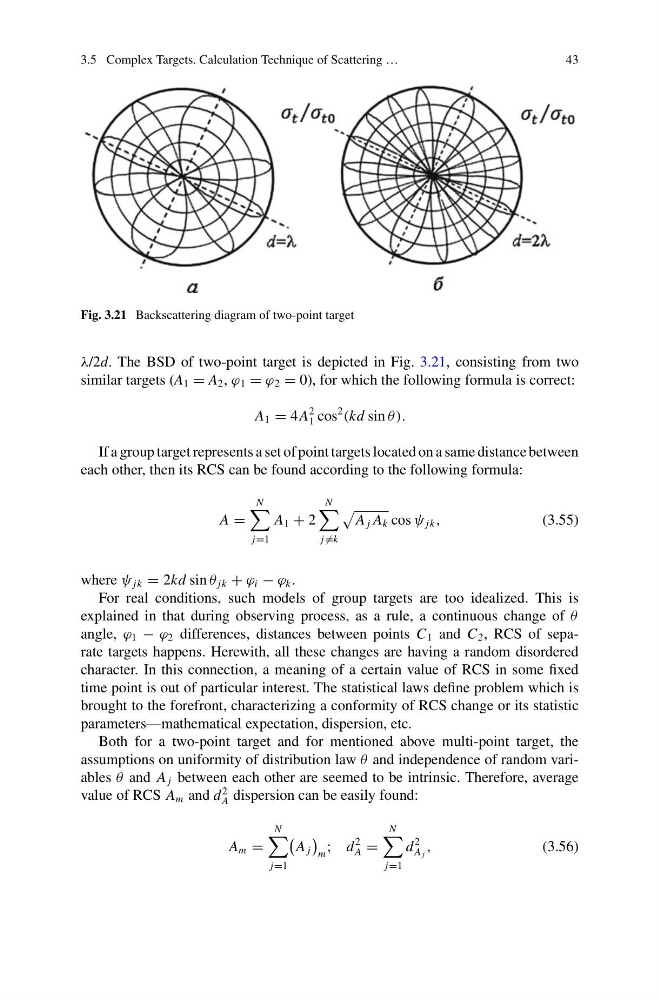
Fig. 3.21 Backscattering diagram of two-point target
λ/2d. The BSD of two-point target is depicted in Fig. 3.21, consisting from two
similar targets (A 1 = A 2 , ϕ 1 = ϕ 2 = 0), for which the following formula is correct:
A 1 = 4 A
2
1 cos
2
(kd sin θ ).
If a group target represents a set of point targets located on a same distance between
each other, then its RCS can be found according to the following formula:
A =
N
j=1
A 1 + 2
N
j =k
A j A k cos ψ jk ,
(3.55)
where ψ jk = 2kd sin θ jk + ϕ i − ϕ k .
For real conditions, such models of group targets are too idealized. This is
explained in that during observing process, as a rule, a continuous change of θ
angle, ϕ 1 − ϕ 2 differences, distances between points C 1 and C 2 , RCS of separate targets happens. Herewith, all these changes are having a random disordered
character. In this connection, a meaning of a certain value of RCS in some fixed
time point is out of particular interest. The statistical laws define problem which is
brought to the forefront, characterizing a conformity of RCS change or its statistic
parameters—mathematical expectation, dispersion, etc.
Both for a two-point target and for mentioned above multi-point target, the
assumptions on uniformity of distribution law θ and independence of random variables θ and A j between each other are seemed to be intrinsic. Therefore, average
value of RCS A m and d
2
A dispersion can be easily found:
A m =
N
j=1
A j
m
; d
2
A =
N
j=1
d
2
A j
,
(3.56)
43
Fig. 3.21 Backscattering diagram of two-point target
λ/2d. The BSD of two-point target is depicted in Fig. 3.21, consisting from two
similar targets (A 1 = A 2 , ϕ 1 = ϕ 2 = 0), for which the following formula is correct:
A 1 = 4 A
2
1 cos
2
(kd sin θ ).
If a group target represents a set of point targets located on a same distance between
each other, then its RCS can be found according to the following formula:
A =
N
j=1
A 1 + 2
N
j =k
A j A k cos ψ jk ,
(3.55)
where ψ jk = 2kd sin θ jk + ϕ i − ϕ k .
For real conditions, such models of group targets are too idealized. This is
explained in that during observing process, as a rule, a continuous change of θ
angle, ϕ 1 − ϕ 2 differences, distances between points C 1 and C 2 , RCS of separate targets happens. Herewith, all these changes are having a random disordered
character. In this connection, a meaning of a certain value of RCS in some fixed
time point is out of particular interest. The statistical laws define problem which is
brought to the forefront, characterizing a conformity of RCS change or its statistic
parameters—mathematical expectation, dispersion, etc.
Both for a two-point target and for mentioned above multi-point target, the
assumptions on uniformity of distribution law θ and independence of random variables θ and A j between each other are seemed to be intrinsic. Therefore, average
value of RCS A m and d
2
A dispersion can be easily found:
A m =
N
j=1
A j
m
; d
2
A =
N
j=1
d
2
A j
,
(3.56)