

42
3 Radar Targets and Its Reflecting Properties
3.5 Complex Targets. Calculation Technique of Scattering
Cross Section of Complex Bodies
The previous point stated that the main contribution into scattered by a target field is
given by some glitter points. However, even for the simplest real radar targets, there
are a lot of such points on its surface. This leads to abrupt change as opposed to the
case with one such point of electromagnetic wave scattering character and naturally
to significant calculation complication of reflecting characteristics.
For a group target, let us regard a target which should be modeled by not less
than two dependent or independent between each other point scatterers.
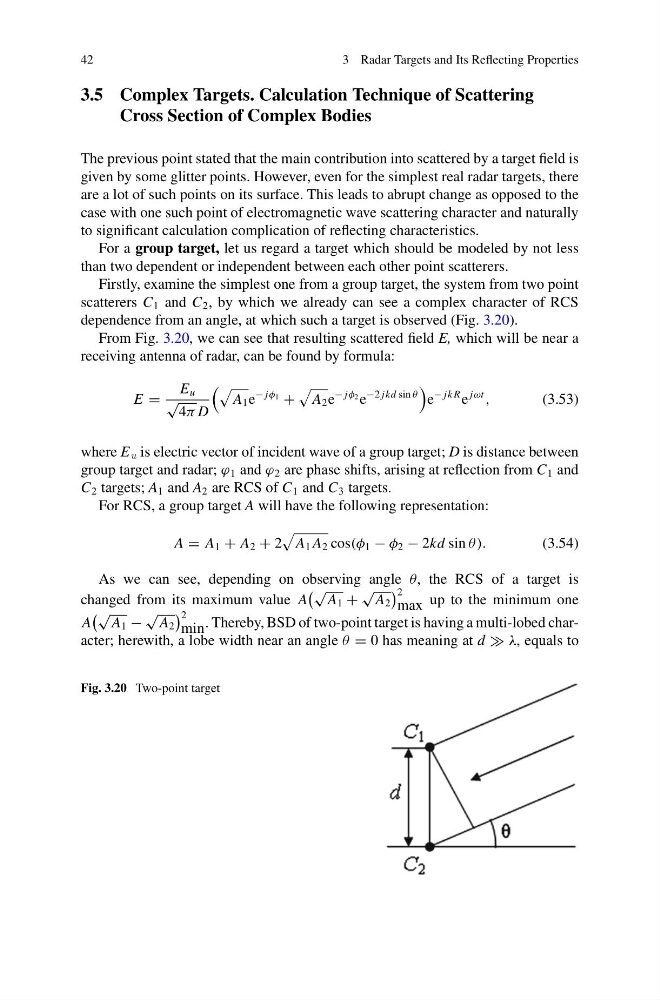
Firstly, examine the simplest one from a group target, the system from two point
scatterers C 1 and C 2 , by which we already can see a complex character of RCS
dependence from an angle, at which such a target is observed (Fig. 3.20).
From Fig. 3.20, we can see that resulting scattered field E, which will be near a
receiving antenna of radar, can be found by formula:
E =
E u
√
4π D
A 1 e
− jφ 1 +
A 2 e
− jφ 2 e
−2 jkd sin θ
e
− jk R e
jωt
,
(3.53)
where E i is electric vector of incident wave of a group target; D is distance between
group target and radar; ϕ 1 and ϕ 2 are phase shifts, arising at reflection from C 1 and
C 2 targets; A 1 and A 2 are RCS of C 1 and C 3 targets.
For RCS, a group target A will have the following representation:
A = A 1 + A 2 + 2
A 1 A 2 cos(φ 1 − φ 2 − 2kd sin θ).
(3.54)
As we can see, depending on observing angle θ, the RCS of a target is
changed from its maximum value A
√
A 1 +
√
A 2
2
max up to the minimum one
A
√
A 1 −
√
A 2
2
min . Thereby, BSD of two-point target is having a multi-lobed character; herewith, a lobe width near an angle θ = 0 has meaning at d λ, equals to
Fig. 3.20 Two-point target
3 Radar Targets and Its Reflecting Properties
3.5 Complex Targets. Calculation Technique of Scattering
Cross Section of Complex Bodies
The previous point stated that the main contribution into scattered by a target field is
given by some glitter points. However, even for the simplest real radar targets, there
are a lot of such points on its surface. This leads to abrupt change as opposed to the
case with one such point of electromagnetic wave scattering character and naturally
to significant calculation complication of reflecting characteristics.
For a group target, let us regard a target which should be modeled by not less
than two dependent or independent between each other point scatterers.
Firstly, examine the simplest one from a group target, the system from two point
scatterers C 1 and C 2 , by which we already can see a complex character of RCS
dependence from an angle, at which such a target is observed (Fig. 3.20).
From Fig. 3.20, we can see that resulting scattered field E, which will be near a
receiving antenna of radar, can be found by formula:
E =
E u
√
4π D
A 1 e
− jφ 1 +
A 2 e
− jφ 2 e
−2 jkd sin θ
e
− jk R e
jωt
,
(3.53)
where E i is electric vector of incident wave of a group target; D is distance between
group target and radar; ϕ 1 and ϕ 2 are phase shifts, arising at reflection from C 1 and
C 2 targets; A 1 and A 2 are RCS of C 1 and C 3 targets.
For RCS, a group target A will have the following representation:
A = A 1 + A 2 + 2
A 1 A 2 cos(φ 1 − φ 2 − 2kd sin θ).
(3.54)
As we can see, depending on observing angle θ, the RCS of a target is
changed from its maximum value A
√
A 1 +
√
A 2
2
max up to the minimum one
A
√
A 1 −
√
A 2
2
min . Thereby, BSD of two-point target is having a multi-lobed character; herewith, a lobe width near an angle θ = 0 has meaning at d λ, equals to
Fig. 3.20 Two-point target