

26
3 Radar Targets and Its Reflecting Properties
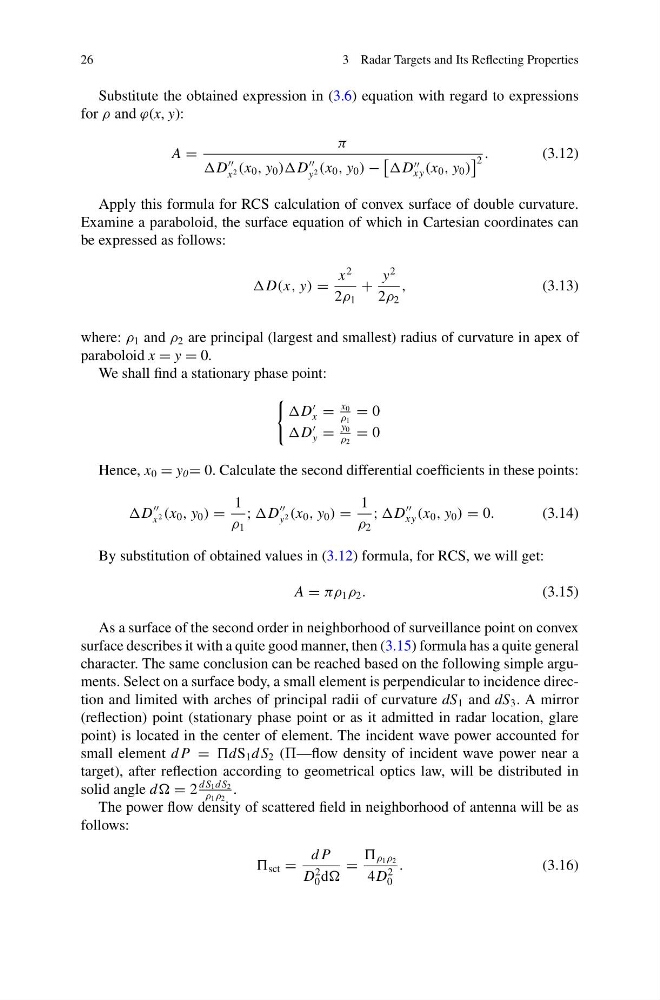
Substitute the obtained expression in (3.6) equation with regard to expressions
for ρ and ϕ(x, y):
A =
π
D
x 2 (x 0 , y 0 )D
y 2 (x 0 , y 0 ) −
D
xy (x 0 , y 0 )
2 .
(3.12)
Apply this formula for RCS calculation of convex surface of double curvature.
Examine a paraboloid, the surface equation of which in Cartesian coordinates can
be expressed as follows:
D(x, y) =
x
2
2ρ 1
+
y
2
2ρ 2
,
(3.13)
where: ρ 1 and ρ 2 are principal (largest and smallest) radius of curvature in apex of
paraboloid x = y = 0.
We shall find a stationary phase point:
D
x =
x 0
ρ 1
= 0
D
y =
y 0
ρ 2
= 0
Hence, x 0 = y 0 = 0. Calculate the second differential coefficients in these points:
D
x 2 (x 0 , y 0 ) =
1
ρ 1
; D
y 2 (x 0 , y 0 ) =
1
ρ 2
; D
xy (x 0 , y 0 ) = 0.
(3.14)
By substitution of obtained values in (3.12) formula, for RCS, we will get:
A = πρ 1 ρ 2 .
(3.15)
As a surface of the second order in neighborhood of surveillance point on convex
surface describes it with a quite good manner, then (3.15) formula has a quite general
character. The same conclusion can be reached based on the following simple arguments. Select on a surface body, a small element is perpendicular to incidence direction and limited with arches of principal radii of curvature dS 1 and dS 3 . A mirror
(reflection) point (stationary phase point or as it admitted in radar location, glare
point) is located in the center of element. The incident wave power accounted for
small element d P = dS 1 d S 2 (P—flow density of incident wave power near a
target), after reflection according to geometrical optics law, will be distributed in
solid angle d = 2
d S 1 d S 2
ρ 1 ρ 2
.
The power flow density of scattered field in neighborhood of antenna will be as
follows:
sct =
d P
D
2
0 d
=
ρ 1 ρ 2
4D
2
0
.
(3.16)
3 Radar Targets and Its Reflecting Properties
Substitute the obtained expression in (3.6) equation with regard to expressions
for ρ and ϕ(x, y):
A =
π
D
x 2 (x 0 , y 0 )D
y 2 (x 0 , y 0 ) −
D
xy (x 0 , y 0 )
2 .
(3.12)
Apply this formula for RCS calculation of convex surface of double curvature.
Examine a paraboloid, the surface equation of which in Cartesian coordinates can
be expressed as follows:
D(x, y) =
x
2
2ρ 1
+
y
2
2ρ 2
,
(3.13)
where: ρ 1 and ρ 2 are principal (largest and smallest) radius of curvature in apex of
paraboloid x = y = 0.
We shall find a stationary phase point:
D
x =
x 0
ρ 1
= 0
D
y =
y 0
ρ 2
= 0
Hence, x 0 = y 0 = 0. Calculate the second differential coefficients in these points:
D
x 2 (x 0 , y 0 ) =
1
ρ 1
; D
y 2 (x 0 , y 0 ) =
1
ρ 2
; D
xy (x 0 , y 0 ) = 0.
(3.14)
By substitution of obtained values in (3.12) formula, for RCS, we will get:
A = πρ 1 ρ 2 .
(3.15)
As a surface of the second order in neighborhood of surveillance point on convex
surface describes it with a quite good manner, then (3.15) formula has a quite general
character. The same conclusion can be reached based on the following simple arguments. Select on a surface body, a small element is perpendicular to incidence direction and limited with arches of principal radii of curvature dS 1 and dS 3 . A mirror
(reflection) point (stationary phase point or as it admitted in radar location, glare
point) is located in the center of element. The incident wave power accounted for
small element d P = dS 1 d S 2 (P—flow density of incident wave power near a
target), after reflection according to geometrical optics law, will be distributed in
solid angle d = 2
d S 1 d S 2
ρ 1 ρ 2
.
The power flow density of scattered field in neighborhood of antenna will be as
follows:
sct =
d P
D
2
0 d
=
ρ 1 ρ 2
4D
2
0
.
(3.16)