

3.2 Radar Cross Section of Radar Targets
25
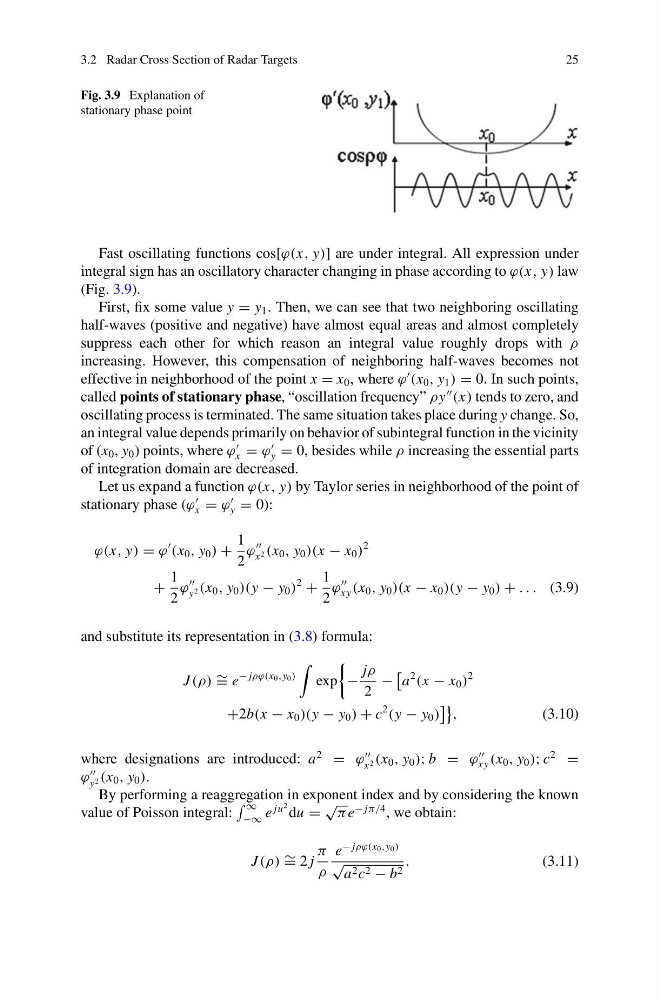
Fig. 3.9 Explanation of
stationary phase point
Fast oscillating functions cos[ϕ(x, y)] are under integral. All expression under
integral sign has an oscillatory character changing in phase according to ϕ(x, y) law
(Fig. 3.9).
First, fix some value y = y 1 . Then, we can see that two neighboring oscillating
half-waves (positive and negative) have almost equal areas and almost completely
suppress each other for which reason an integral value roughly drops with ρ
increasing. However, this compensation of neighboring half-waves becomes not
effective in neighborhood of the point x = x 0 , where ϕ
(x 0 , y 1 ) = 0. In such points,
called points of stationary phase, “oscillation frequency” ρy
(x) tends to zero, and
oscillating process is terminated. The same situation takes place during y change. So,
an integral value depends primarily on behavior of subintegral function in the vicinity
of (x 0 , y 0 ) points, where ϕ
x = ϕ
y = 0, besides while ρ increasing the essential parts
of integration domain are decreased.
Let us expand a function ϕ(x, y) by Taylor series in neighborhood of the point of
stationary phase (ϕ
x = ϕ
y = 0):
ϕ(x, y) = ϕ
(x 0 , y 0 ) +
1
2
ϕ
x 2 (x 0 , y 0 )(x − x 0 )
2
+
1
2
ϕ
y 2 (x 0 , y 0 )(y − y 0 )
2
+
1
2
ϕ
xy (x 0 , y 0 )(x − x 0 )(y − y 0 ) + . . . (3.9)
and substitute its representation in (3.8) formula:
J (ρ) ∼ = e
− jρϕ(x 0 ,y 0 )
exp
−
jρ
2
−
a
2
(x − x 0 )
2
+2b(x − x 0 )(y − y 0 ) + c
2
(y − y 0 )
,
(3.10)
where designations are introduced: a
2
= ϕ
x 2 (x 0 , y 0 ); b = ϕ
xy (x 0 , y 0 ); c
2
=
ϕ
y 2 (x 0 , y 0 ).
By performing a reaggregation in exponent index and by considering the known
value of Poisson integral:
∞
−∞ e
ju
2 du =
√
π e
− jπ/4 , we obtain:
J (ρ) ∼ = 2 j
π
ρ
e
− jρϕ(x 0 ,y 0 )
√
a 2 c 2 − b 2
.
(3.11)
25
Fig. 3.9 Explanation of
stationary phase point
Fast oscillating functions cos[ϕ(x, y)] are under integral. All expression under
integral sign has an oscillatory character changing in phase according to ϕ(x, y) law
(Fig. 3.9).
First, fix some value y = y 1 . Then, we can see that two neighboring oscillating
half-waves (positive and negative) have almost equal areas and almost completely
suppress each other for which reason an integral value roughly drops with ρ
increasing. However, this compensation of neighboring half-waves becomes not
effective in neighborhood of the point x = x 0 , where ϕ
(x 0 , y 1 ) = 0. In such points,
called points of stationary phase, “oscillation frequency” ρy
(x) tends to zero, and
oscillating process is terminated. The same situation takes place during y change. So,
an integral value depends primarily on behavior of subintegral function in the vicinity
of (x 0 , y 0 ) points, where ϕ
x = ϕ
y = 0, besides while ρ increasing the essential parts
of integration domain are decreased.
Let us expand a function ϕ(x, y) by Taylor series in neighborhood of the point of
stationary phase (ϕ
x = ϕ
y = 0):
ϕ(x, y) = ϕ
(x 0 , y 0 ) +
1
2
ϕ
x 2 (x 0 , y 0 )(x − x 0 )
2
+
1
2
ϕ
y 2 (x 0 , y 0 )(y − y 0 )
2
+
1
2
ϕ
xy (x 0 , y 0 )(x − x 0 )(y − y 0 ) + . . . (3.9)
and substitute its representation in (3.8) formula:
J (ρ) ∼ = e
− jρϕ(x 0 ,y 0 )
exp
−
jρ
2
−
a
2
(x − x 0 )
2
+2b(x − x 0 )(y − y 0 ) + c
2
(y − y 0 )
,
(3.10)
where designations are introduced: a
2
= ϕ
x 2 (x 0 , y 0 ); b = ϕ
xy (x 0 , y 0 ); c
2
=
ϕ
y 2 (x 0 , y 0 ).
By performing a reaggregation in exponent index and by considering the known
value of Poisson integral:
∞
−∞ e
ju
2 du =
√
π e
− jπ/4 , we obtain:
J (ρ) ∼ = 2 j
π
ρ
e
− jρϕ(x 0 ,y 0 )
√
a 2 c 2 − b 2
.
(3.11)