

20
3 Radar Targets and Its Reflecting Properties
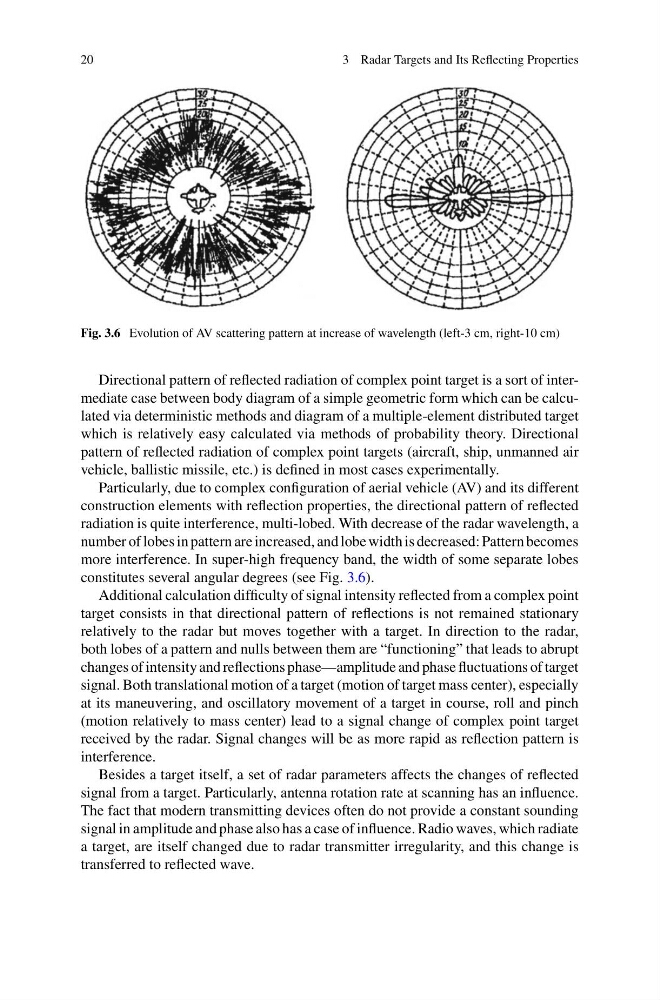
Fig. 3.6 Evolution of AV scattering pattern at increase of wavelength (left-3 cm, right-10 cm)
Directional pattern of reflected radiation of complex point target is a sort of intermediate case between body diagram of a simple geometric form which can be calculated via deterministic methods and diagram of a multiple-element distributed target
which is relatively easy calculated via methods of probability theory. Directional
pattern of reflected radiation of complex point targets (aircraft, ship, unmanned air
vehicle, ballistic missile, etc.) is defined in most cases experimentally.
Particularly, due to complex configuration of aerial vehicle (AV) and its different
construction elements with reflection properties, the directional pattern of reflected
radiation is quite interference, multi-lobed. With decrease of the radar wavelength, a
number of lobes in pattern are increased, and lobe width is decreased: Pattern becomes
more interference. In super-high frequency band, the width of some separate lobes
constitutes several angular degrees (see Fig. 3.6).
Additional calculation difficulty of signal intensity reflected from a complex point
target consists in that directional pattern of reflections is not remained stationary
relatively to the radar but moves together with a target. In direction to the radar,
both lobes of a pattern and nulls between them are “functioning” that leads to abrupt
changes of intensity and reflections phase—amplitude and phase fluctuations of target
signal. Both translational motion of a target (motion of target mass center), especially
at its maneuvering, and oscillatory movement of a target in course, roll and pinch
(motion relatively to mass center) lead to a signal change of complex point target
received by the radar. Signal changes will be as more rapid as reflection pattern is
interference.
Besides a target itself, a set of radar parameters affects the changes of reflected
signal from a target. Particularly, antenna rotation rate at scanning has an influence.
The fact that modern transmitting devices often do not provide a constant sounding
signal in amplitude and phase also has a case of influence. Radio waves, which radiate
a target, are itself changed due to radar transmitter irregularity, and this change is
transferred to reflected wave.
3 Radar Targets and Its Reflecting Properties
Fig. 3.6 Evolution of AV scattering pattern at increase of wavelength (left-3 cm, right-10 cm)
Directional pattern of reflected radiation of complex point target is a sort of intermediate case between body diagram of a simple geometric form which can be calculated via deterministic methods and diagram of a multiple-element distributed target
which is relatively easy calculated via methods of probability theory. Directional
pattern of reflected radiation of complex point targets (aircraft, ship, unmanned air
vehicle, ballistic missile, etc.) is defined in most cases experimentally.
Particularly, due to complex configuration of aerial vehicle (AV) and its different
construction elements with reflection properties, the directional pattern of reflected
radiation is quite interference, multi-lobed. With decrease of the radar wavelength, a
number of lobes in pattern are increased, and lobe width is decreased: Pattern becomes
more interference. In super-high frequency band, the width of some separate lobes
constitutes several angular degrees (see Fig. 3.6).
Additional calculation difficulty of signal intensity reflected from a complex point
target consists in that directional pattern of reflections is not remained stationary
relatively to the radar but moves together with a target. In direction to the radar,
both lobes of a pattern and nulls between them are “functioning” that leads to abrupt
changes of intensity and reflections phase—amplitude and phase fluctuations of target
signal. Both translational motion of a target (motion of target mass center), especially
at its maneuvering, and oscillatory movement of a target in course, roll and pinch
(motion relatively to mass center) lead to a signal change of complex point target
received by the radar. Signal changes will be as more rapid as reflection pattern is
interference.
Besides a target itself, a set of radar parameters affects the changes of reflected
signal from a target. Particularly, antenna rotation rate at scanning has an influence.
The fact that modern transmitting devices often do not provide a constant sounding
signal in amplitude and phase also has a case of influence. Radio waves, which radiate
a target, are itself changed due to radar transmitter irregularity, and this change is
transferred to reflected wave.