

3.1 Types of Radar Targets
19
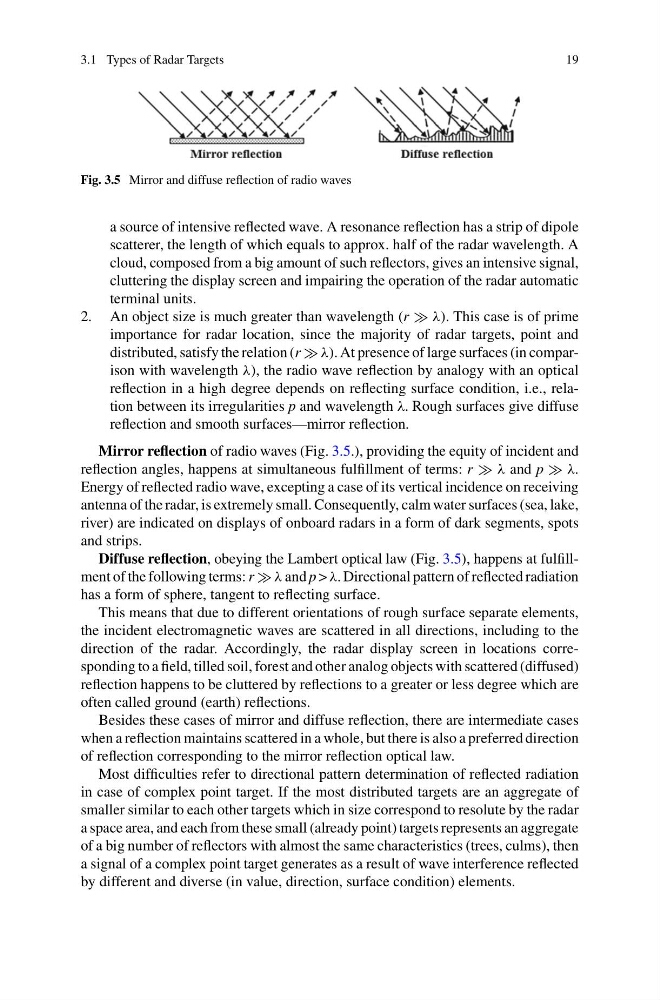
Fig. 3.5 Mirror and diffuse reflection of radio waves
a source of intensive reflected wave. A resonance reflection has a strip of dipole
scatterer, the length of which equals to approx. half of the radar wavelength. A
cloud, composed from a big amount of such reflectors, gives an intensive signal,
cluttering the display screen and impairing the operation of the radar automatic
terminal units.
2. An object size is much greater than wavelength (r λ). This case is of prime
importance for radar location, since the majority of radar targets, point and
distributed, satisfy the relation (r λ). At presence of large surfaces (in comparison with wavelength λ), the radio wave reflection by analogy with an optical
reflection in a high degree depends on reflecting surface condition, i.e., relation between its irregularities p and wavelength λ. Rough surfaces give diffuse
reflection and smooth surfaces—mirror reflection.
Mirror reflection of radio waves (Fig. 3.5.), providing the equity of incident and
reflection angles, happens at simultaneous fulfillment of terms: r λ and p λ.
Energy of reflected radio wave, excepting a case of its vertical incidence on receiving
antenna of the radar, is extremely small. Consequently, calm water surfaces (sea, lake,
river) are indicated on displays of onboard radars in a form of dark segments, spots
and strips.
Diffuse reflection, obeying the Lambert optical law (Fig. 3.5), happens at fulfillment of the following terms: r λ and p > λ. Directional pattern of reflected radiation
has a form of sphere, tangent to reflecting surface.
This means that due to different orientations of rough surface separate elements,
the incident electromagnetic waves are scattered in all directions, including to the
direction of the radar. Accordingly, the radar display screen in locations corresponding to a field, tilled soil, forest and other analog objects with scattered (diffused)
reflection happens to be cluttered by reflections to a greater or less degree which are
often called ground (earth) reflections.
Besides these cases of mirror and diffuse reflection, there are intermediate cases
when a reflection maintains scattered in a whole, but there is also a preferred direction
of reflection corresponding to the mirror reflection optical law.
Most difficulties refer to directional pattern determination of reflected radiation
in case of complex point target. If the most distributed targets are an aggregate of
smaller similar to each other targets which in size correspond to resolute by the radar
a space area, and each from these small (already point) targets represents an aggregate
of a big number of reflectors with almost the same characteristics (trees, culms), then
a signal of a complex point target generates as a result of wave interference reflected
by different and diverse (in value, direction, surface condition) elements.
19
Fig. 3.5 Mirror and diffuse reflection of radio waves
a source of intensive reflected wave. A resonance reflection has a strip of dipole
scatterer, the length of which equals to approx. half of the radar wavelength. A
cloud, composed from a big amount of such reflectors, gives an intensive signal,
cluttering the display screen and impairing the operation of the radar automatic
terminal units.
2. An object size is much greater than wavelength (r λ). This case is of prime
importance for radar location, since the majority of radar targets, point and
distributed, satisfy the relation (r λ). At presence of large surfaces (in comparison with wavelength λ), the radio wave reflection by analogy with an optical
reflection in a high degree depends on reflecting surface condition, i.e., relation between its irregularities p and wavelength λ. Rough surfaces give diffuse
reflection and smooth surfaces—mirror reflection.
Mirror reflection of radio waves (Fig. 3.5.), providing the equity of incident and
reflection angles, happens at simultaneous fulfillment of terms: r λ and p λ.
Energy of reflected radio wave, excepting a case of its vertical incidence on receiving
antenna of the radar, is extremely small. Consequently, calm water surfaces (sea, lake,
river) are indicated on displays of onboard radars in a form of dark segments, spots
and strips.
Diffuse reflection, obeying the Lambert optical law (Fig. 3.5), happens at fulfillment of the following terms: r λ and p > λ. Directional pattern of reflected radiation
has a form of sphere, tangent to reflecting surface.
This means that due to different orientations of rough surface separate elements,
the incident electromagnetic waves are scattered in all directions, including to the
direction of the radar. Accordingly, the radar display screen in locations corresponding to a field, tilled soil, forest and other analog objects with scattered (diffused)
reflection happens to be cluttered by reflections to a greater or less degree which are
often called ground (earth) reflections.
Besides these cases of mirror and diffuse reflection, there are intermediate cases
when a reflection maintains scattered in a whole, but there is also a preferred direction
of reflection corresponding to the mirror reflection optical law.
Most difficulties refer to directional pattern determination of reflected radiation
in case of complex point target. If the most distributed targets are an aggregate of
smaller similar to each other targets which in size correspond to resolute by the radar
a space area, and each from these small (already point) targets represents an aggregate
of a big number of reflectors with almost the same characteristics (trees, culms), then
a signal of a complex point target generates as a result of wave interference reflected
by different and diverse (in value, direction, surface condition) elements.