

16 Hyperbolic Radio Navigation Systems
313
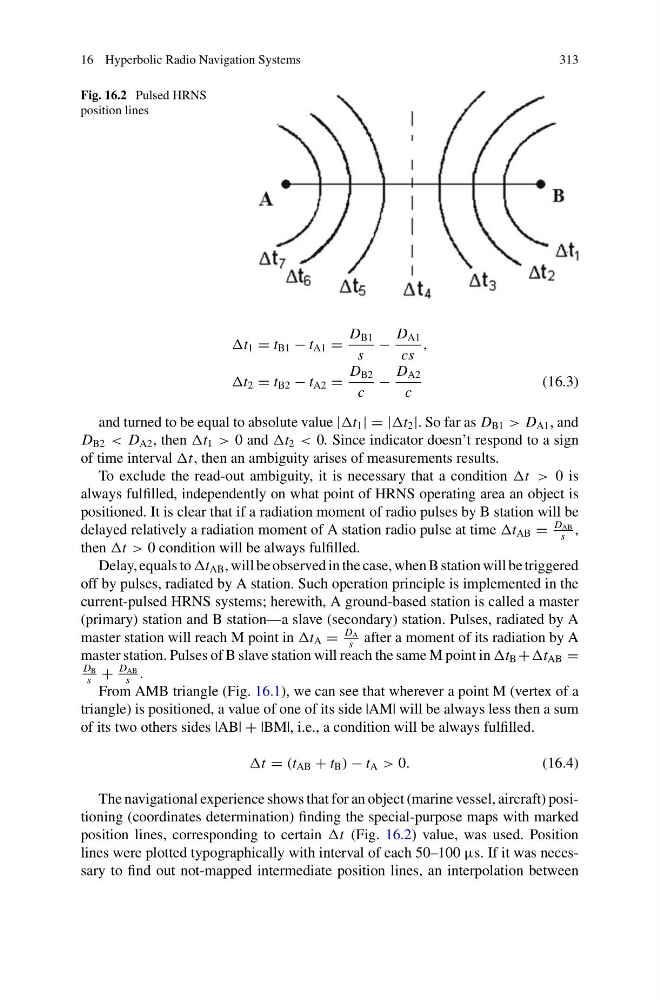
Fig. 16.2 Pulsed HRNS
position lines
t 1 = t B1 − t A1 =
D B1
s
−
D A1
cs
,
t 2 = t B2 − t A2 =
D B2
c
−
D A2
c
(16.3)
and turned to be equal to absolute value |t 1 | = |t 2 |. So far as D B1 > D A1 , and
D B2 < D A2 , then t 1 > 0 and t 2 < 0. Since indicator doesn’t respond to a sign
of time interval t, then an ambiguity arises of measurements results.
To exclude the read-out ambiguity, it is necessary that a condition t > 0 is
always fulfilled, independently on what point of HRNS operating area an object is
positioned. It is clear that if a radiation moment of radio pulses by B station will be
delayed relatively a radiation moment of A station radio pulse at time t AB =
D AB
s
,
then t > 0 condition will be always fulfilled.
Delay, equals to t AB , will be observed in the case, when B station will be triggered
off by pulses, radiated by A station. Such operation principle is implemented in the
current-pulsed HRNS systems; herewith, A ground-based station is called a master
(primary) station and B station—a slave (secondary) station. Pulses, radiated by A
master station will reach M point in t A =
D A
s
after a moment of its radiation by A
master station. Pulses of B slave station will reach the same M point in t B +t AB =
D B
s
+
D AB
s
.
From AMB triangle (Fig. 16.1), we can see that wherever a point M (vertex of a
triangle) is positioned, a value of one of its side |AM| will be always less then a sum
of its two others sides |AB| + |BM|, i.e., a condition will be always fulfilled.
t = (t AB + t B ) − t A > 0.
(16.4)
The navigational experience shows that for an object (marine vessel, aircraft) positioning (coordinates determination) finding the special-purpose maps with marked
position lines, corresponding to certain t (Fig. 16.2) value, was used. Position
lines were plotted typographically with interval of each 50–100 µs. If it was necessary to find out not-mapped intermediate position lines, an interpolation between
313
Fig. 16.2 Pulsed HRNS
position lines
t 1 = t B1 − t A1 =
D B1
s
−
D A1
cs
,
t 2 = t B2 − t A2 =
D B2
c
−
D A2
c
(16.3)
and turned to be equal to absolute value |t 1 | = |t 2 |. So far as D B1 > D A1 , and
D B2 < D A2 , then t 1 > 0 and t 2 < 0. Since indicator doesn’t respond to a sign
of time interval t, then an ambiguity arises of measurements results.
To exclude the read-out ambiguity, it is necessary that a condition t > 0 is
always fulfilled, independently on what point of HRNS operating area an object is
positioned. It is clear that if a radiation moment of radio pulses by B station will be
delayed relatively a radiation moment of A station radio pulse at time t AB =
D AB
s
,
then t > 0 condition will be always fulfilled.
Delay, equals to t AB , will be observed in the case, when B station will be triggered
off by pulses, radiated by A station. Such operation principle is implemented in the
current-pulsed HRNS systems; herewith, A ground-based station is called a master
(primary) station and B station—a slave (secondary) station. Pulses, radiated by A
master station will reach M point in t A =
D A
s
after a moment of its radiation by A
master station. Pulses of B slave station will reach the same M point in t B +t AB =
D B
s
+
D AB
s
.
From AMB triangle (Fig. 16.1), we can see that wherever a point M (vertex of a
triangle) is positioned, a value of one of its side |AM| will be always less then a sum
of its two others sides |AB| + |BM|, i.e., a condition will be always fulfilled.
t = (t AB + t B ) − t A > 0.
(16.4)
The navigational experience shows that for an object (marine vessel, aircraft) positioning (coordinates determination) finding the special-purpose maps with marked
position lines, corresponding to certain t (Fig. 16.2) value, was used. Position
lines were plotted typographically with interval of each 50–100 µs. If it was necessary to find out not-mapped intermediate position lines, an interpolation between