

290
15 Goniometric Radio Navigation Systems
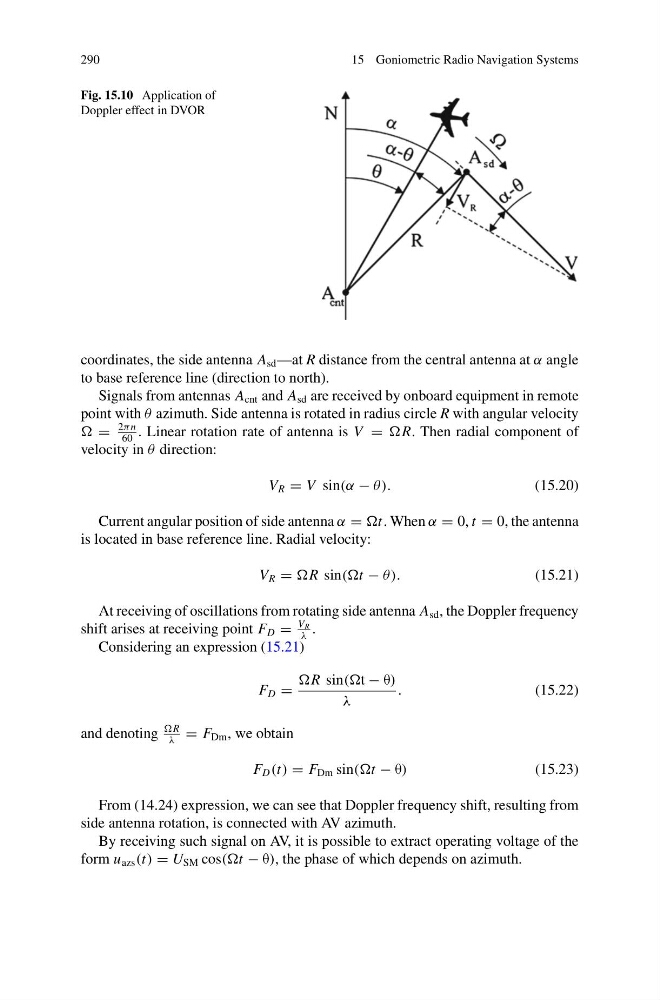
Fig. 15.10 Application of
Doppler effect in DVOR
coordinates, the side antenna A sd —at R distance from the central antenna at α angle
to base reference line (direction to north).
Signals from antennas A cnt and A sd are received by onboard equipment in remote
point with θ azimuth. Side antenna is rotated in radius circle R with angular velocity
=
2πn
60
. Linear rotation rate of antenna is V = R. Then radial component of
velocity in θ direction:
V R = V sin(α − θ ).
(15.20)
Current angular position of side antenna α = t. When α = 0, t = 0, the antenna
is located in base reference line. Radial velocity:
V R = R sin(t − θ ).
(15.21)
At receiving of oscillations from rotating side antenna A sd , the Doppler frequency
shift arises at receiving point F D =
V R
λ
.
Considering an expression (15.21)
F D =
R sin(t − θ)
λ
.
(15.22)
and denoting
R
λ
= F Dm , we obtain
F D (t) = F Dm sin(t − θ)
(15.23)
From (14.24) expression, we can see that Doppler frequency shift, resulting from
side antenna rotation, is connected with AV azimuth.
By receiving such signal on AV, it is possible to extract operating voltage of the
form u azs (t) = U SM cos(t − θ), the phase of which depends on azimuth.
15 Goniometric Radio Navigation Systems
Fig. 15.10 Application of
Doppler effect in DVOR
coordinates, the side antenna A sd —at R distance from the central antenna at α angle
to base reference line (direction to north).
Signals from antennas A cnt and A sd are received by onboard equipment in remote
point with θ azimuth. Side antenna is rotated in radius circle R with angular velocity
=
2πn
60
. Linear rotation rate of antenna is V = R. Then radial component of
velocity in θ direction:
V R = V sin(α − θ ).
(15.20)
Current angular position of side antenna α = t. When α = 0, t = 0, the antenna
is located in base reference line. Radial velocity:
V R = R sin(t − θ ).
(15.21)
At receiving of oscillations from rotating side antenna A sd , the Doppler frequency
shift arises at receiving point F D =
V R
λ
.
Considering an expression (15.21)
F D =
R sin(t − θ)
λ
.
(15.22)
and denoting
R
λ
= F Dm , we obtain
F D (t) = F Dm sin(t − θ)
(15.23)
From (14.24) expression, we can see that Doppler frequency shift, resulting from
side antenna rotation, is connected with AV azimuth.
By receiving such signal on AV, it is possible to extract operating voltage of the
form u azs (t) = U SM cos(t − θ), the phase of which depends on azimuth.