

264
14 Pseudo-Ranging Radio Navigation Systems
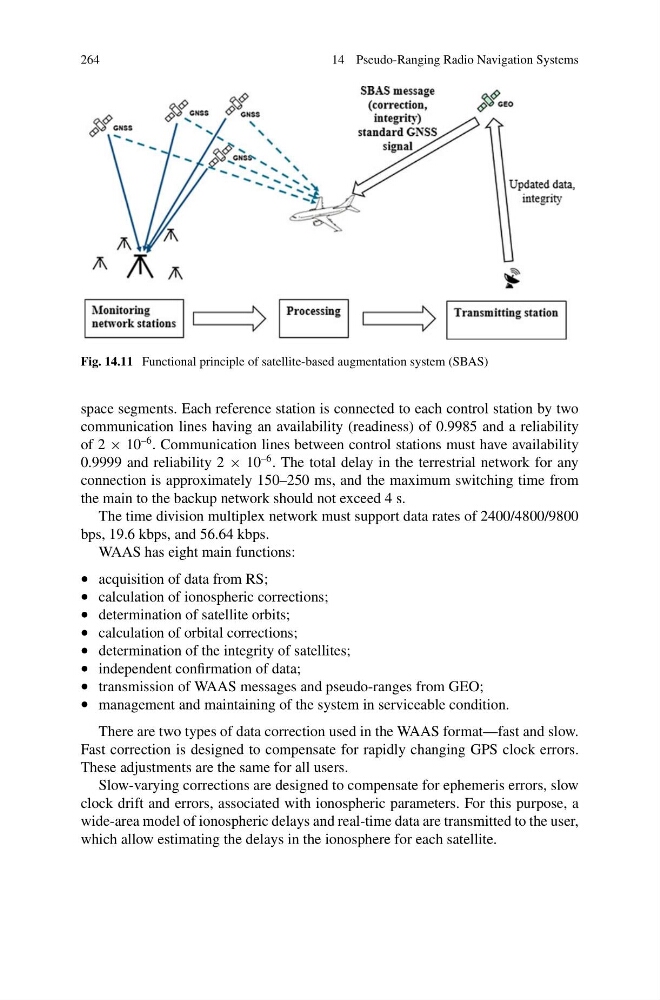
Fig. 14.11 Functional principle of satellite-based augmentation system (SBAS)
space segments. Each reference station is connected to each control station by two
communication lines having an availability (readiness) of 0.9985 and a reliability
of 2 × 10
–6 . Communication lines between control stations must have availability
0.9999 and reliability 2 × 10
–6 . The total delay in the terrestrial network for any
connection is approximately 150–250 ms, and the maximum switching time from
the main to the backup network should not exceed 4 s.
The time division multiplex network must support data rates of 2400/4800/9800
bps, 19.6 kbps, and 56.64 kbps.
WAAS has eight main functions:
• acquisition of data from RS;
• calculation of ionospheric corrections;
• determination of satellite orbits;
• calculation of orbital corrections;
• determination of the integrity of satellites;
• independent confirmation of data;
• transmission of WAAS messages and pseudo-ranges from GEO;
• management and maintaining of the system in serviceable condition.
There are two types of data correction used in the WAAS format—fast and slow.
Fast correction is designed to compensate for rapidly changing GPS clock errors.
These adjustments are the same for all users.
Slow-varying corrections are designed to compensate for ephemeris errors, slow
clock drift and errors, associated with ionospheric parameters. For this purpose, a
wide-area model of ionospheric delays and real-time data are transmitted to the user,
which allow estimating the delays in the ionosphere for each satellite.
14 Pseudo-Ranging Radio Navigation Systems
Fig. 14.11 Functional principle of satellite-based augmentation system (SBAS)
space segments. Each reference station is connected to each control station by two
communication lines having an availability (readiness) of 0.9985 and a reliability
of 2 × 10
–6 . Communication lines between control stations must have availability
0.9999 and reliability 2 × 10
–6 . The total delay in the terrestrial network for any
connection is approximately 150–250 ms, and the maximum switching time from
the main to the backup network should not exceed 4 s.
The time division multiplex network must support data rates of 2400/4800/9800
bps, 19.6 kbps, and 56.64 kbps.
WAAS has eight main functions:
• acquisition of data from RS;
• calculation of ionospheric corrections;
• determination of satellite orbits;
• calculation of orbital corrections;
• determination of the integrity of satellites;
• independent confirmation of data;
• transmission of WAAS messages and pseudo-ranges from GEO;
• management and maintaining of the system in serviceable condition.
There are two types of data correction used in the WAAS format—fast and slow.
Fast correction is designed to compensate for rapidly changing GPS clock errors.
These adjustments are the same for all users.
Slow-varying corrections are designed to compensate for ephemeris errors, slow
clock drift and errors, associated with ionospheric parameters. For this purpose, a
wide-area model of ionospheric delays and real-time data are transmitted to the user,
which allow estimating the delays in the ionosphere for each satellite.