

252
14 Pseudo-Ranging Radio Navigation Systems
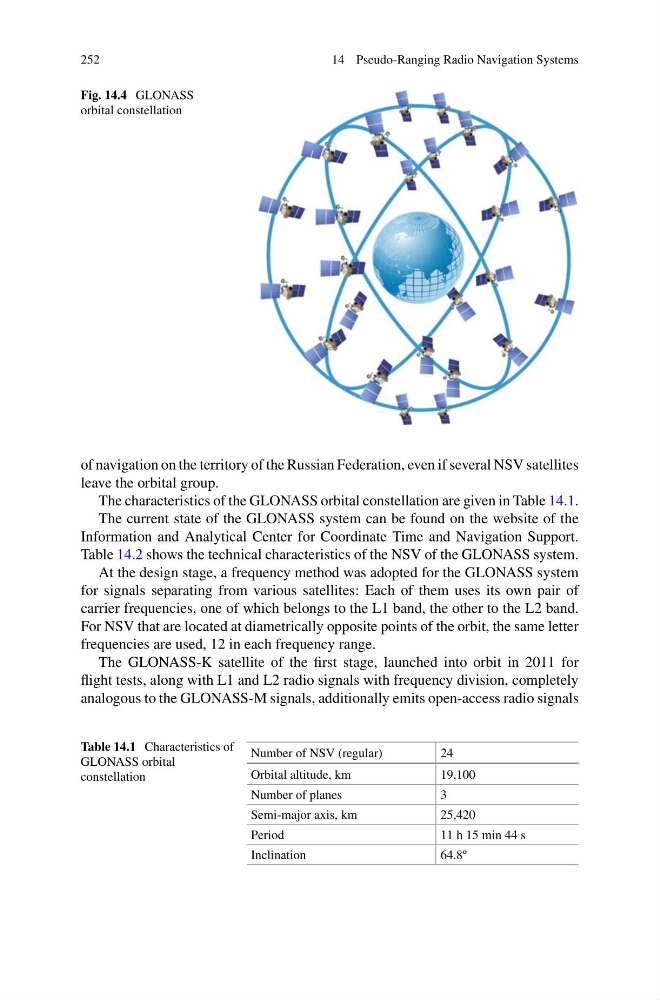
Fig. 14.4 GLONASS
orbital constellation
of navigation on the territory of the Russian Federation, even if several NSV satellites
leave the orbital group.
The characteristics of the GLONASS orbital constellation are given in Table 14.1.
The current state of the GLONASS system can be found on the website of the
Information and Analytical Center for Coordinate Time and Navigation Support.
Table 14.2 shows the technical characteristics of the NSV of the GLONASS system.
At the design stage, a frequency method was adopted for the GLONASS system
for signals separating from various satellites: Each of them uses its own pair of
carrier frequencies, one of which belongs to the L1 band, the other to the L2 band.
For NSV that are located at diametrically opposite points of the orbit, the same letter
frequencies are used, 12 in each frequency range.
The GLONASS-K satellite of the first stage, launched into orbit in 2011 for
flight tests, along with L1 and L2 radio signals with frequency division, completely
analogous to the GLONASS-M signals, additionally emits open-access radio signals
Table 14.1 Characteristics of
GLONASS orbital
constellation
Number of NSV (regular)
24
Orbital altitude, km
19,100
Number of planes
3
Semi-major axis, km
25,420
Period
11 h 15 min 44 s
Inclination
64.8º
14 Pseudo-Ranging Radio Navigation Systems
Fig. 14.4 GLONASS
orbital constellation
of navigation on the territory of the Russian Federation, even if several NSV satellites
leave the orbital group.
The characteristics of the GLONASS orbital constellation are given in Table 14.1.
The current state of the GLONASS system can be found on the website of the
Information and Analytical Center for Coordinate Time and Navigation Support.
Table 14.2 shows the technical characteristics of the NSV of the GLONASS system.
At the design stage, a frequency method was adopted for the GLONASS system
for signals separating from various satellites: Each of them uses its own pair of
carrier frequencies, one of which belongs to the L1 band, the other to the L2 band.
For NSV that are located at diametrically opposite points of the orbit, the same letter
frequencies are used, 12 in each frequency range.
The GLONASS-K satellite of the first stage, launched into orbit in 2011 for
flight tests, along with L1 and L2 radio signals with frequency division, completely
analogous to the GLONASS-M signals, additionally emits open-access radio signals
Table 14.1 Characteristics of
GLONASS orbital
constellation
Number of NSV (regular)
24
Orbital altitude, km
19,100
Number of planes
3
Semi-major axis, km
25,420
Period
11 h 15 min 44 s
Inclination
64.8º