

14.1 Pseudo-Ranging Position Finding Method of an Object and Design …
245
where N—is the radius of curvature of the first vertical, determined by the formula
N = a
1 − e
2 sin
2
ϕ
−
1
2 ; a—semi-major axis of the earth ellipsoid, e—eccentricity
of the earth ellipsoid.
The calculator of the object equipment also solves the inverse problem with respect
to the above formulas—using already known rectangular coordinates, it calculates
the latitude, longitude and height above the surface of the earth’s ellipsoid.
Let us now consider how pseudo-range is measured in user equipment. All NCV
SRNS are equal in their system. Each satellite transmits a coded signal through
the transmitting antenna on two carrier frequencies in the L1 and L2 bands. Signal
emission in two frequency ranges is necessary to compensate for ionospheric signal
propagation errors.
The signals transmitted by the NSV are continuous modulated oscillations. The
information transmitted by the NSV includes:
• pseudo-random ranging code, which is used to measure the range to the satellite,
• a navigation message containing the information necessary for the user (NSV
ephemeris, system almanac, data on the condition of the NSV, shifts of NSV time
scales relative to UTC, etc.).
A pseudo-random ranging code represents a long, periodically repeating sequence
of video pulses. This sequence looks completely random, but in fact it is formed
according to a very definite law. This law is the code, without knowledge of which
it is impossible to obtain information from the NSV. The codes of all NSV systems
are recorded in the computer memory of the user equipment. It also generates a code
(sequence of pulses) identical to that received from the NSV.
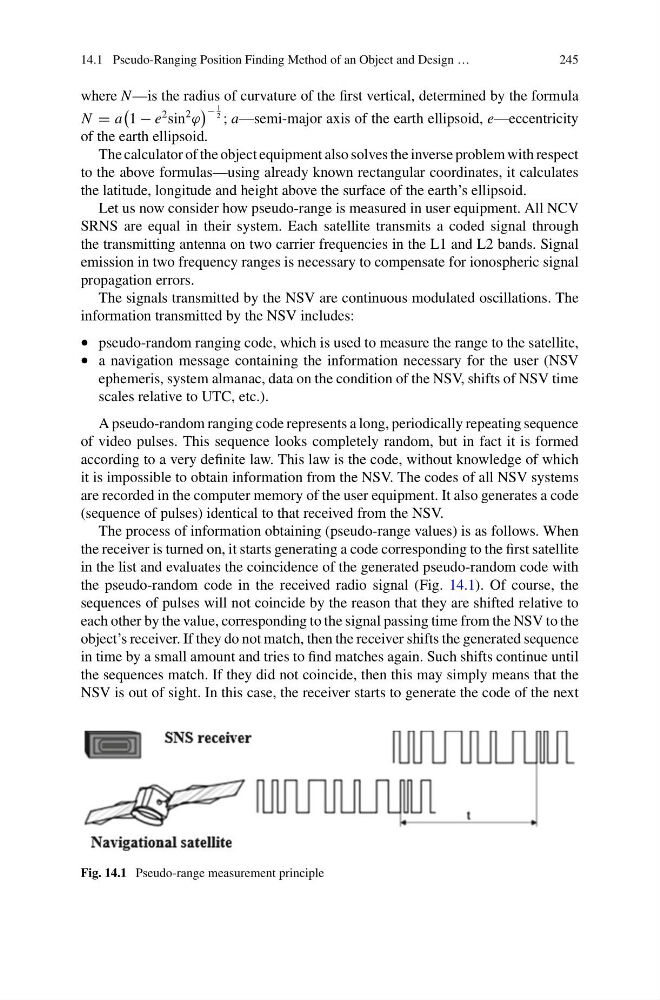
The process of information obtaining (pseudo-range values) is as follows. When
the receiver is turned on, it starts generating a code corresponding to the first satellite
in the list and evaluates the coincidence of the generated pseudo-random code with
the pseudo-random code in the received radio signal (Fig. 14.1). Of course, the
sequences of pulses will not coincide by the reason that they are shifted relative to
each other by the value, corresponding to the signal passing time from the NSV to the
object’s receiver. If they do not match, then the receiver shifts the generated sequence
in time by a small amount and tries to find matches again. Such shifts continue until
the sequences match. If they did not coincide, then this may simply means that the
NSV is out of sight. In this case, the receiver starts to generate the code of the next
Fig. 14.1 Pseudo-range measurement principle
245
where N—is the radius of curvature of the first vertical, determined by the formula
N = a
1 − e
2 sin
2
ϕ
−
1
2 ; a—semi-major axis of the earth ellipsoid, e—eccentricity
of the earth ellipsoid.
The calculator of the object equipment also solves the inverse problem with respect
to the above formulas—using already known rectangular coordinates, it calculates
the latitude, longitude and height above the surface of the earth’s ellipsoid.
Let us now consider how pseudo-range is measured in user equipment. All NCV
SRNS are equal in their system. Each satellite transmits a coded signal through
the transmitting antenna on two carrier frequencies in the L1 and L2 bands. Signal
emission in two frequency ranges is necessary to compensate for ionospheric signal
propagation errors.
The signals transmitted by the NSV are continuous modulated oscillations. The
information transmitted by the NSV includes:
• pseudo-random ranging code, which is used to measure the range to the satellite,
• a navigation message containing the information necessary for the user (NSV
ephemeris, system almanac, data on the condition of the NSV, shifts of NSV time
scales relative to UTC, etc.).
A pseudo-random ranging code represents a long, periodically repeating sequence
of video pulses. This sequence looks completely random, but in fact it is formed
according to a very definite law. This law is the code, without knowledge of which
it is impossible to obtain information from the NSV. The codes of all NSV systems
are recorded in the computer memory of the user equipment. It also generates a code
(sequence of pulses) identical to that received from the NSV.
The process of information obtaining (pseudo-range values) is as follows. When
the receiver is turned on, it starts generating a code corresponding to the first satellite
in the list and evaluates the coincidence of the generated pseudo-random code with
the pseudo-random code in the received radio signal (Fig. 14.1). Of course, the
sequences of pulses will not coincide by the reason that they are shifted relative to
each other by the value, corresponding to the signal passing time from the NSV to the
object’s receiver. If they do not match, then the receiver shifts the generated sequence
in time by a small amount and tries to find matches again. Such shifts continue until
the sequences match. If they did not coincide, then this may simply means that the
NSV is out of sight. In this case, the receiver starts to generate the code of the next
Fig. 14.1 Pseudo-range measurement principle