

200
11 Radar Systems of Air Transport
Fig. 11.10 WNRS phased
antenna array
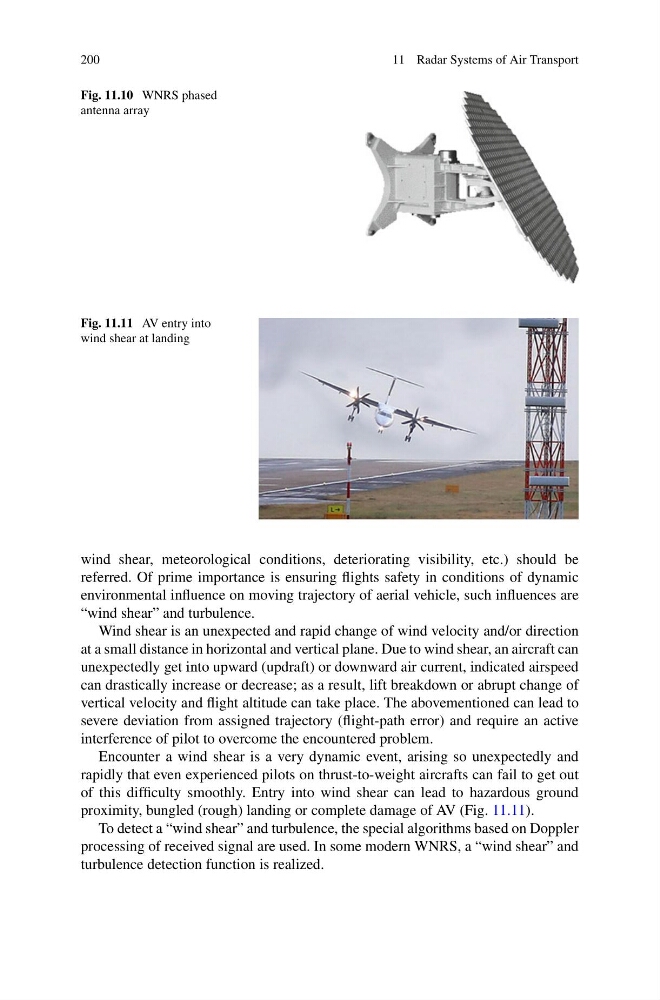
Fig. 11.11 AV entry into
wind shear at landing
wind shear, meteorological conditions, deteriorating visibility, etc.) should be
referred. Of prime importance is ensuring flights safety in conditions of dynamic
environmental influence on moving trajectory of aerial vehicle, such influences are
“wind shear” and turbulence.
Wind shear is an unexpected and rapid change of wind velocity and/or direction
at a small distance in horizontal and vertical plane. Due to wind shear, an aircraft can
unexpectedly get into upward (updraft) or downward air current, indicated airspeed
can drastically increase or decrease; as a result, lift breakdown or abrupt change of
vertical velocity and flight altitude can take place. The abovementioned can lead to
severe deviation from assigned trajectory (flight-path error) and require an active
interference of pilot to overcome the encountered problem.
Encounter a wind shear is a very dynamic event, arising so unexpectedly and
rapidly that even experienced pilots on thrust-to-weight aircrafts can fail to get out
of this difficulty smoothly. Entry into wind shear can lead to hazardous ground
proximity, bungled (rough) landing or complete damage of AV (Fig. 11.11).
To detect a “wind shear” and turbulence, the special algorithms based on Doppler
processing of received signal are used. In some modern WNRS, a “wind shear” and
turbulence detection function is realized.
11 Radar Systems of Air Transport
Fig. 11.10 WNRS phased
antenna array
Fig. 11.11 AV entry into
wind shear at landing
wind shear, meteorological conditions, deteriorating visibility, etc.) should be
referred. Of prime importance is ensuring flights safety in conditions of dynamic
environmental influence on moving trajectory of aerial vehicle, such influences are
“wind shear” and turbulence.
Wind shear is an unexpected and rapid change of wind velocity and/or direction
at a small distance in horizontal and vertical plane. Due to wind shear, an aircraft can
unexpectedly get into upward (updraft) or downward air current, indicated airspeed
can drastically increase or decrease; as a result, lift breakdown or abrupt change of
vertical velocity and flight altitude can take place. The abovementioned can lead to
severe deviation from assigned trajectory (flight-path error) and require an active
interference of pilot to overcome the encountered problem.
Encounter a wind shear is a very dynamic event, arising so unexpectedly and
rapidly that even experienced pilots on thrust-to-weight aircrafts can fail to get out
of this difficulty smoothly. Entry into wind shear can lead to hazardous ground
proximity, bungled (rough) landing or complete damage of AV (Fig. 11.11).
To detect a “wind shear” and turbulence, the special algorithms based on Doppler
processing of received signal are used. In some modern WNRS, a “wind shear” and
turbulence detection function is realized.