

10 Multi-channel Radar Systems
187
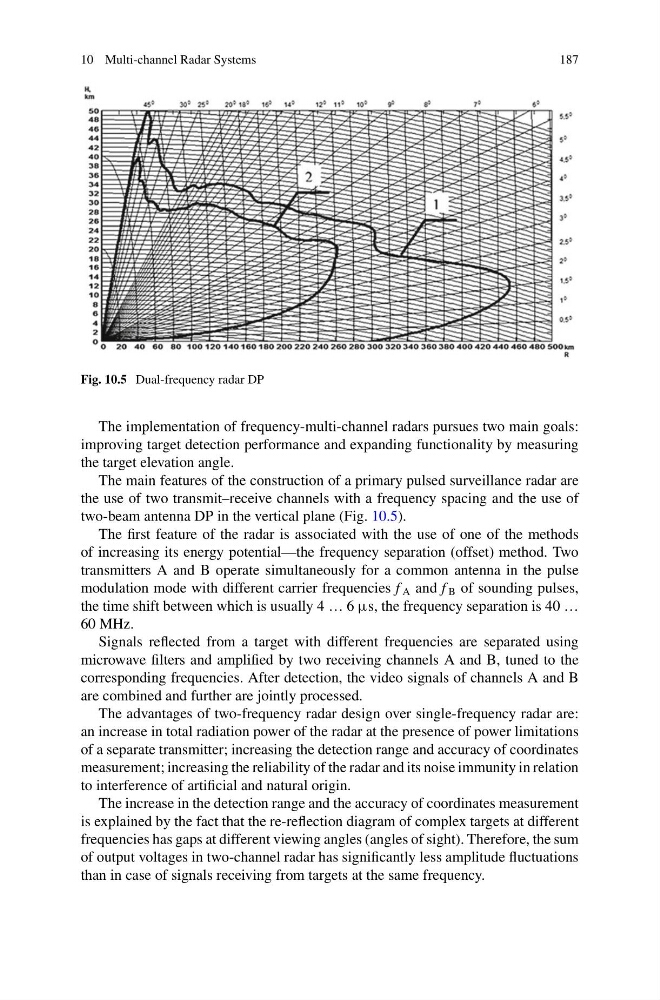
Fig. 10.5 Dual-frequency radar DP
The implementation of frequency-multi-channel radars pursues two main goals:
improving target detection performance and expanding functionality by measuring
the target elevation angle.
The main features of the construction of a primary pulsed surveillance radar are
the use of two transmit–receive channels with a frequency spacing and the use of
two-beam antenna DP in the vertical plane (Fig. 10.5).
The first feature of the radar is associated with the use of one of the methods
of increasing its energy potential—the frequency separation (offset) method. Two
transmitters A and B operate simultaneously for a common antenna in the pulse
modulation mode with different carrier frequencies f A and f B of sounding pulses,
the time shift between which is usually 4 … 6 μs, the frequency separation is 40 …
60 MHz.
Signals reflected from a target with different frequencies are separated using
microwave filters and amplified by two receiving channels A and B, tuned to the
corresponding frequencies. After detection, the video signals of channels A and B
are combined and further are jointly processed.
The advantages of two-frequency radar design over single-frequency radar are:
an increase in total radiation power of the radar at the presence of power limitations
of a separate transmitter; increasing the detection range and accuracy of coordinates
measurement; increasing the reliability of the radar and its noise immunity in relation
to interference of artificial and natural origin.
The increase in the detection range and the accuracy of coordinates measurement
is explained by the fact that the re-reflection diagram of complex targets at different
frequencies has gaps at different viewing angles (angles of sight). Therefore, the sum
of output voltages in two-channel radar has significantly less amplitude fluctuations
than in case of signals receiving from targets at the same frequency.
187
Fig. 10.5 Dual-frequency radar DP
The implementation of frequency-multi-channel radars pursues two main goals:
improving target detection performance and expanding functionality by measuring
the target elevation angle.
The main features of the construction of a primary pulsed surveillance radar are
the use of two transmit–receive channels with a frequency spacing and the use of
two-beam antenna DP in the vertical plane (Fig. 10.5).
The first feature of the radar is associated with the use of one of the methods
of increasing its energy potential—the frequency separation (offset) method. Two
transmitters A and B operate simultaneously for a common antenna in the pulse
modulation mode with different carrier frequencies f A and f B of sounding pulses,
the time shift between which is usually 4 … 6 μs, the frequency separation is 40 …
60 MHz.
Signals reflected from a target with different frequencies are separated using
microwave filters and amplified by two receiving channels A and B, tuned to the
corresponding frequencies. After detection, the video signals of channels A and B
are combined and further are jointly processed.
The advantages of two-frequency radar design over single-frequency radar are:
an increase in total radiation power of the radar at the presence of power limitations
of a separate transmitter; increasing the detection range and accuracy of coordinates
measurement; increasing the reliability of the radar and its noise immunity in relation
to interference of artificial and natural origin.
The increase in the detection range and the accuracy of coordinates measurement
is explained by the fact that the re-reflection diagram of complex targets at different
frequencies has gaps at different viewing angles (angles of sight). Therefore, the sum
of output voltages in two-channel radar has significantly less amplitude fluctuations
than in case of signals receiving from targets at the same frequency.