

182
10 Multi-channel Radar Systems
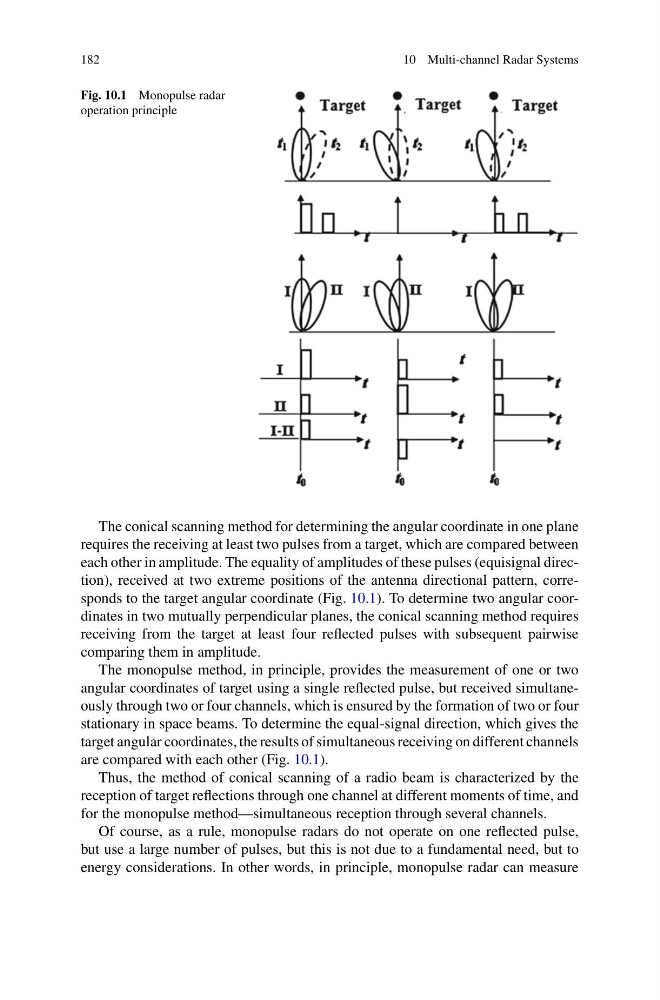
Fig. 10.1 Monopulse radar
operation principle
The conical scanning method for determining the angular coordinate in one plane
requires the receiving at least two pulses from a target, which are compared between
each other in amplitude. The equality of amplitudes of these pulses (equisignal direction), received at two extreme positions of the antenna directional pattern, corresponds to the target angular coordinate (Fig. 10.1). To determine two angular coordinates in two mutually perpendicular planes, the conical scanning method requires
receiving from the target at least four reflected pulses with subsequent pairwise
comparing them in amplitude.
The monopulse method, in principle, provides the measurement of one or two
angular coordinates of target using a single reflected pulse, but received simultaneously through two or four channels, which is ensured by the formation of two or four
stationary in space beams. To determine the equal-signal direction, which gives the
target angular coordinates, the results of simultaneous receiving on different channels
are compared with each other (Fig. 10.1).
Thus, the method of conical scanning of a radio beam is characterized by the
reception of target reflections through one channel at different moments of time, and
for the monopulse method—simultaneous reception through several channels.
Of course, as a rule, monopulse radars do not operate on one reflected pulse,
but use a large number of pulses, but this is not due to a fundamental need, but to
energy considerations. In other words, in principle, monopulse radar can measure
10 Multi-channel Radar Systems
Fig. 10.1 Monopulse radar
operation principle
The conical scanning method for determining the angular coordinate in one plane
requires the receiving at least two pulses from a target, which are compared between
each other in amplitude. The equality of amplitudes of these pulses (equisignal direction), received at two extreme positions of the antenna directional pattern, corresponds to the target angular coordinate (Fig. 10.1). To determine two angular coordinates in two mutually perpendicular planes, the conical scanning method requires
receiving from the target at least four reflected pulses with subsequent pairwise
comparing them in amplitude.
The monopulse method, in principle, provides the measurement of one or two
angular coordinates of target using a single reflected pulse, but received simultaneously through two or four channels, which is ensured by the formation of two or four
stationary in space beams. To determine the equal-signal direction, which gives the
target angular coordinates, the results of simultaneous receiving on different channels
are compared with each other (Fig. 10.1).
Thus, the method of conical scanning of a radio beam is characterized by the
reception of target reflections through one channel at different moments of time, and
for the monopulse method—simultaneous reception through several channels.
Of course, as a rule, monopulse radars do not operate on one reflected pulse,
but use a large number of pulses, but this is not due to a fundamental need, but to
energy considerations. In other words, in principle, monopulse radar can measure