

178
9 Compensation of Signals from Stationary Objects
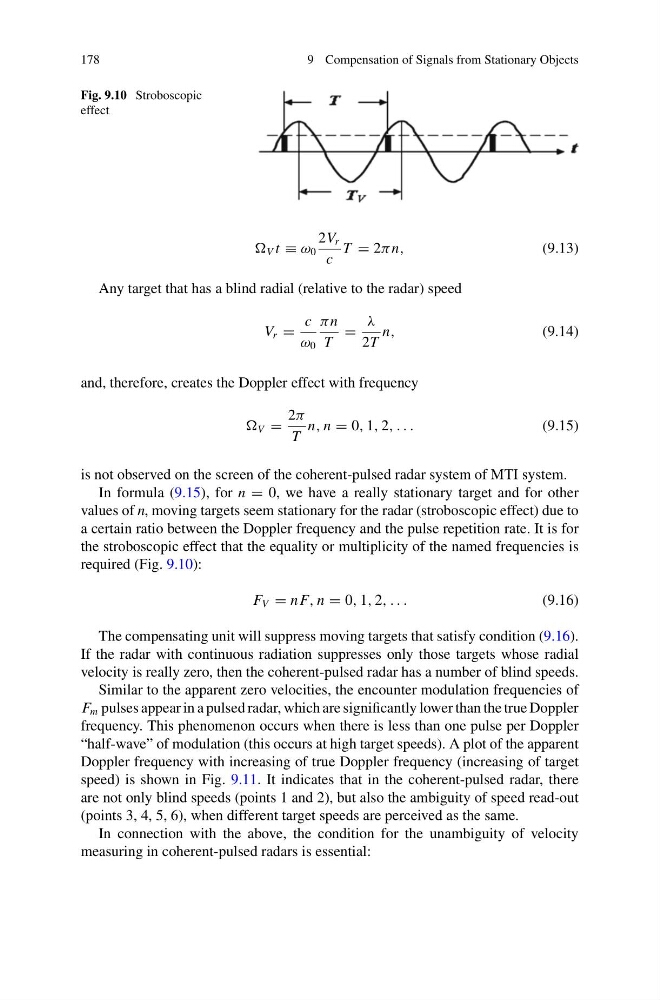
Fig. 9.10 Stroboscopic
effect
V t ≡ ω 0
2V r
c
T = 2π n,
(9.13)
Any target that has a blind radial (relative to the radar) speed
V r =
c
ω 0
π n
T
=
λ
2T
n,
(9.14)
and, therefore, creates the Doppler effect with frequency
V =
2π
T
n, n = 0, 1, 2, . . .
(9.15)
is not observed on the screen of the coherent-pulsed radar system of MTI system.
In formula (9.15), for n = 0, we have a really stationary target and for other
values of n, moving targets seem stationary for the radar (stroboscopic effect) due to
a certain ratio between the Doppler frequency and the pulse repetition rate. It is for
the stroboscopic effect that the equality or multiplicity of the named frequencies is
required (Fig. 9.10):
F V = n F, n = 0, 1, 2, . . .
(9.16)
The compensating unit will suppress moving targets that satisfy condition (9.16).
If the radar with continuous radiation suppresses only those targets whose radial
velocity is really zero, then the coherent-pulsed radar has a number of blind speeds.
Similar to the apparent zero velocities, the encounter modulation frequencies of
F m pulses appear in a pulsed radar, which are significantly lower than the true Doppler
frequency. This phenomenon occurs when there is less than one pulse per Doppler
“half-wave” of modulation (this occurs at high target speeds). A plot of the apparent
Doppler frequency with increasing of true Doppler frequency (increasing of target
speed) is shown in Fig. 9.11. It indicates that in the coherent-pulsed radar, there
are not only blind speeds (points 1 and 2), but also the ambiguity of speed read-out
(points 3, 4, 5, 6), when different target speeds are perceived as the same.
In connection with the above, the condition for the unambiguity of velocity
measuring in coherent-pulsed radars is essential:
9 Compensation of Signals from Stationary Objects
Fig. 9.10 Stroboscopic
effect
V t ≡ ω 0
2V r
c
T = 2π n,
(9.13)
Any target that has a blind radial (relative to the radar) speed
V r =
c
ω 0
π n
T
=
λ
2T
n,
(9.14)
and, therefore, creates the Doppler effect with frequency
V =
2π
T
n, n = 0, 1, 2, . . .
(9.15)
is not observed on the screen of the coherent-pulsed radar system of MTI system.
In formula (9.15), for n = 0, we have a really stationary target and for other
values of n, moving targets seem stationary for the radar (stroboscopic effect) due to
a certain ratio between the Doppler frequency and the pulse repetition rate. It is for
the stroboscopic effect that the equality or multiplicity of the named frequencies is
required (Fig. 9.10):
F V = n F, n = 0, 1, 2, . . .
(9.16)
The compensating unit will suppress moving targets that satisfy condition (9.16).
If the radar with continuous radiation suppresses only those targets whose radial
velocity is really zero, then the coherent-pulsed radar has a number of blind speeds.
Similar to the apparent zero velocities, the encounter modulation frequencies of
F m pulses appear in a pulsed radar, which are significantly lower than the true Doppler
frequency. This phenomenon occurs when there is less than one pulse per Doppler
“half-wave” of modulation (this occurs at high target speeds). A plot of the apparent
Doppler frequency with increasing of true Doppler frequency (increasing of target
speed) is shown in Fig. 9.11. It indicates that in the coherent-pulsed radar, there
are not only blind speeds (points 1 and 2), but also the ambiguity of speed read-out
(points 3, 4, 5, 6), when different target speeds are perceived as the same.
In connection with the above, the condition for the unambiguity of velocity
measuring in coherent-pulsed radars is essential: