

8 Coherent Radar Systems
161
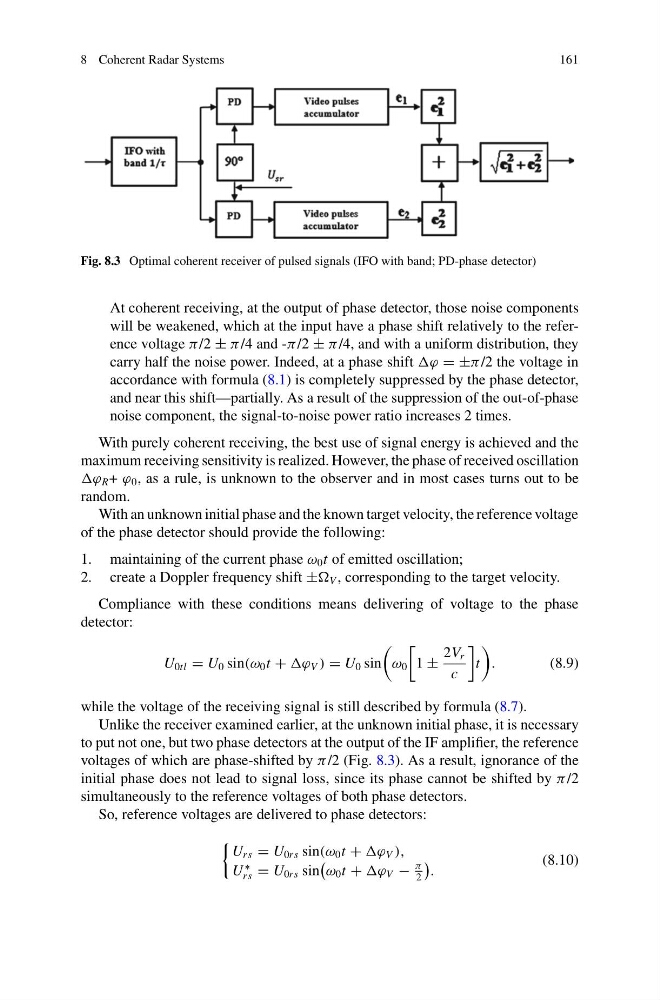
Fig. 8.3 Optimal coherent receiver of pulsed signals (IFO with band; PD-phase detector)
At coherent receiving, at the output of phase detector, those noise components
will be weakened, which at the input have a phase shift relatively to the reference voltage π /2 ± π /4 and -π /2 ± π /4, and with a uniform distribution, they
carry half the noise power. Indeed, at a phase shift ϕ = ±π /2 the voltage in
accordance with formula (8.1) is completely suppressed by the phase detector,
and near this shift—partially. As a result of the suppression of the out-of-phase
noise component, the signal-to-noise power ratio increases 2 times.
With purely coherent receiving, the best use of signal energy is achieved and the
maximum receiving sensitivity is realized. However, the phase of received oscillation
ϕ R + ϕ 0 , as a rule, is unknown to the observer and in most cases turns out to be
random.
With an unknown initial phase and the known target velocity, the reference voltage
of the phase detector should provide the following:
1. maintaining of the current phase ω 0 t of emitted oscillation;
2. create a Doppler frequency shift ± V , corresponding to the target velocity.
Compliance with these conditions means delivering of voltage to the phase
detector:
U 0tl = U 0 sin(ω 0 t + ϕ V ) = U 0 sin
ω 0
1 ±
2V r
c
t
.
(8.9)
while the voltage of the receiving signal is still described by formula (8.7).
Unlike the receiver examined earlier, at the unknown initial phase, it is necessary
to put not one, but two phase detectors at the output of the IF amplifier, the reference
voltages of which are phase-shifted by π /2 (Fig. 8.3). As a result, ignorance of the
initial phase does not lead to signal loss, since its phase cannot be shifted by π /2
simultaneously to the reference voltages of both phase detectors.
So, reference voltages are delivered to phase detectors:
U rs = U 0rs sin(ω 0 t + ϕ V ),
U
∗
rs = U 0rs sin
ω 0 t + ϕ V −
π
2
.
(8.10)
161
Fig. 8.3 Optimal coherent receiver of pulsed signals (IFO with band; PD-phase detector)
At coherent receiving, at the output of phase detector, those noise components
will be weakened, which at the input have a phase shift relatively to the reference voltage π /2 ± π /4 and -π /2 ± π /4, and with a uniform distribution, they
carry half the noise power. Indeed, at a phase shift ϕ = ±π /2 the voltage in
accordance with formula (8.1) is completely suppressed by the phase detector,
and near this shift—partially. As a result of the suppression of the out-of-phase
noise component, the signal-to-noise power ratio increases 2 times.
With purely coherent receiving, the best use of signal energy is achieved and the
maximum receiving sensitivity is realized. However, the phase of received oscillation
ϕ R + ϕ 0 , as a rule, is unknown to the observer and in most cases turns out to be
random.
With an unknown initial phase and the known target velocity, the reference voltage
of the phase detector should provide the following:
1. maintaining of the current phase ω 0 t of emitted oscillation;
2. create a Doppler frequency shift ± V , corresponding to the target velocity.
Compliance with these conditions means delivering of voltage to the phase
detector:
U 0tl = U 0 sin(ω 0 t + ϕ V ) = U 0 sin
ω 0
1 ±
2V r
c
t
.
(8.9)
while the voltage of the receiving signal is still described by formula (8.7).
Unlike the receiver examined earlier, at the unknown initial phase, it is necessary
to put not one, but two phase detectors at the output of the IF amplifier, the reference
voltages of which are phase-shifted by π /2 (Fig. 8.3). As a result, ignorance of the
initial phase does not lead to signal loss, since its phase cannot be shifted by π /2
simultaneously to the reference voltages of both phase detectors.
So, reference voltages are delivered to phase detectors:
U rs = U 0rs sin(ω 0 t + ϕ V ),
U
∗
rs = U 0rs sin
ω 0 t + ϕ V −
π
2
.
(8.10)