

6.2 Coordinates and Movement Parameters Measuring …
141
by internal noises, are called noise errors and are evaluated by the mean-square value
of measured parameter σ ns .
Secondly, even in the absence of target movement relatively to radar due to noises,
the delay time t dly , Doppler frequency shift f Dp and direction of arrival γ of reflected
wave are changed, that leads to errors in determination of these parameters.
Thirdly, at target movement, its elementary reflectors (glittering dots) are rotating
relatively the center of mass. This leads to random change of amplitude and field
phase of reflected wave in radar deployment point, and consequently, leads to errors
in coordinates and parameters finding of target movement. These errors are called
fluctuation errors σ f l (α).
Fourthly, propagation conditions of electromagnetic waves (EMW) during radar
surveillance can change that, for example, leads to EMW propagation trajectory
bending, and as a consequence, to measurement errors of received signal parameters
α i (t). These measurement errors are called propagation errors and are evaluated by
σ prop (α).
Since the mentioned factors, leading to measurement errors, act independently
from each other, then summary error of informative parameter measurement α of
radar signal can be represented as follows:
σ α =
σ 2
ns (α) + σ 2
prop (α)
(6.28)
Along with random errors, mentioned before, systematic errors also effects on
radar change process, under which the difference is meant the following:
α = α 0 − α avr
(6.29)
where α 0 —true value of measuring parameter; α avr —average value of radar signal,
obtained after multiple measurements.
The reasons of systematic errors, for example, can be stable defects of radar equipment (instrumental errors); errors, arising at approximation of calculating formulas
(procedure errors); steady errors of operator. As opposed to random errors, the
systematic errors can be corrected during adjustment and alignment of equipment.
Hence, further we discuss only random errors, which follow the radar measurement.
Above all, we examine those random errors, which cannot be eliminated. For this
reason at further examining of issues on radar measurement we will assume that a
noise n(t), including in receiving oscillation y(t) (6.27), is an internal noise of radar
receiver, which can be represented by wideband Gaussian noise.
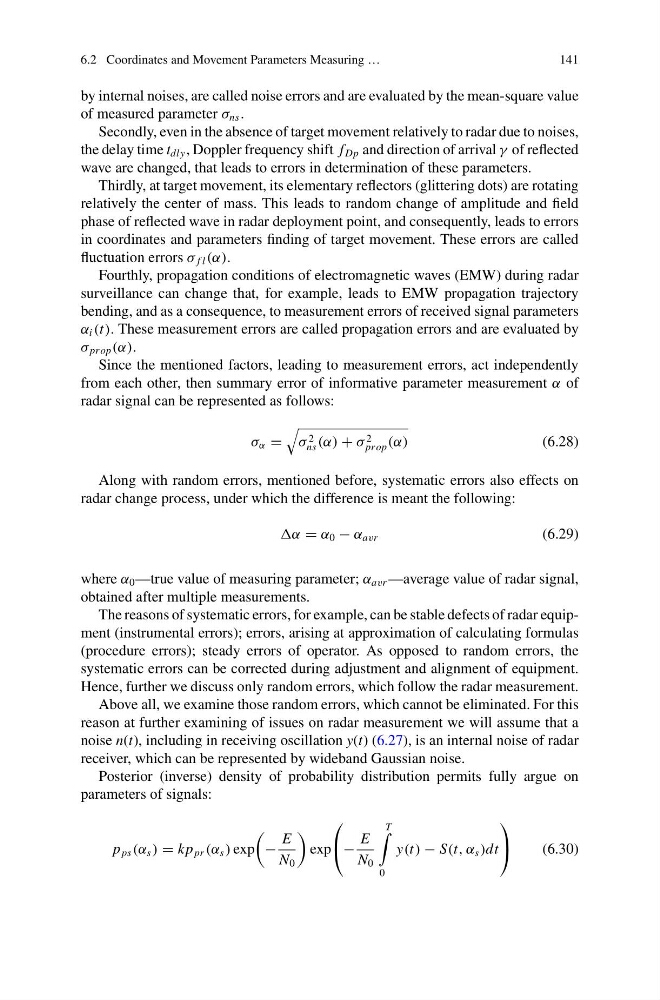
Posterior (inverse) density of probability distribution permits fully argue on
parameters of signals:
p ps (α s ) = kp pr (α s ) exp
−
E
N 0
exp
⎛
⎝ −
E
N 0
T
0
y(t) − S(t, α s )dt
⎞
⎠
(6.30)
141
by internal noises, are called noise errors and are evaluated by the mean-square value
of measured parameter σ ns .
Secondly, even in the absence of target movement relatively to radar due to noises,
the delay time t dly , Doppler frequency shift f Dp and direction of arrival γ of reflected
wave are changed, that leads to errors in determination of these parameters.
Thirdly, at target movement, its elementary reflectors (glittering dots) are rotating
relatively the center of mass. This leads to random change of amplitude and field
phase of reflected wave in radar deployment point, and consequently, leads to errors
in coordinates and parameters finding of target movement. These errors are called
fluctuation errors σ f l (α).
Fourthly, propagation conditions of electromagnetic waves (EMW) during radar
surveillance can change that, for example, leads to EMW propagation trajectory
bending, and as a consequence, to measurement errors of received signal parameters
α i (t). These measurement errors are called propagation errors and are evaluated by
σ prop (α).
Since the mentioned factors, leading to measurement errors, act independently
from each other, then summary error of informative parameter measurement α of
radar signal can be represented as follows:
σ α =
σ 2
ns (α) + σ 2
prop (α)
(6.28)
Along with random errors, mentioned before, systematic errors also effects on
radar change process, under which the difference is meant the following:
α = α 0 − α avr
(6.29)
where α 0 —true value of measuring parameter; α avr —average value of radar signal,
obtained after multiple measurements.
The reasons of systematic errors, for example, can be stable defects of radar equipment (instrumental errors); errors, arising at approximation of calculating formulas
(procedure errors); steady errors of operator. As opposed to random errors, the
systematic errors can be corrected during adjustment and alignment of equipment.
Hence, further we discuss only random errors, which follow the radar measurement.
Above all, we examine those random errors, which cannot be eliminated. For this
reason at further examining of issues on radar measurement we will assume that a
noise n(t), including in receiving oscillation y(t) (6.27), is an internal noise of radar
receiver, which can be represented by wideband Gaussian noise.
Posterior (inverse) density of probability distribution permits fully argue on
parameters of signals:
p ps (α s ) = kp pr (α s ) exp
−
E
N 0
exp
⎛
⎝ −
E
N 0
T
0
y(t) − S(t, α s )dt
⎞
⎠
(6.30)