

6.1 Detection of Radio Signals
133
where
N o
2
—spectral density of noise at input of radar system.
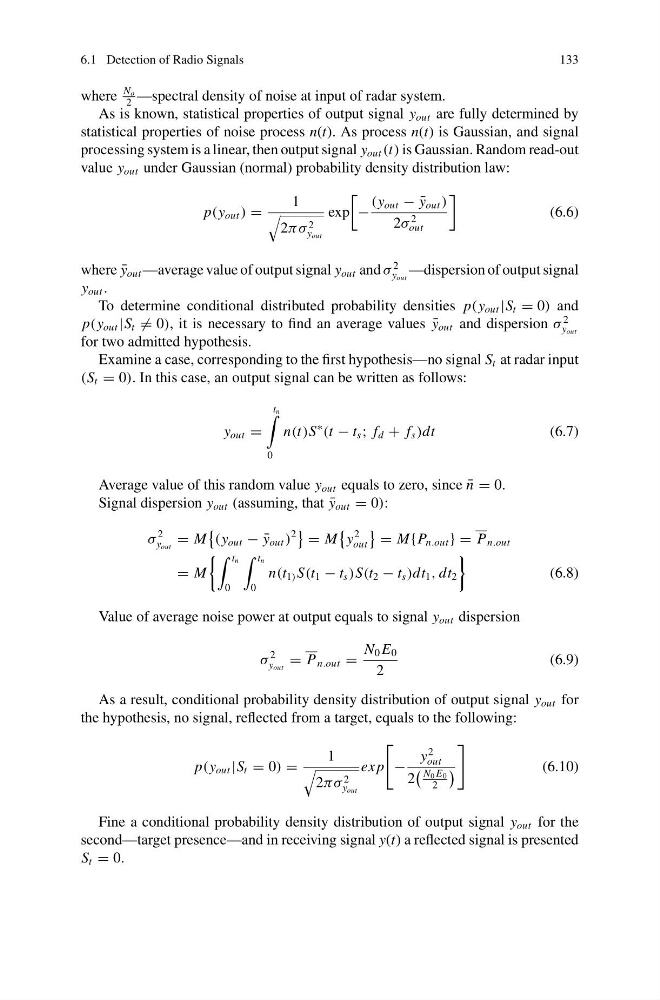
As is known, statistical properties of output signal y out are fully determined by
statistical properties of noise process n(t). As process n(t) is Gaussian, and signal
processing system is a linear, then output signal y out (t) is Gaussian. Random read-out
value y out under Gaussian (normal) probability density distribution law:
p(y out ) =
1
2πσ 2
y out
exp
−
(y out − ¯
y out )
2σ
2
out
(6.6)
where ¯
y out —average value of output signal y out and σ
2
y out
—dispersion of output signal
y out .
To determine conditional distributed probability densities p(y out |S t = 0) and
p(y out |S t = 0), it is necessary to find an average values ¯
y out and dispersion σ
2
y out
for two admitted hypothesis.
Examine a case, corresponding to the first hypothesis—no signal S t at radar input
(S t = 0). In this case, an output signal can be written as follows:
y out =
t n
0
n(t)S
∗
(t − t s ; f d + f s )dt
(6.7)
Average value of this random value y out equals to zero, since ¯
n = 0.
Signal dispersion y out (assuming, that ¯
y out = 0):
σ
2
y out
= M
(y out − ¯
y out )
2
= M
y
2
out
= M{P n.out } = P n.out
= M
t n
0
t n
0
n(t 1) S(t 1 − t s )S(t 2 − t s )dt 1 , dt 2
(6.8)
Value of average noise power at output equals to signal y out dispersion
σ
2
y out
= P n.out =
N 0 E 0
2
(6.9)
As a result, conditional probability density distribution of output signal y out for
the hypothesis, no signal, reflected from a target, equals to the following:
p(y out |S t = 0) =
1
2πσ 2
y out
ex p
−
y
2
out
2
N 0 E 0
2
(6.10)
Fine a conditional probability density distribution of output signal y out for the
second—target presence—and in receiving signal y(t) a reflected signal is presented
S t = 0.
133
where
N o
2
—spectral density of noise at input of radar system.
As is known, statistical properties of output signal y out are fully determined by
statistical properties of noise process n(t). As process n(t) is Gaussian, and signal
processing system is a linear, then output signal y out (t) is Gaussian. Random read-out
value y out under Gaussian (normal) probability density distribution law:
p(y out ) =
1
2πσ 2
y out
exp
−
(y out − ¯
y out )
2σ
2
out
(6.6)
where ¯
y out —average value of output signal y out and σ
2
y out
—dispersion of output signal
y out .
To determine conditional distributed probability densities p(y out |S t = 0) and
p(y out |S t = 0), it is necessary to find an average values ¯
y out and dispersion σ
2
y out
for two admitted hypothesis.
Examine a case, corresponding to the first hypothesis—no signal S t at radar input
(S t = 0). In this case, an output signal can be written as follows:
y out =
t n
0
n(t)S
∗
(t − t s ; f d + f s )dt
(6.7)
Average value of this random value y out equals to zero, since ¯
n = 0.
Signal dispersion y out (assuming, that ¯
y out = 0):
σ
2
y out
= M
(y out − ¯
y out )
2
= M
y
2
out
= M{P n.out } = P n.out
= M
t n
0
t n
0
n(t 1) S(t 1 − t s )S(t 2 − t s )dt 1 , dt 2
(6.8)
Value of average noise power at output equals to signal y out dispersion
σ
2
y out
= P n.out =
N 0 E 0
2
(6.9)
As a result, conditional probability density distribution of output signal y out for
the hypothesis, no signal, reflected from a target, equals to the following:
p(y out |S t = 0) =
1
2πσ 2
y out
ex p
−
y
2
out
2
N 0 E 0
2
(6.10)
Fine a conditional probability density distribution of output signal y out for the
second—target presence—and in receiving signal y(t) a reflected signal is presented
S t = 0.